
Verified skill
Automated pull request reviews for security, logic, and style consistency across multiple languages.

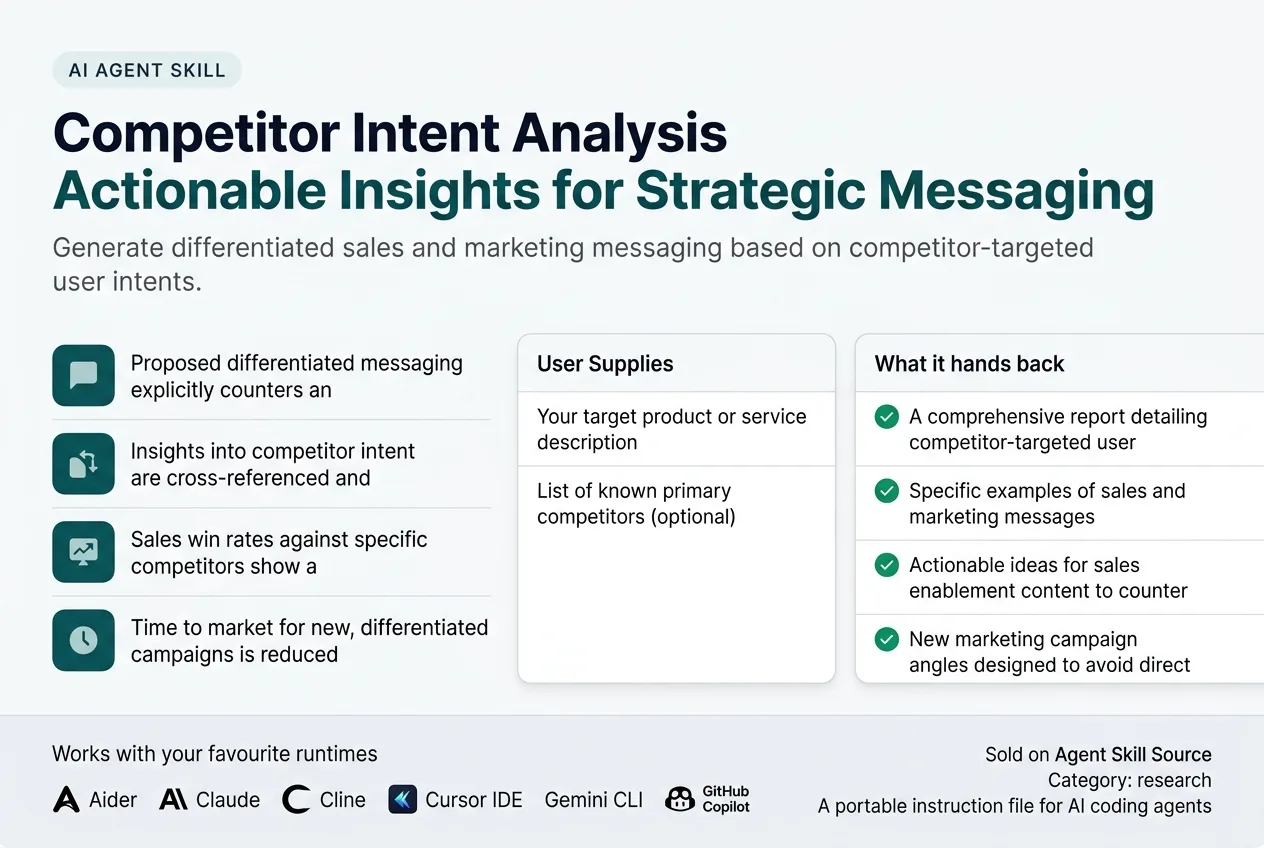
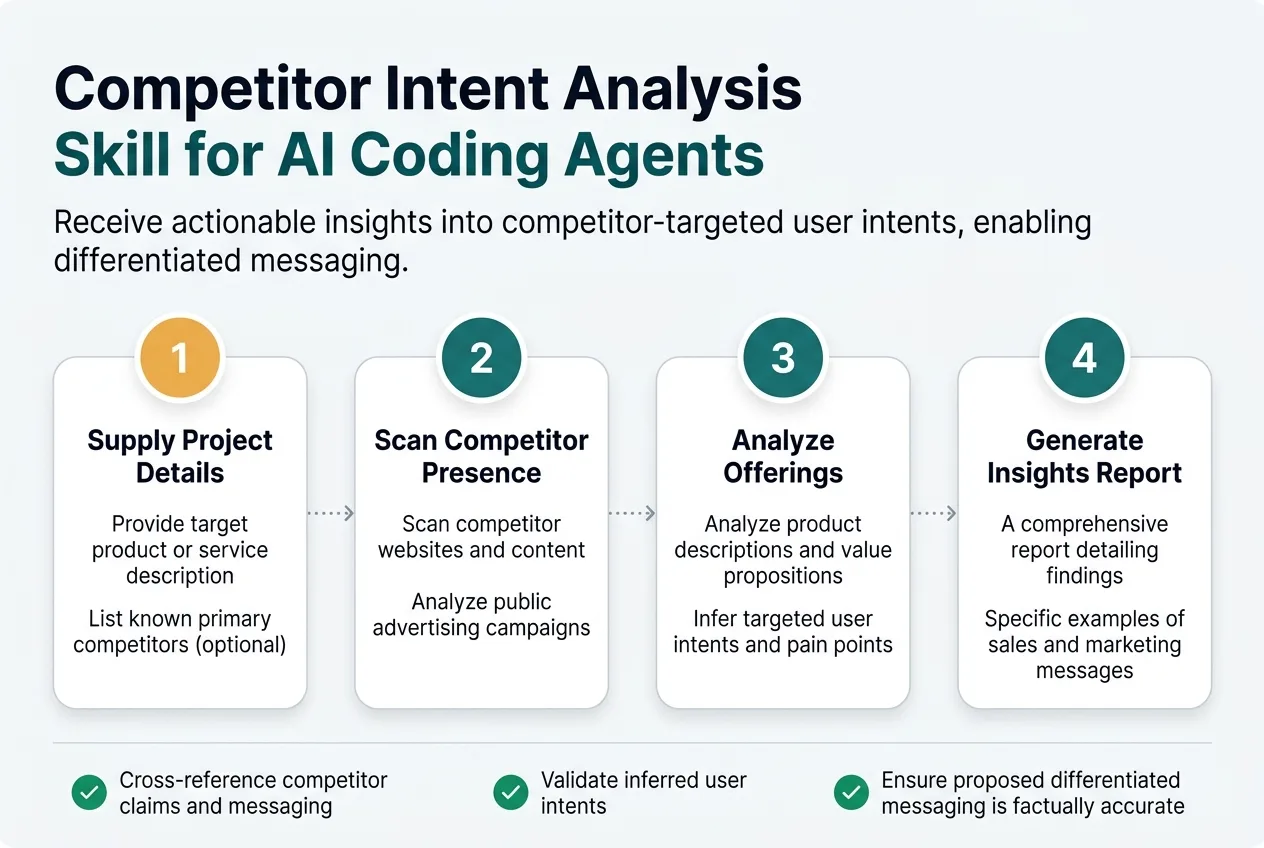
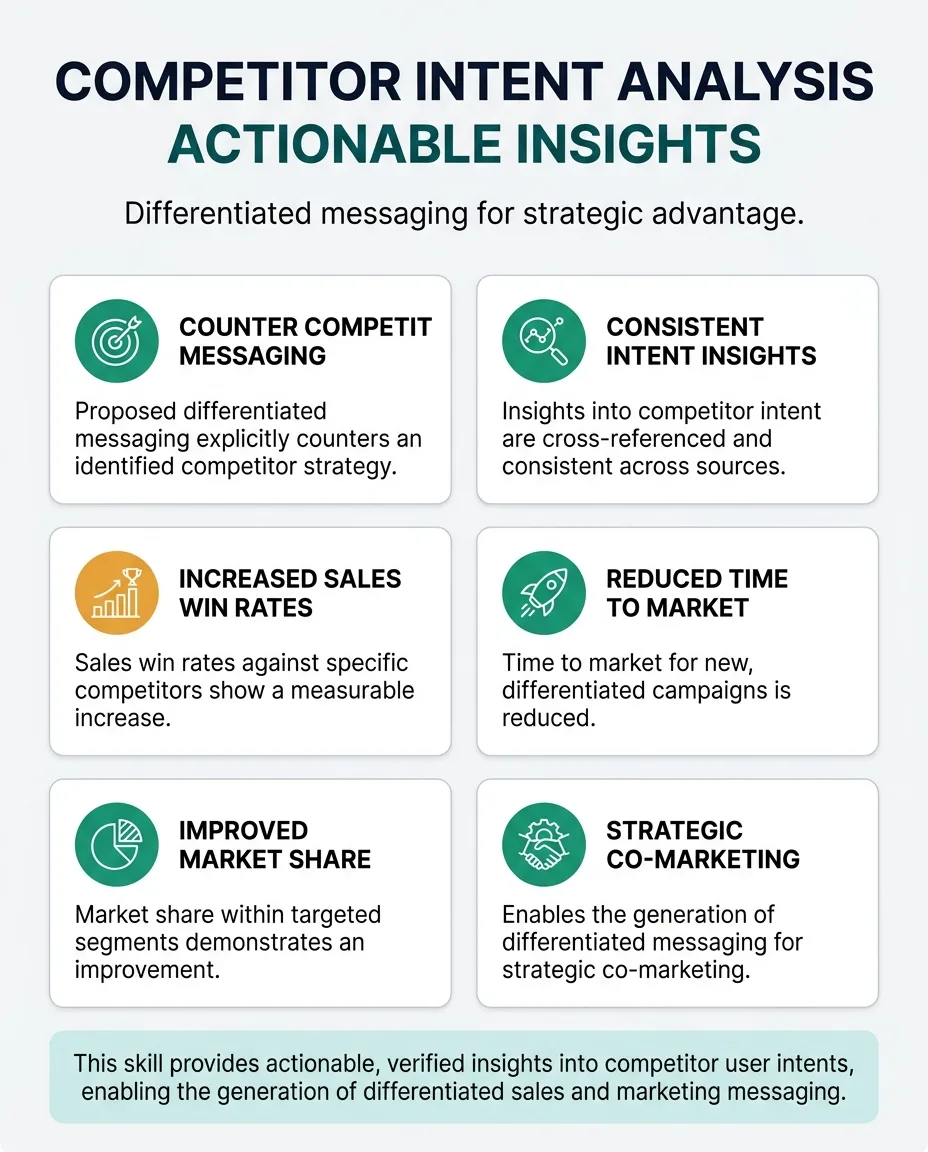
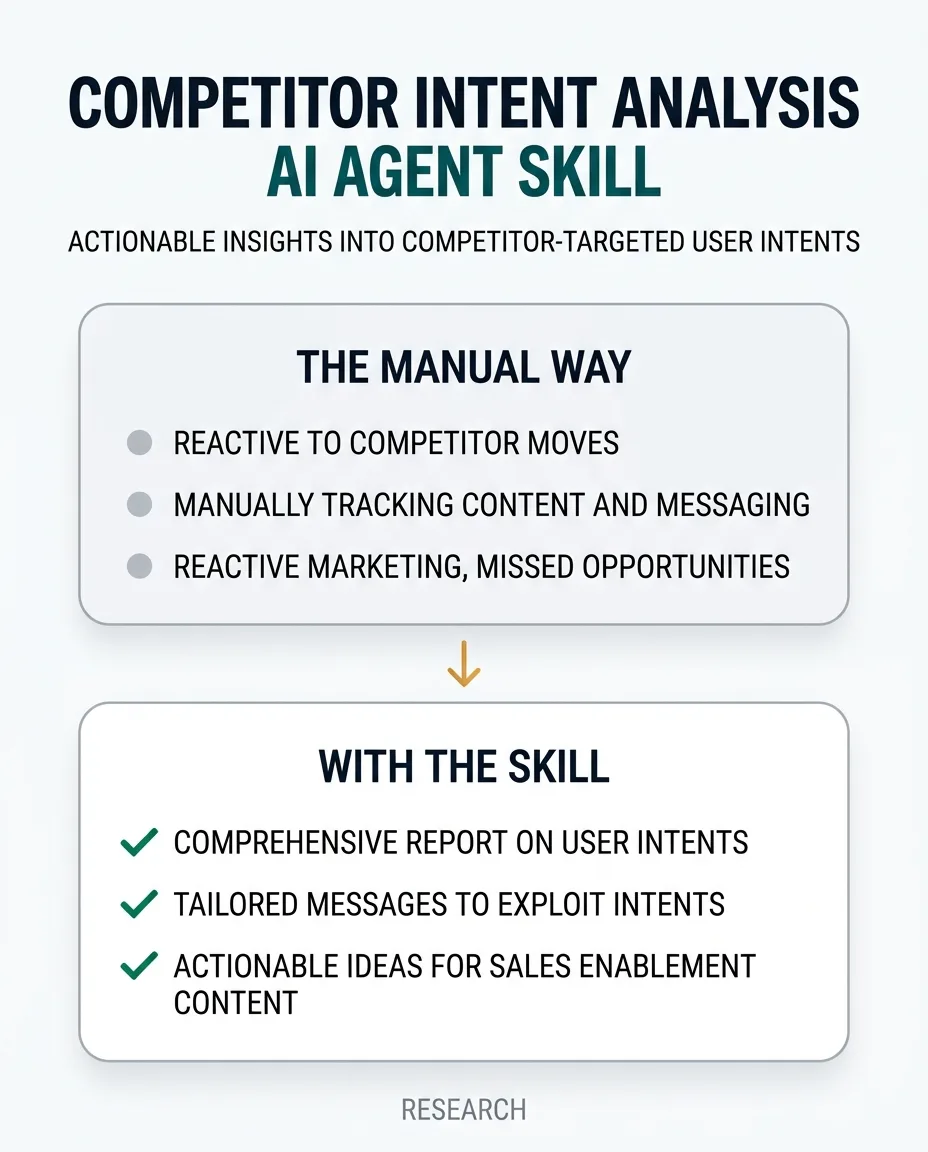
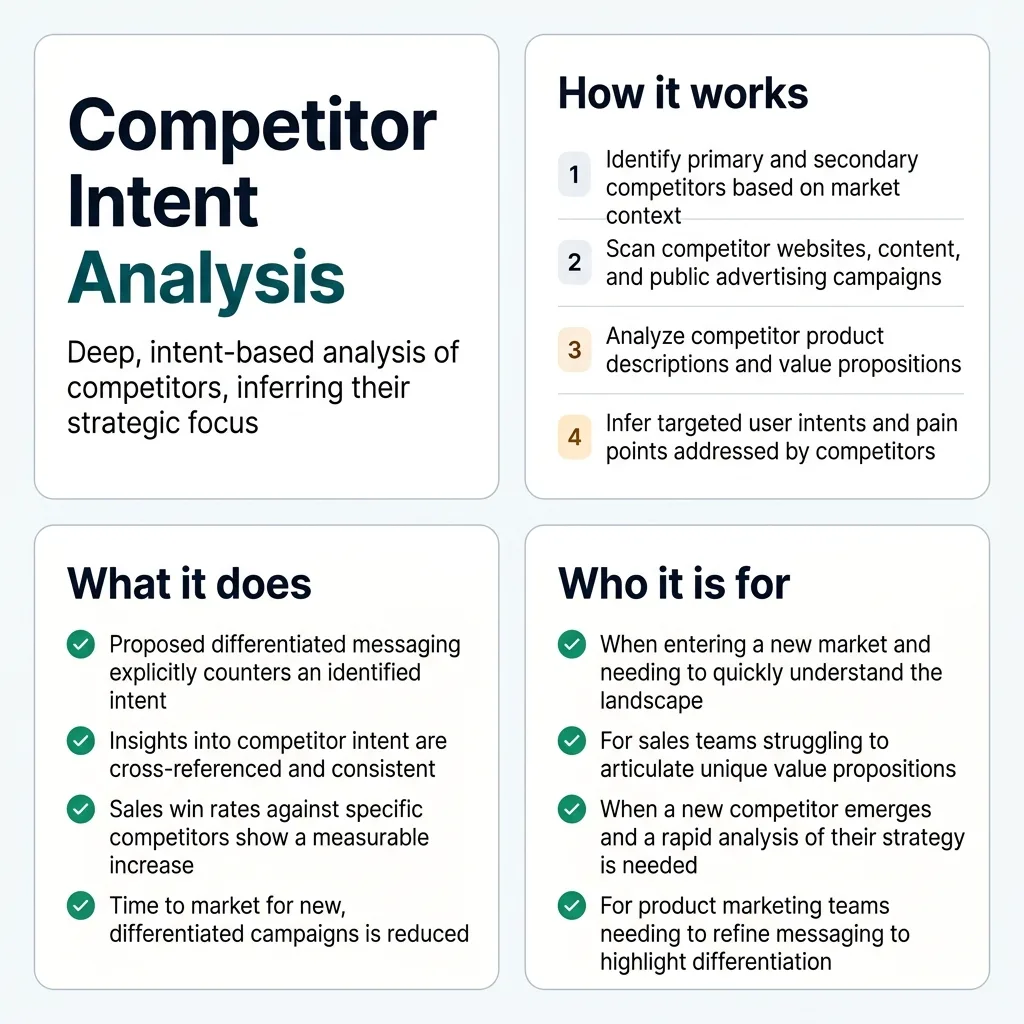
This skill automatically discovers and monitors key competitors in your market. It analyzes their public-facing content, advertising campaigns, product positioning, and online presence to infer the specific user intents they are targeting. It identifies areas where competitors are strong, weak, or completely missing opportunities. The skill then produces actionable insights, including differentiated messaging strategies, unique value propositions, and sales enablement content ideas that exploit competitor weaknesses and highlight your strengths. It verifies all insights against publicly available data, never inventing competitor strategies, and continuously monitors competitor activity to keep insights current.
This skill automatically discovers and monitors key competitors in your market. It analyzes their public-facing content, advertising campaigns, product positioning, and online presence to infer the specific user intents they are targeting. It identifies areas where competitors are strong, weak, or completely missing opportunities. The skill then produces actionable insights, including differentiated messaging strategies, unique value propositions, and sales enablement content ideas that exploit competitor weaknesses and highlight your strengths. It verifies all insights against publicly available data, never inventing competitor strategies, and continuously monitors competitor activity to keep insights current.
Businesses often react to competitor moves rather than proactively identifying and leveraging their strategies based on user intent. Manually tracking competitor content, ad campaigns, product messaging, and inferring their underlying intent is an exhaustive, time-consuming, and often incomplete process. This results in reactive marketing, missed opportunities for differentiation, and a lack of clear competitive advantage, leading to lost market share and reduced sales effectiveness.
This skill is for Sales Strategists, Product Marketing Managers, and Marketing Analysts in competitive B2B and B2C markets.
Especially valuable when:
This skill replaces hours of manual market research, competitor website analysis, and strategic brainstorming. It automates the complex process of inferring competitor user intents and identifying strategic gaps, which typically requires specialized expertise.
The value compounds by providing continuous, up-to-date insights, allowing businesses to proactively adapt their sales and marketing strategies. This prevents costly mistakes from outdated information or generic messaging, leading to higher conversion rates and more effective campaigns.
Buyers pay for the sophisticated analytical framework, the continuous monitoring capabilities, and the actionable, verified strategic recommendations that directly contribute to competitive advantage and increased market share, far beyond simple text generation.
One payment, yours permanently. Download it again at any time and get later versions free.
competitor-alternatives lists alternatives, and competitive-landscape provides a general overview. This skill performs a deep intent-based analysis of competitors, inferring their strategic focus and generating differentiated sales and marketing messaging to gain a direct advantage. It's not just about what competitors do, but why they do it in terms of user intent, and how to counter it.
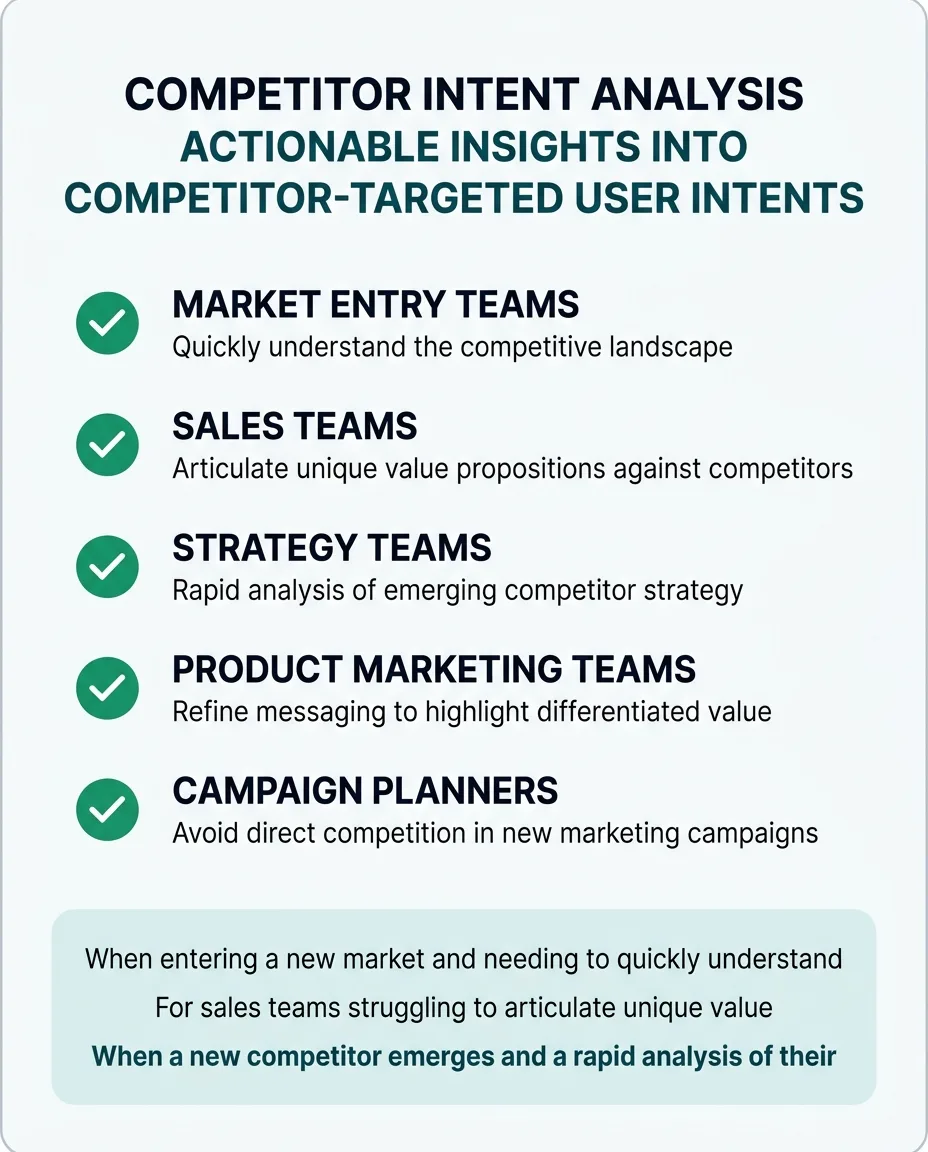
- When entering a new market and needing to quickly understand the competitive landscape and differentiation opportunities.
- For sales teams struggling to articulate unique value propositions against specific competitors.
- When a new competitor emerges and a rapid analysis of their strategy is required.
- For product marketing teams needing to refine messaging to highlight competitive advantages.
- When planning new marketing campaigns and wanting to avoid direct competition or find blue oceans.
yourProductServiceDescription: A detailed description of your product or service, including its features, benefits, and target audience.
knownPrimaryCompetitors: An optional list of specific competitors to focus the analysis on. If not provided, the skill will discover them.
competitorIntentAnalysisReport: A comprehensive report detailing competitor-targeted user intents, strategic gaps, and differentiated messaging recommendations.
differentiatedMessagingExamples: Specific examples of sales and marketing messages tailored to exploit competitor weaknesses and highlight your strengths.
salesEnablementContentIdeas: Actionable ideas for sales enablement content to counter competitor claims and support your sales team.
marketingCampaignAngles: New marketing campaign angles designed to avoid direct competition or capitalize on underserved intents.
Competitor Intent Analysis was run on 15 October 2026 by Gemini 2.5 Flash: the model followed the skill's own SKILL.md instructions on the sample input below. No live system was connected, so anything the skill would read from one came from the input, and what it could not check is listed under the output. The output is shown exactly as the run produced it, unedited.
Your product: 'TaskFlow' is a project management SaaS for small to medium teams, emphasizing intuitive visual workflows and deep integration with developer tools. Known competitors: ['ProjectPilot', 'BoardFlow'].The worked example from the skill definition, with real names replaced by fictional ones.
Competitor Intent Analysis Report: {"competitors":[{"name":"ProjectPilot","inferredUserIntents":[{"intent":"End-to-end project visibility","confidence":"INTERNAL_ESTIMATE"},{"intent":"Process standardization","confidence":"INTERNAL_ESTIMATE"},{"intent":"Cross-functional collaboration","confidence":"INTERNAL_ESTIMATE"},{"intent":"Detailed progress tracking","confidence":"INTERNAL_ESTIMATE"},{"intent":"Enterprise scalability","confidence":"INTERNAL_ESTIMATE"}],"positioningRelativeToYourOffering":"ProjectPilot offers a comprehensive, enterprise-grade project management solution, often perceived as robust but potentially complex for small-to-medium teams. It emphasizes broad process management and reporting. TaskFlow differentiates by focusing on intuitive visual workflows and deep developer tool integration, offering a more agile and specialized solution for its target market.","strategicGaps":[{"gap":"Overly complex for small-to-medium teams","underservedIntent":"Simplicity and agility for smaller teams"},{"gap":"Less emphasis on deep developer tool integration","underservedIntent":"Seamless integration with developer workflows"}]}, {"name":"BoardFlow","inferredUserIntents":[{"intent":"Simple task organization","confidence":"INTERNAL_ESTIMATE"},{"intent":"Visual workflow management","confidence":"INTERNAL_ESTIMATE"},{"intent":"Quick team updates","confidence":"INTERNAL_ESTIMATE"},{"intent":"Agile project tracking","confidence":"INTERNAL_ESTIMATE"},{"intent":"Ease of adoption","confidence":"INTERNAL_ESTIMATE"}],"positioningRelativeToYourOffering":"BoardFlow provides a highly visual and easy-to-use Kanban-style project management experience, ideal for quick task management and basic team collaboration. TaskFlow also offers intuitive visual workflows but extends this with deep integration into developer tools, providing more robust capabilities for teams with technical needs where BoardFlow might be too simplistic.","strategicGaps":[{"gap":"Lacks depth for complex developer workflows","underservedIntent":"Advanced developer tool integration"},{"gap":"Limited features for growing teams needing more structure","underservedIntent":"Scalable visual workflows with robust features"}]}],"yourProduct":{"name":"TaskFlow","description":"A project management SaaS for small to medium teams, emphasizing intuitive visual workflows and deep integration with developer tools.","coreStrengths":["Intuitive visual workflows","Deep integration with developer tools","Tailored for small to medium teams"]},"overallStrategicOpportunities":["Target small-to-medium teams seeking a balance between visual simplicity and powerful developer-centric features, avoiding the complexity of enterprise solutions and the limitations of overly simplistic tools.","Position TaskFlow as the go-to solution for development teams that need visual project management seamlessly integrated into their existing toolchain."],"unresolvedInsights":[]} Differentiated Messaging Examples: * "Tired of ProjectPilot's complexity? TaskFlow offers intuitive visual workflows designed for your team's agility, not enterprise bureaucracy. Get powerful project management without the overhead."* "BoardFlow is great for simple tasks, but your dev team needs more. TaskFlow delivers deep integration with developer tools alongside beautiful visual workflows, so your code and projects are always in sync."* "Stop juggling multiple tools. TaskFlow brings your visual project management and developer workflows together, giving small to medium teams the power to build faster, smarter." Sales Enablement Content Ideas: * Battle Card: TaskFlow vs. ProjectPilot: Focus on ease of use, faster setup for small/medium teams, and superior developer integration.* Battle Card: TaskFlow vs. BoardFlow: Emphasize advanced visual workflow capabilities, robust integrations, and scalability beyond basic Kanban.* FAQ/Objection Handling Guide: "Why TaskFlow over a general PM tool?", Highlight developer-centric features, visual clarity, and team size focus.* Case Study Template: Showcase a small-to-medium development team that successfully migrated from a competitor to TaskFlow, detailing improved efficiency and collaboration. Marketing Campaign Angles: * Theme: "Code, Collaborate, Conquer: Visual Workflows for Dev Teams": Target developer communities and tech-focused small/medium businesses.* Theme: "Beyond Basic Boards: The Visual PM Tool Your Dev Team Deserves": Directly challenge BoardFlow's simplicity by highlighting TaskFlow's depth.* Theme: "Uncomplicate Your Projects: ProjectPilot Power, TaskFlow Simplicity": Position TaskFlow as a more accessible alternative to complex enterprise solutions.* Target Audience: Small to medium-sized software development teams, engineering managers, product owners in tech startups.
Needs live systems: the check needs real accounts, data or tools that a sample run does not have, so it was not judged here.
Each promised output and check was judged by a second, separate model pass that quotes its evidence. The automatic checks run in code.
Use market data and provided inputs to identify primary and secondary competitors.
Done when: A prioritized list of relevant competitors is generated.
If it cannot finish: Report inability to identify sufficient competitors and request more specific market context.
Scan competitor websites, content, public advertising campaigns, and product descriptions.
Done when: All identified competitors have their public content, ads, and product messaging collected.
If it cannot finish: Flag competitors for which public data is sparse and proceed with available information, noting limitations.
Analyze collected competitor content, ad copy, and value propositions to infer targeted user intents and pain points.
Done when: A list of inferred user intents is generated for each competitor.
If it cannot finish: Mark intents as 'unresolved' if inference confidence is low due to ambiguous data.
Compare inferred competitor intents and value propositions against your own product or service offerings.
Done when: A mapping of competitor positioning relative to your offering is created.
If it cannot finish: Report if your product or service description is insufficient for accurate mapping and request clarification.
Identify strategic gaps, weaknesses, and underserved user intents in competitor strategies by comparing against known market intents.
Done when: A list of identified strategic gaps and competitor weaknesses is compiled.
If it cannot finish: If no clear gaps are found, report this and suggest a deeper dive into niche segments.
Generate unique selling propositions and differentiated sales messaging that exploits identified competitor weaknesses and highlights your strengths.
Done when: A set of differentiated sales and marketing messages is produced.
If it cannot finish: If messaging cannot be sufficiently differentiated, flag for human review and suggest alternative angles.
Suggest new marketing campaign angles and sales enablement content ideas to leverage differentiated messaging.
Done when: A list of actionable marketing and sales content proposals is generated.
If it cannot finish: If proposals lack specificity, request more context on target audience or campaign goals.
Cross-reference all inferred intents, identified gaps, and generated messaging against multiple public sources, checking for recency, accuracy, and legal compliance.
Done when: All insights and messaging are verified and refined based on checks.
If it cannot finish: Flag any unverified or problematic insights for human review with specific reasons.
| The mistake | What it costs | How the skill prevents it |
|---|---|---|
| Misinterpreting a competitor's primary user intent from their content. | Developing marketing campaigns and sales pitches that target the wrong customer needs, resulting in low engagement, wasted ad spend, and missed sales opportunities. | Cross-reference the inferred intent with the competitor's explicit value propositions, ad copy, and customer testimonials, ensuring a consistent alignment across at least three distinct public sources. |
| Generating differentiated messaging that is generic or not truly unique. | Sales teams struggle to articulate a compelling reason to choose your product, leading to 'me-too' positioning, lower win rates, and difficulty standing out in a competitive market. | Require each proposed differentiated message to explicitly identify a specific competitor's weakness or an underserved user intent, and demonstrate how your offering uniquely addresses it, verifiable by direct comparison to competitor statements. |
| Basing strategic recommendations on outdated competitor content or advertising. | Implementing strategies that are irrelevant or counterproductive because competitor offerings, messaging, or market focus have already shifted, leading to wasted effort and lost competitive edge. | Implement a recency check on all analyzed competitor data, flagging any source older than 60 days for re-verification or exclusion from the current analysis, and notify the user of data age. |
| Overlooking a significant strategic gap or emerging opportunity that competitors are missing. | Failing to capitalize on 'blue ocean' opportunities or allowing a competitor to quietly capture an underserved market segment, leading to slower growth and reduced market share. | Systematically compare the aggregated user intents targeted by all identified competitors against a comprehensive list of known market intents, highlighting any significant intents that are not adequately addressed by any player. |
| Proposing differentiated messaging that is unsubstantiated or legally questionable. | Facing legal challenges, reputational damage, or a loss of customer trust due to false claims, misleading comparisons, or direct disparagement of competitors. | Include a check for common legal and ethical red flags in all generated messaging, such as superlative claims without evidence or direct negative statements about competitors, and flag these for mandatory human legal review. |
| Focusing analysis on irrelevant or minor competitors, diluting strategic insights. | Wasting resources on analyzing competitors that pose little threat or opportunity, diverting attention from the most impactful competitive dynamics and strategic priorities. | Prioritize competitor analysis based on market share, revenue, or direct competitive overlap with the user's offering, and provide a confidence score for the relevance of each competitor to the user's specific context. |
A SaaS company, 'TaskFlow', offers project management software and wants to understand how to differentiate itself from 'Asana' and 'Trello' by identifying their core user intents and finding underserved areas.
Your product: 'TaskFlow' is a project management SaaS for small to medium teams, emphasizing intuitive visual workflows and deep integration with developer tools. Known competitors: ['Asana', 'Trello'].The report identifies Asana's primary intent as 'large-scale project coordination and reporting for enterprise teams' and Trello's as 'simple task tracking and collaboration for small, agile teams'. It highlights an underserved intent: 'visual workflow automation for technical teams needing deep dev tool integration'. Differentiated messaging for TaskFlow focuses on 'seamlessly integrating project management with your existing dev stack for automated workflows, reducing manual updates and increasing deployment speed', directly contrasting Asana's broader enterprise focus and Trello's simplicity.Why this output: The output directly addresses the user's need to differentiate by analyzing competitor intent. It pinpoints specific competitor focuses, identifies a clear market gap, and then crafts messaging that leverages TaskFlow's unique strengths (visual workflows, dev tool integration) to target that underserved intent, providing a strategic advantage.
The skill continuously monitors identified competitors for new content, advertising campaigns, product updates, and messaging shifts. It automatically updates its intent analysis and strategic recommendations, ensuring competitive insights remain fresh and actionable.
Copy to ~/.claude/skills/Configure in API settingsAdd to Copilot workspace settingsAdd to .cursor/skills/Add to .vscode/skills/Add to Cline skills directoryConfigure in .aider.conf.ymlAdd to Windsurf skillsAdd to ~/.gemini/skills/Register as MCP toolThe skill cross-references competitor claims and messaging against multiple public sources and implements a recency check, flagging any data older than 60 days for re-verification. It also continuously monitors competitor activity to keep insights fresh.
Yes, by systematically comparing the aggregated user intents targeted by all identified competitors against a comprehensive list of known market intents, the skill highlights significant intents that are not adequately addressed by any player, revealing strategic gaps.
The skill includes a check for common legal and ethical red flags in all generated messaging. If a proposal is deemed too aggressive or risky, it will be flagged for mandatory human legal review, and safer alternatives will be suggested.
This skill is designed to be valuable for businesses of all sizes. Small businesses can gain a significant competitive edge by understanding their market and competitors without extensive manual research, while larger enterprises can use it to refine existing strategies and monitor a broader competitive landscape.
No ratings yet. If you have used this skill, yours would be the first.
Sign in to leave a rating
An account keeps your review with your name on it, and lets you edit it later. Sign in or create one free.
No reviews yet
This skill has not been rated. If you have run it, a short note about what you used it for helps the next person more than any description can.
Discover more AI agent skills in the same category to enhance your workflow automation.
Automated pull request reviews for security, logic, and style consistency across multiple languages.
Real-time security audit skill scanning for OWASP Top 10 vulnerabilities and infrastructure misconfigurations.
This skill provides continuous, verified insights into competitor marketing strategies by analyzing public data. It delivers detailed reports on channels, messaging, ad spend, and strategic gaps, enabling proactive de...
Automatically drafts, refines, and distributes relevant meeting agendas based on context, ensuring productive discussions.
Master essential Bash/Linux terminal patterns, including critical commands, piping, error handling, and scripting for macOS and Linux systems.
You receive comprehensive, SEO-optimized, and E-E-A-T compliant long-form articles and blog posts, fully researched and fact-verified, ready for publication.
Join the community and help AI agents learn new capabilities. Submit your skill and reach thousands of developers.