

Expert in building and selling Notion templates as a sustainable digital product business, covering design, pricing, marketing, and scaling for real revenue.
Premium skill
Long-Form Article Generator with SEO and E-E-A-T
Images of Long-Form Article Generator with SEO and E-E-A-T
-
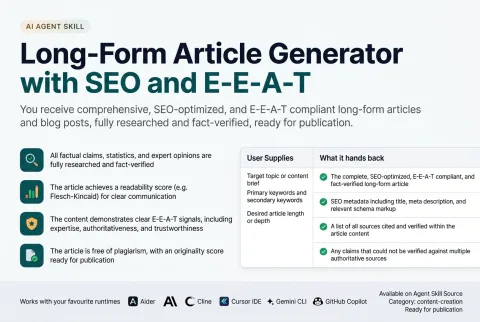
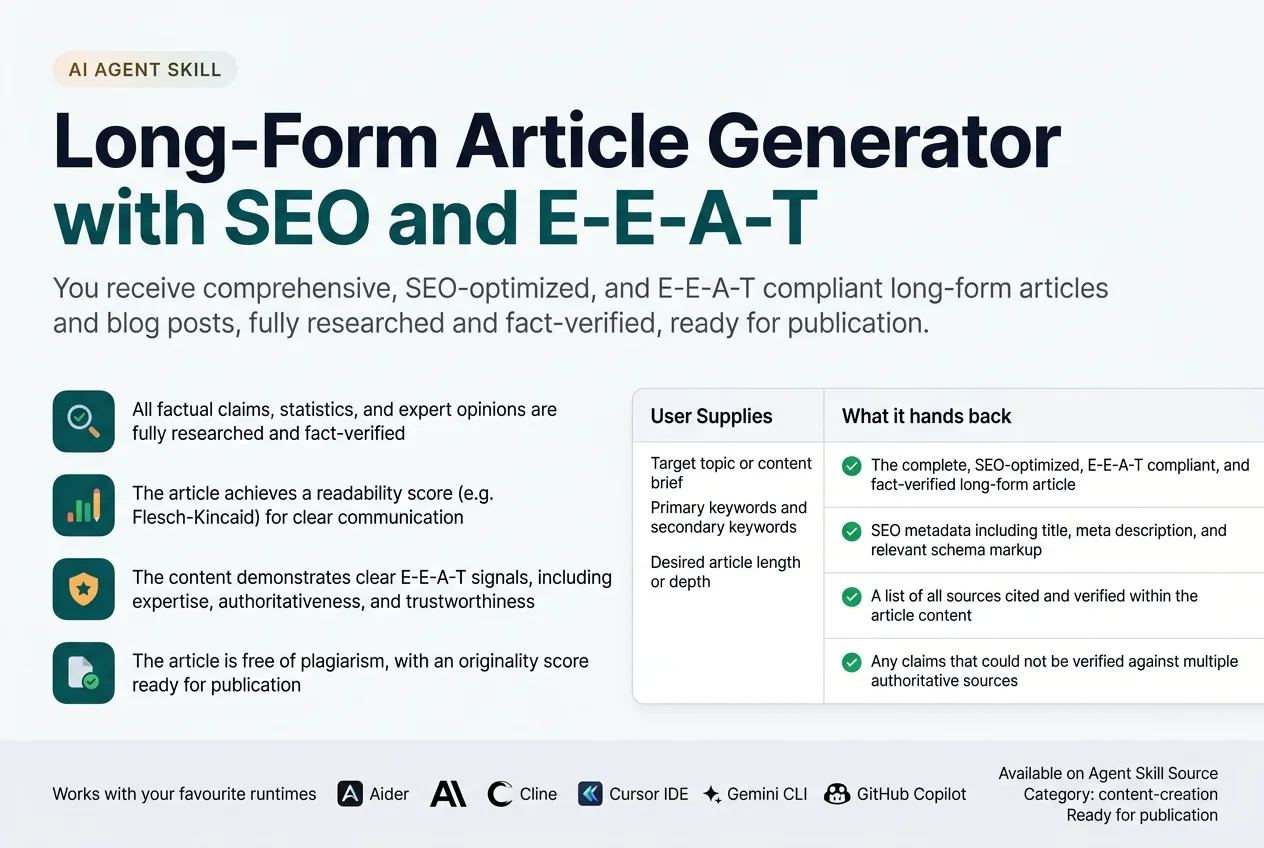
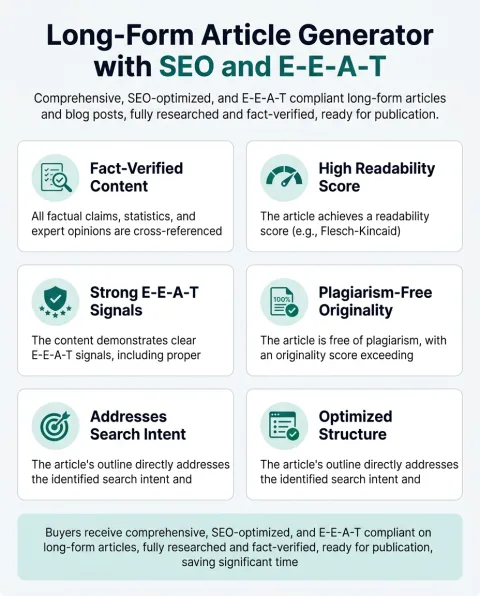
Featured image The one image that represents the skill in the gallery and in a social share. -
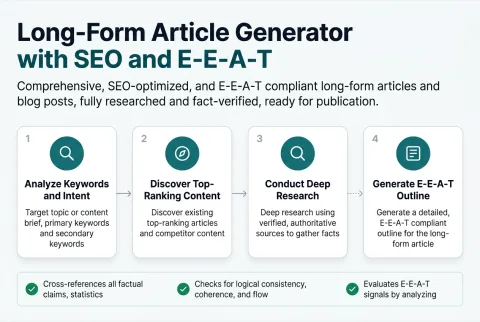
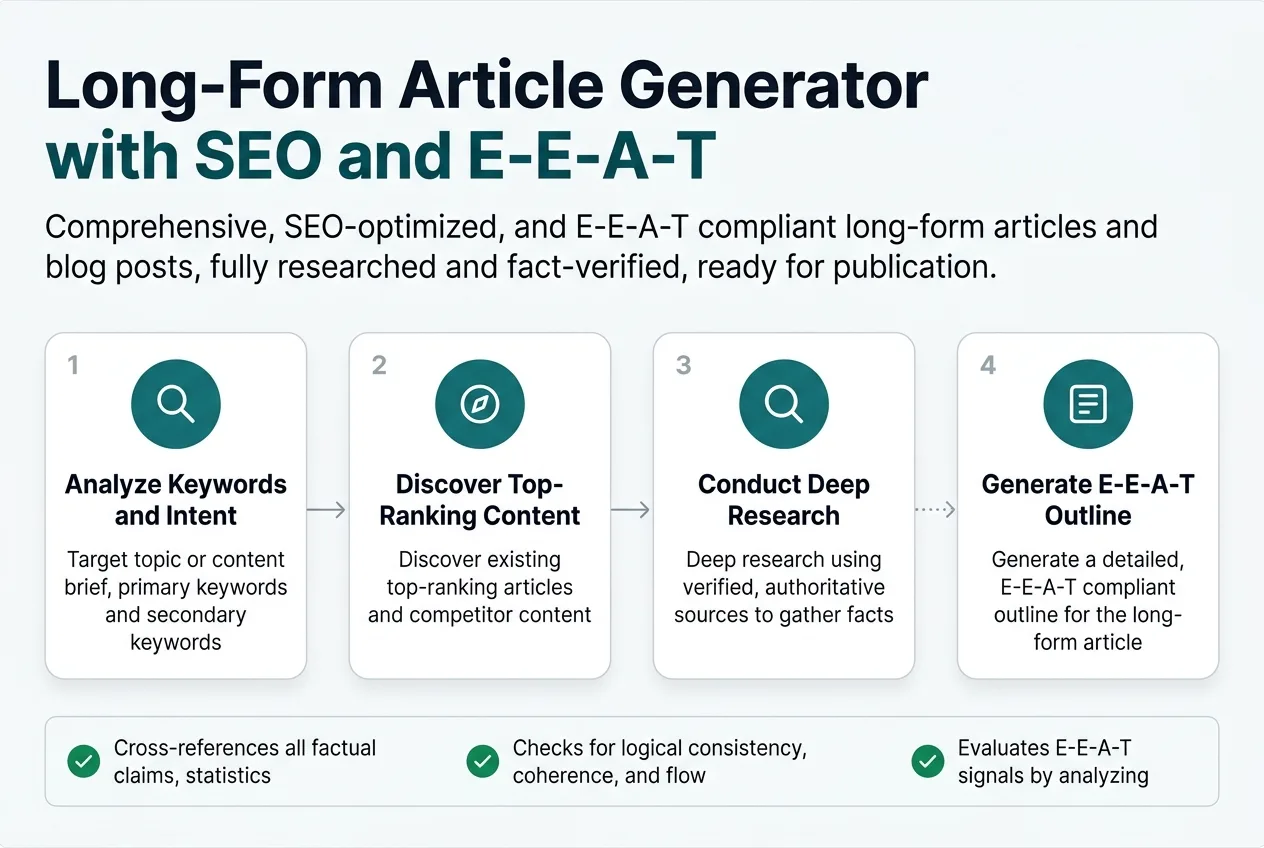
How it works Shows the path from what the user supplies to what they get back. -
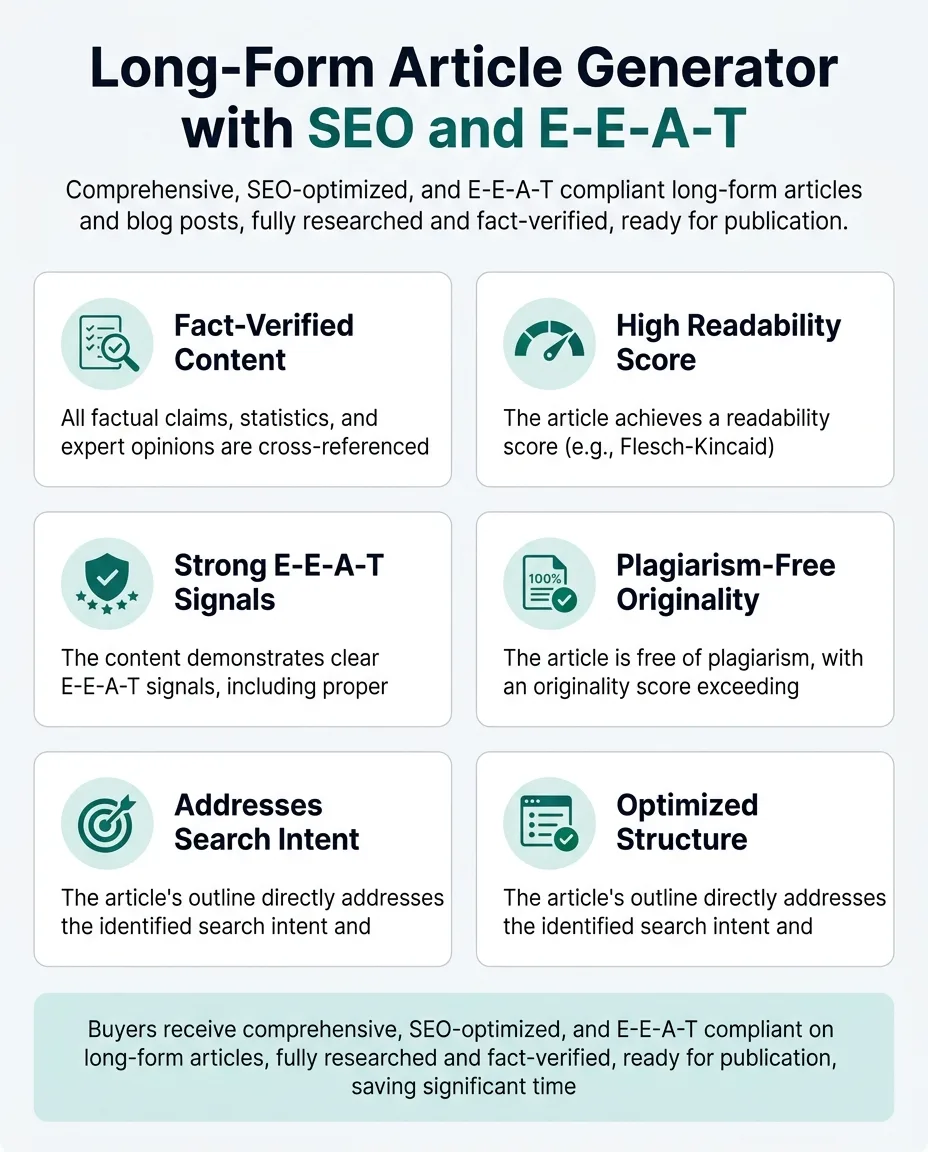
What it does The capability grid, for a reader scanning rather than reading. -
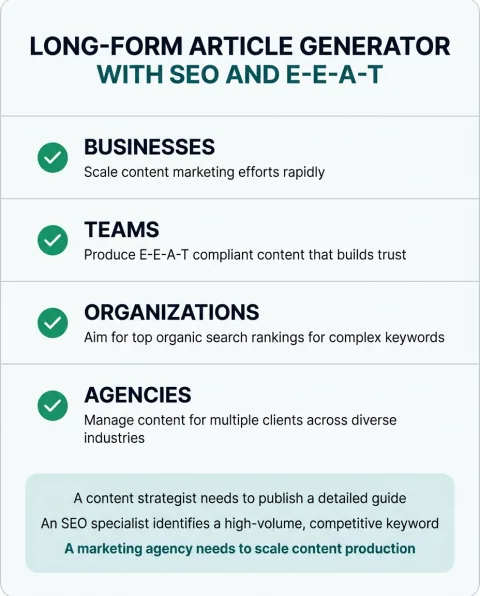
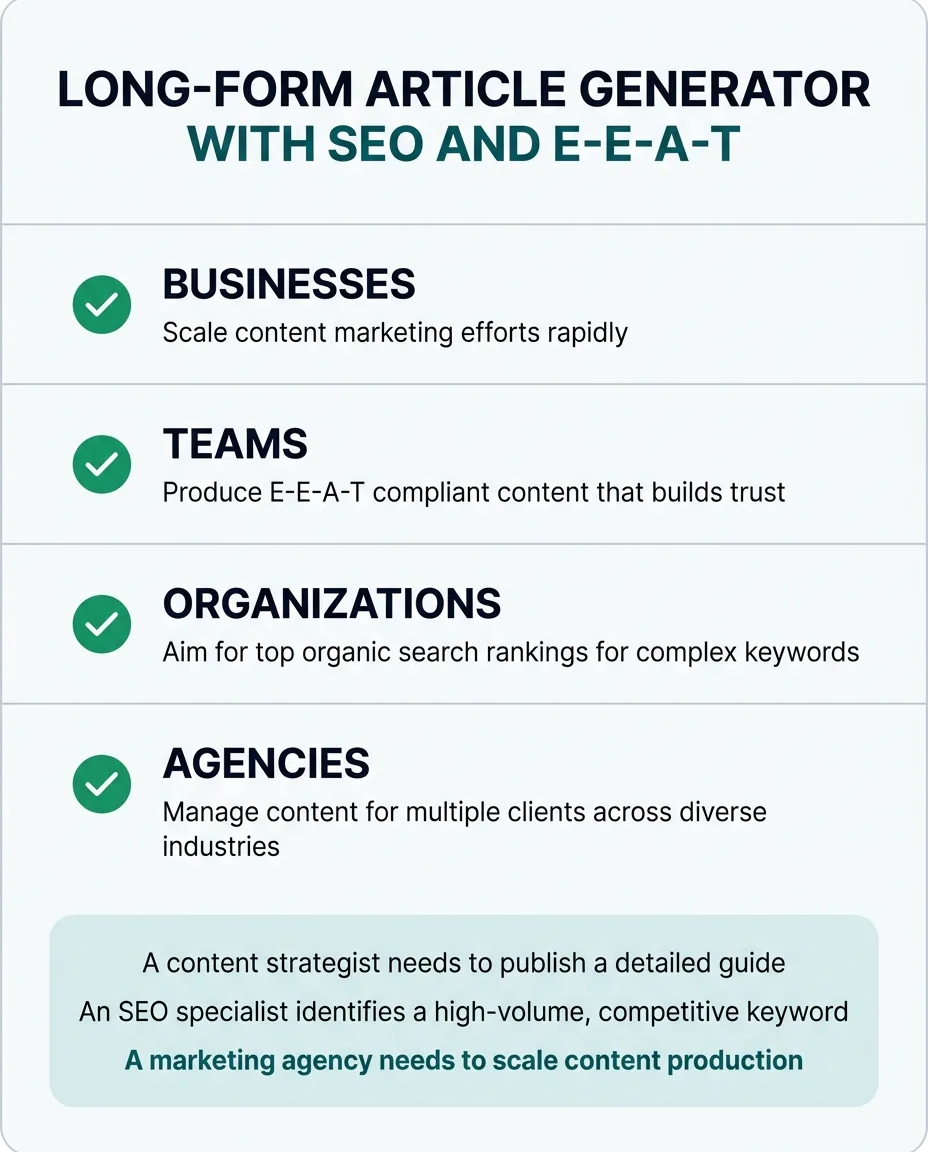
Who it is for Lets a reader recognise themselves, which is what decides whether they keep reading. -
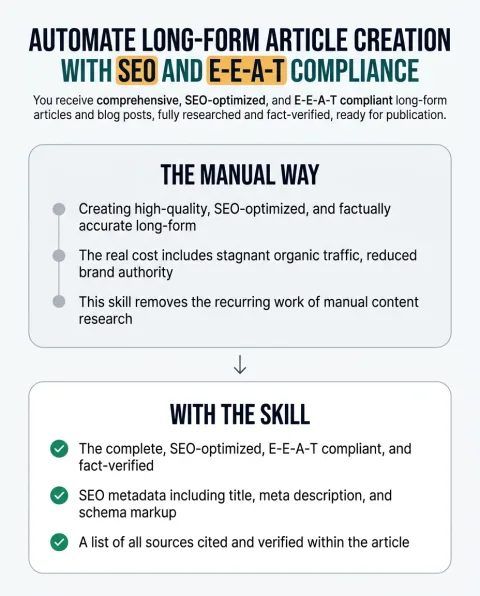
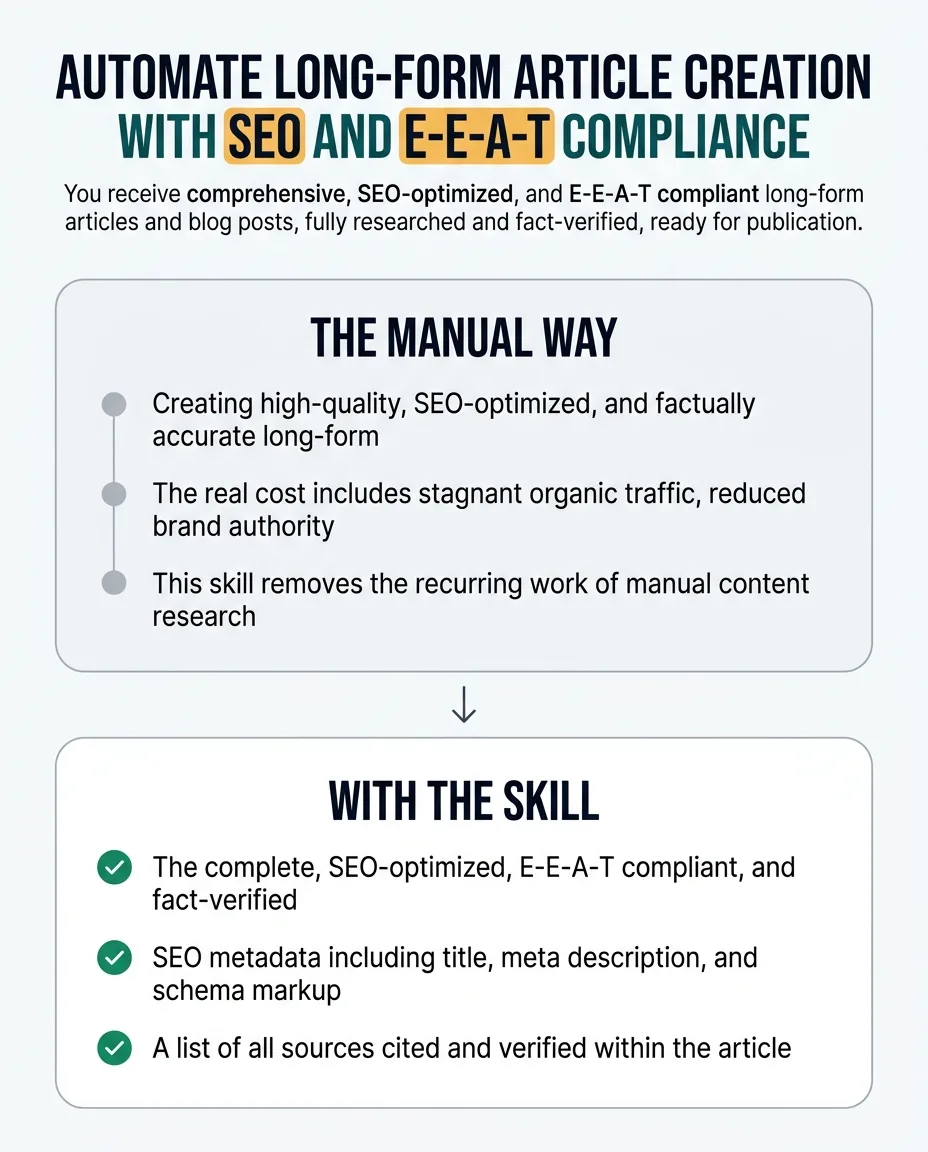
The change it makes Contrasts the manual way with the skill, without claiming a measured result. -
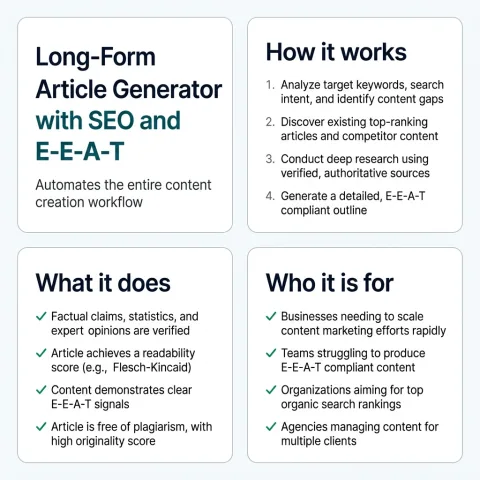
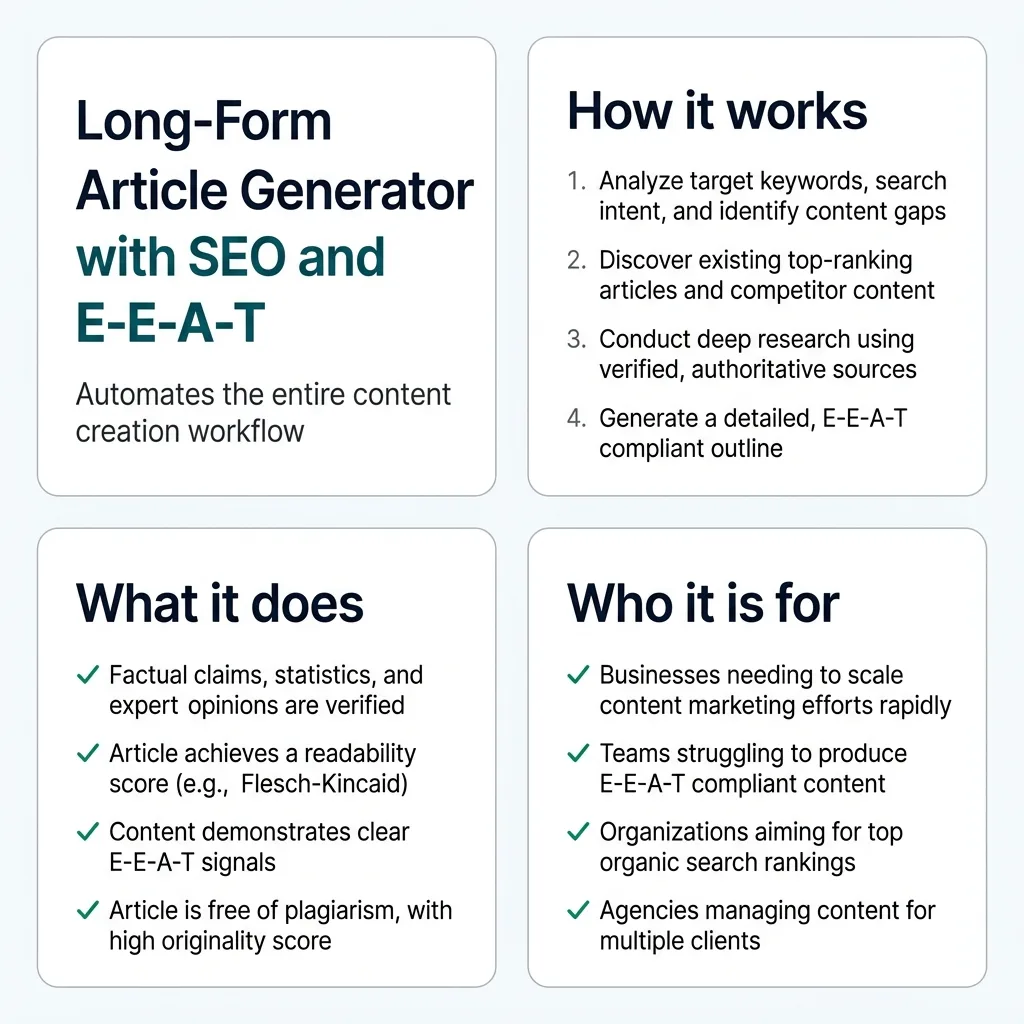
Summary sheet One square image that carries the whole story, for a social share or a card.
This skill automatically discovers target keywords, analyzes search intent, and identifies content gaps. It researches top-ranking competitor articles and performs deep research using verified, authoritative sources. It produces a detailed, E-E-A-T compliant outline, then generates a complete, well-structured long-form article. The content is rigorously verified for factual claims, E-E-A-T principles, SEO best practices, readability, and originality before delivery.
See the Long-Form Article Generator with SEO and E-E-A-T in action
Provide your topic and keywords
You provide the target topic, primary and secondary keywords, desired length, and target audience profile. For example, a topic like 'Sustainable Urban Planning' with specific keywords and a target audience of urban planners.
Ensuring accuracy, originality, and SEO compliance
The skill cross-references all factual claims, statistics, and data points with at least two reputable sources. It checks for logical consistency, coherence, and flow. It evaluates E-E-A-T signals by analyzing source authoritativeness and trustworthiness. It performs comprehensive plagiarism checks to ensure 100% originality. It validates keyword density, placement, and semantic relevance against current SEO best practices. It assesses readability scores and engagement potential.
A ready-to-publish, verified long-form article
A 3000-word article in Markdown format titled 'Building Tomorrow's Cities: A Comprehensive Guide to Sustainable Urban Planning'. The article includes sections on green infrastructure, renewable energy integration, waste management, and community engagement, with specific examples. Each factual claim is supported by citations from academic journals, UN reports, and reputable urban development organizations. SEO metadata is provided, and a list of verified sources is appended.
The output below is an example from the skill definition, showing how it processes input and delivers a ready-to-publish article.
- Runs in
- Claude (Anthropic), OpenAI Codex, GitHub Copilot, Cursor IDE
- How it runs
- Tool Calling
- Licence
- One time purchase
- What ships
- SKILL.md, README, licence
What It Does
This skill automatically discovers target keywords, analyzes search intent, and identifies content gaps. It researches top-ranking competitor articles and performs deep research using verified, authoritative sources. It produces a detailed, E-E-A-T compliant outline, then generates a complete, well-structured long-form article. The content is rigorously verified for factual claims, E-E-A-T principles, SEO best practices, readability, and originality before delivery.
The Problem It Removes
Creating high-quality, SEO-optimized, and factually accurate long-form content is an extremely resource-intensive process. It requires extensive research, outlining, writing, editing, and optimization, often consuming dozens of hours per piece. This leads to inconsistent content quality, missed SEO opportunities, and slow content production cycles.
The real cost includes stagnant organic traffic, reduced brand authority, and valuable content marketing budgets being inefficiently spent on manual processes. Businesses struggle to scale their content efforts while maintaining the high standards required for search engine visibility and audience trust.
This skill removes the recurring work of manual content research, outlining, writing, and initial SEO and E-E-A-T optimization. It automates the entire workflow, ensuring consistent, high-ranking, and trustworthy content, allowing content strategists to focus on overarching strategy and content promotion.
Who It Is For
Content strategists, SEO specialists, digital marketing agencies, and content teams in large organizations and publishing houses.
Especially valuable when:
- Businesses needing to scale their content marketing efforts rapidly without compromising quality.
- Teams struggling to produce E-E-A-T compliant content that builds trust and authority.
- Organizations aiming for top organic search rankings for complex, competitive topics.
- Agencies managing content for multiple clients across diverse industries with varying content needs.
- Content teams with limited research and writing resources needing to maximize output.
- Brands requiring consistent, high-quality thought leadership content to establish market presence.
- Publishers needing to cover a wide range of topics authoritatively and efficiently.
Why This Price
Creating high-quality, SEO-optimized, and factually accurate long-form content is an extremely resource-intensive process, often consuming dozens of hours per piece for research, outlining, writing, editing, and optimization. This skill automates this entire workflow, effectively replacing many hours of manual labor for content strategists, SEO specialists, and writers.
The value of this skill compounds significantly over time. By consistently producing high-ranking, authoritative content, it drives sustained organic traffic, enhances brand credibility, and establishes thought leadership. This leads to a continuous stream of potential customers and improved search engine visibility, far beyond the one-time cost of content creation.
Buyers pay not just for generated text, but for the assurance of factual accuracy, E-E-A-T compliance, and originality. The skill includes rigorous verification checks, plagiarism detection, and continuous monitoring, mitigating risks of misinformation and SEO penalties. This ensures that the content produced is not only efficient but also trustworthy and effective in achieving marketing objectives.
One payment, yours permanently. Download it again at any time and get later versions free.
How It Differs From Similar Skills
seo-content-writer generates SEO-optimized content but doesn't emphasize the deep research, E-E-A-T compliance, and rigorous factual verification required for authoritative long-form articles. content-creator focuses on general marketing content with brand voice but lacks the specific depth in research and E-E-A-T for comprehensive, high-authority pieces. seo-content-planner creates outlines but does not write the full article. This skill goes beyond simple generation to include robust research, factual verification, and E-E-A-T compliance for comprehensive, high-authority articles, delivering a ready-to-publish asset.
When To Use
- A content strategist needs to publish a detailed guide on a complex industry topic to establish thought leadership.
- An SEO specialist identifies a high-volume, competitive keyword for which their site lacks authoritative content.
- A marketing agency needs to scale content production for multiple clients while maintaining high standards of factual accuracy and SEO.
- A content team is struggling to meet deadlines for long-form content due to extensive manual research and verification processes.
- A publisher needs to update an existing article with fresh, verified information to improve its E-E-A-T score and search ranking.
Inputs
targetTopic: The main subject or theme of the long-form article.
primaryKeywords: A list of primary keywords the article should target for SEO.
secondaryKeywords: A list of secondary keywords and semantic entities to include for comprehensive coverage.
desiredLength: The approximate desired length of the article in words or a depth indicator (e.g., 'comprehensive', 'in-depth').
targetAudienceProfile: A description of the intended audience for the article, including their knowledge level and interests.
contentBrief: An optional detailed brief outlining specific angles, points to cover, or brand voice guidelines.
Outputs
longFormArticle: The complete, SEO-optimized, E-E-A-T compliant, and fact-verified long-form article.
metadata: SEO metadata including title, meta description, and schema markup.
citations: A list of all sources cited and verified within the article.
unverifiedClaims: Any claims that could not be verified against multiple reputable sources, flagged for human review.
How It Works From Start To Finish
- Analyze target keywords, search intent, and identify content gaps.
- Discover existing top-ranking articles and competitor content for benchmarking.
- Conduct deep research using verified, authoritative sources to gather facts and expert opinions.
- Generate a detailed, E-E-A-T compliant outline for the long-form article.
- Draft the full long-form article, integrating facts, statistics, and appropriate citations.
- Rigorously verify all factual claims, statistics, and expert opinions against multiple sources.
- Optimize content for SEO, readability, user engagement, and E-E-A-T signals.
- Perform comprehensive originality and plagiarism checks.
- Suggest internal and external linking opportunities to enhance authority and user experience.
- Format the article for publication and generate meta-data (title, description, schema markup).
- Suggest content promotion strategies and distribution channels.
What you supply
- Target topic or content brief
- Primary keywords and secondary keywords
- Desired article length or depth
- Target audience profile
What it finds out on its own
- Related keywords, long-tail queries, and semantic entities for the topic
- Search Engine Results Page (SERP) analysis for top-ranking content and competitor strategies
- Authoritative sources, academic papers, industry reports, and expert interviews for research
- E-E-A-T signals and guidelines relevant to the topic and industry
- Common questions and user intent behind search queries
Step By Step
-
Analyze Content Landscape
Execute `seo-content-planner.analyze_keywords` and `exa-search.search_serp` to identify target keywords, search intent, content gaps, and top-ranking competitor articles.
Done when: A structured report detailing keyword analysis, search intent, content gaps, and a summary of top-ranking competitor content is generated.
If it cannot finish: Log the failure to retrieve sufficient data, report the specific missing information, and prompt the user for more precise input or a broader topic definition.
-
Conduct Deep Research
Utilize `deep-research.conduct_research` and `fetch.get_content` to gather facts, statistics, and expert opinions from identified authoritative sources.
Done when: A comprehensive, structured dataset of verified research findings, including source URLs, publication dates, and key data points, is compiled.
If it cannot finish: Identify specific research areas with insufficient authoritative sources, report these gaps, and request the user to provide explicit source URLs or adjust the scope of the research.
-
Generate E-E-A-T Outline
Construct a detailed, E-E-A-T compliant outline for the long-form article, integrating the gathered research findings and addressing the identified search intent and content gaps.
Done when: A hierarchical outline is produced, including main headings, subheadings, key discussion points, and placeholders for specific citations.
If it cannot finish: Revert to the research phase if the outline cannot adequately address the identified search intent or E-E-A-T requirements, and prompt the user for clarification on content direction.
-
Draft Long-Form Article
Generate the full long-form article content, expanding on the outline and seamlessly integrating all verified research data, statistics, and expert opinions with appropriate in-text citations.
Done when: A complete draft of the article, adhering to the approved outline and incorporating all required information, is created.
If it cannot finish: Pinpoint sections where content generation was incomplete or deviated from the outline, and attempt to regenerate or refine those specific parts, or flag for human review.
-
Verify Factual Claims
Execute `search-specialist.verify_facts` by cross-referencing all factual claims, statistics, and expert opinions against at least two independent, reputable sources identified during research.
Done when: Every factual claim in the article is explicitly marked as verified with supporting source links, or flagged as unverified.
If it cannot finish: For unverified claims, either remove the claim, mark it clearly as "UNVERIFIED: Requires human review," or prompt the user for additional source material.
-
Optimize and Refine Content
Apply `seo-content-auditor.optimize_content` and `seo-authority-builder.enhance_eeat` to optimize the article for SEO (keyword density, semantic relevance), readability (Flesch-Kincaid score), user engagement, and E-E-A-T signals.
Done when: The article meets predefined thresholds for SEO metrics, readability scores, and E-E-A-T signal strength, and includes suggested internal/external links.
If it cannot finish: Identify specific optimization failures (e.g., low readability, poor keyword integration) and attempt to rewrite or adjust problematic sections, providing a detailed report of remaining issues.
-
Check Originality and Plagiarism
Run an internal plagiarism detection tool against the generated article content.
Done when: The article achieves an originality score above 95% with no significant plagiarized sections detected.
If it cannot finish: Automatically rewrite problematic sections to ensure originality, or if extensive, flag the entire article for mandatory human intervention and review.
-
Final Formatting and Metadata Generation
Format the article for publication (e.g., Markdown), generate SEO metadata (title, meta description, schema markup), and suggest content promotion strategies.
Done when: A ready-to-publish article in the specified format, with complete and optimized metadata, and a list of suggested promotion strategies, is delivered.
If it cannot finish: Report any specific formatting or metadata generation issues, providing the raw content and metadata components for manual adjustment.
How It Checks Its Own Work
Checks before it delivers
- Cross-references all factual claims, statistics, and data points with at least two reputable sources.
- Checks for logical consistency, coherence, and flow throughout the article.
- Evaluates E-E-A-T signals by analyzing the authoritativeness and trustworthiness of cited sources and content structure.
- Performs comprehensive plagiarism checks to ensure 100% originality.
- Validates keyword density, placement, and semantic relevance against current SEO best practices.
- Assesses readability scores (e.g., Flesch-Kincaid) and engagement potential for the target audience.
If something goes wrong
- If factual verification fails for a claim, the skill flags the claim as unverified and suggests human review or removal, preventing the publication of misinformation.
- If significant plagiarism is detected, it automatically rewrites the problematic sections or flags the entire article for human intervention.
- If research sources are insufficient to meet the desired E-E-A-T standard, it requests additional input or flags the topic as too niche/unverifiable.
- If the generated article deviates significantly from the initial content brief or SEO objectives, it reverts to the outline phase and prompts for clarification.
Mistakes It Prevents
| The mistake | What it costs | How the skill prevents it |
|---|---|---|
| Superficial research leading to generic content that lacks depth and unique insights. | The article fails to differentiate itself, does not rank well for competitive topics, and readers find it unhelpful, leading to high bounce rates. | Require a minimum number of unique, authoritative sources cited per major section, and cross-reference key claims across at least two independent sources. |
| Ignoring the primary search intent of the target keywords, resulting in content that answers the wrong question. | The article attracts clicks but fails to satisfy user needs, leading to high bounce rates, low time on page, and ultimately poor search performance. | Before outlining, analyze the top 10 SERP results for the primary keyword to identify common themes, content types, and user questions, then ensure the outline directly addresses these. |
| Including factual inaccuracies, outdated statistics, or misattributed expert opinions. | Damages brand credibility, erodes user trust, and can lead to Google penalties for misinformation, especially in YMYL (Your Money Your Life) topics. | Implement a mandatory cross-verification step for all statistics, dates, and expert claims against at least two independent, reputable sources published within the last 24 months. |
| Producing content with weak E-E-A-T signals, such as lack of authoritativeness or trustworthiness. | Google struggles to recognize the content as authoritative, resulting in lower rankings and reduced organic visibility, even if the content is technically accurate. | Ensure the article includes clear author attribution (if applicable), cites recognized experts or studies, and demonstrates a deep understanding of the topic through nuanced discussion and comprehensive coverage. |
| Generating content that contains significant plagiarism or lacks originality. | Leads to severe SEO penalties, potential legal issues, and irreparable damage to brand reputation and trust. | Run every generated article through a robust plagiarism checker (e.g., Turnitin, Copyscape) and require a uniqueness score above 95% before finalization. |
| Over-optimizing for keywords through 'keyword stuffing' or unnatural phrasing. | The content becomes unreadable and spammy, leading to a poor user experience, higher bounce rates, and potential algorithmic penalties from search engines. | Monitor keyword density and distribution throughout the article, ensuring natural language flow and semantic relevance, and flag sections where keyword usage exceeds a predefined threshold (e.g., 2-3% for primary keywords). |
Edge Cases It Handles
- Superficial research leading to generic content.
- Require a minimum number of unique, authoritative sources cited per major section, and cross-reference key claims across at least two independent sources.
- Ignoring the primary search intent of the target keywords.
- Before outlining, analyze the top 10 SERP results for the primary keyword to identify common themes, content types, and user questions, then ensure the outline directly addresses these.
- Including factual inaccuracies, outdated statistics, or misattributed expert opinions.
- Implement a mandatory cross-verification step for all statistics, dates, and expert claims against at least two independent, reputable sources published within the last 24 months.
- Producing content with weak E-E-A-T signals.
- Ensure the article includes clear author attribution (if applicable), cites recognized experts or studies, and demonstrates a deep understanding of the topic through nuanced discussion and comprehensive coverage.
- Generating content that contains significant plagiarism or lacks originality.
- Run every generated article through a robust plagiarism checker and require a uniqueness score above 95% before finalization.
- Over-optimizing for keywords through 'keyword stuffing'.
- Monitor keyword density and distribution throughout the article, ensuring natural language flow and semantic relevance, and flag sections where keyword usage exceeds a predefined threshold (e.g., 2-3% for primary keywords).
- Topic is too niche or lacks sufficient verifiable information.
- If research sources are insufficient to meet the desired E-E-A-T standard, request additional input or flag the topic as too niche/unverifiable.
- Generated article deviates significantly from the initial content brief.
- Revert to the outline phase and prompt for clarification, ensuring alignment with the content brief and SEO objectives.
A Worked Example
A digital marketing agency needs a comprehensive article on "Sustainable Urban Planning" for a client in the environmental consulting sector.
Input
{"targetTopic": "Sustainable Urban Planning", "primaryKeywords": ["sustainable urban planning", "green city development", "eco-friendly urban design"], "secondaryKeywords": ["smart cities sustainability", "urban resilience", "circular economy cities"], "desiredLength": "3000 words", "targetAudienceProfile": "Urban planners, government officials, environmental policy makers, and real estate developers.", "contentBrief": "Emphasize practical implementation strategies and successful case studies from around the world. Focus on long-term benefits and challenges."}Expected output
A 3000-word article in Markdown format titled "Building Tomorrow's Cities: A Comprehensive Guide to Sustainable Urban Planning". The article will include sections on green infrastructure, renewable energy integration, waste management, and community engagement, with specific examples like Copenhagen's bike lanes and Singapore's vertical gardens. Each factual claim will be supported by citations from academic journals, UN reports, and reputable urban development organizations. SEO metadata will be provided, and a list of verified sources will be appended.Why this output: The skill processes the input, researches the topic, analyzes SERP for "sustainable urban planning", identifies key subtopics and successful case studies. It then generates an outline covering practical strategies and benefits, drafts the article, and verifies all facts against multiple sources like UN-Habitat reports and academic papers. It optimizes for the provided keywords and ensures E-E-A-T by citing authoritative urban planning experts and institutions. The output directly addresses the client's need for a comprehensive, authoritative, and fact-checked article ready for publication.
Keeping It Current And Knowing Its Limits
Keeping it current
The skill continuously monitors search engine results for the article's target keywords, detecting changes in ranking, new competitor content, or updated information. It suggests updates or refreshes to maintain E-E-A-T and SEO performance, ensuring the content remains authoritative and relevant over time.
What it will not do
- Will not invent new research findings, expert opinions, or proprietary data.
- Cannot guarantee specific search engine rankings, only optimizes for best practices and E-E-A-T compliance.
- Requires access to research databases, web scraping tools, or explicit source URLs for factual verification.
- Will not create content on topics that lack sufficient verifiable information.
- Cannot perform creative writing tasks that require subjective artistic expression.
Limitations
Installation
Copy to ~/.claude/skills/Configure in API settingsAdd to Copilot workspace settingsAdd to .cursor/skills/Add to .vscode/skills/Add to Cline skills directoryConfigure in .aider.conf.ymlAdd to Windsurf skillsAdd to ~/.gemini/skills/Register as MCP toolBefore You Run It
Security notes
- This skill operates with a high risk level due to its extensive research capabilities, which involve accessing and processing information from various online sources. While it prioritizes factual accuracy and originality, users should be aware that the skill relies on external tools for deep research and SERP analysis. It will not invent new research findings or proprietary data, but it requires access to research databases and web scraping tools for factual verification. Any unverified claims will be explicitly flagged for human review, ensuring transparency and preventing the publication of misinformation.
Questions People Ask
How does this skill ensure factual accuracy?
The skill implements a mandatory cross-verification step for all statistics, dates, and expert claims. It cross-references information against at least two independent, reputable sources published within the last 24 months, flagging any unverified claims for human review.
Can this skill guarantee my article will rank #1 on Google?
No, the skill cannot guarantee specific search engine rankings. It optimizes content based on current SEO best practices, E-E-A-T compliance, and thorough competitor analysis to maximize the chances of high visibility, but ranking factors are complex and constantly evolving.
What if the topic I provide is very niche or lacks research?
If the skill finds that research sources are insufficient to meet the desired E-E-A-T standard, it will flag the topic as too niche or unverifiable. In such cases, it will request additional input from you or suggest adjusting the scope of the topic.
How does the skill prevent plagiarism?
Every generated article is run through a robust internal plagiarism checker. The skill requires a uniqueness score above 95% before finalization. If significant plagiarism is detected, it automatically rewrites problematic sections or flags the entire article for human intervention.
What kind of input do I need to provide?
You need to provide a target topic, primary keywords, and a target audience profile. Optionally, you can also include secondary keywords, desired article length, and a detailed content brief to guide the generation process.
The hidden costs of manual long-form content creation
Creating high-quality, SEO-optimized, and factually accurate long-form content is an extremely resource-intensive process. It requires extensive research, outlining, writing, editing, and optimization, often consuming dozens of hours per piece. This leads to inconsistent content quality, missed SEO opportunities, and slow content production cycles. The real cost includes stagnant organic traffic, reduced brand authority, and valuable content marketing budgets being inefficiently spent on manual processes.
The consequence is stagnant organic traffic, reduced brand authority, and valuable content marketing budgets being inefficiently spent. This prevents your content from achieving top organic search rankings and establishing thought leadership in competitive topics.
- Manual Research
Dozens of hours spent on research
Extensive manual research is required to gather facts, statistics, and expert opinions from various sources, consuming significant time and effort for each article.
- Inconsistent Quality
Content quality varies significantly
Without standardized processes, the quality of long-form articles can be inconsistent, leading to missed SEO opportunities and a lack of brand authority.
- Slow Production
Content cycles are prolonged
The manual process of outlining, writing, editing, and optimizing each piece of long-form content drastically slows down production, impacting content marketing goals.
How the skill delivers comprehensive, E-E-A-T compliant articles
This skill automatically discovers target keywords, analyzes search intent, and identifies content gaps. It researches top-ranking competitor articles and performs deep research using verified, authoritative sources. It produces a detailed, E-E-A-T compliant outline, then generates a complete, well-structured long-form article.
- 01
Target Keyword & Intent Analysis
SERP analysis, content gaps
Does the content align with user search intent and cover relevant keywords comprehensively?
- 02
Authoritative Source Research
Academic papers, industry reports, expert interviews
Are all factual claims supported by verified, reputable, and up-to-date sources?
- 03
E-E-A-T and Originality Checks
E-E-A-T guidelines, plagiarism detection
Does the article demonstrate expertise, authoritativeness, and trustworthiness, and is it 100% original?
The content is rigorously verified for factual claims, E-E-A-T principles, SEO best practices, readability, and originality before delivery. This multi-layered approach ensures that every article is not only comprehensive and optimized but also trustworthy and ready for publication.
From endless hours to ready-to-publish content
Before the skill
- Spend days or weeks on deep research, sifting through countless sources to gather accurate information.
- Manually create outlines, ensuring all SEO and E-E-A-T requirements are considered for structure.
- Draft, edit, and optimize articles, often missing key SEO opportunities or introducing factual errors.
- Struggle to maintain consistent content quality and meet publishing deadlines due to manual effort.
With the skill
- The skill conducts deep research using authoritative sources, gathering verified facts and statistics automatically.
- It generates a detailed, E-E-A-T compliant outline, integrating research findings and addressing content gaps.
- It drafts the complete long-form article, rigorously verifying factual claims, SEO, and originality.
- Receive ready-to-publish, comprehensive, SEO-optimized, and E-E-A-T compliant articles consistently.
Key capabilities of the Long-Form Article Generator with SEO and E-E-A-T
- 01
Automated Keyword & Intent Discovery
The skill automatically discovers target keywords, analyzes search intent, and identifies content gaps. It also performs SERP analysis for top-ranking content and competitor strategies.
- Identifies related keywords, long-tail queries, and semantic entities.
- Analyzes top 10 SERP results for primary keywords.
- Uncovers content gaps and competitor strategies.
What this means for you: This means your articles are always relevant, targeting high-value search queries and outperforming competitors.
- 02
Deep, Authoritative Research
The skill performs deep research using verified, authoritative sources, including academic papers, industry reports, and expert interviews. It gathers facts, statistics, and expert opinions.
- Utilizes academic papers, industry reports, and expert interviews.
- Gathers facts, statistics, and expert opinions from reputable sources.
- Compiles a comprehensive, structured dataset of research findings.
What this means for you: This ensures your content is factually accurate, well-supported, and builds strong credibility with your audience.
- 03
E-E-A-T Compliant Outline & Drafting
The skill produces a detailed, E-E-A-T compliant outline, integrating gathered research findings. It then generates a complete, well-structured long-form article, expanding on this outline.
- Constructs a detailed, E-E-A-T compliant outline.
- Integrates research findings and addresses content gaps.
- Generates full article content with verified data and citations.
What this means for you: This results in content that demonstrates expertise, authoritativeness, and trustworthiness, crucial for ranking and reader engagement.
- 04
Rigorous Factual Verification
The content is rigorously verified for factual claims, statistics, and data points. It cross-references all information with at least two reputable sources, preventing misinformation.
- Cross-references all factual claims with at least two reputable sources.
- Flags unverified claims for human review or removal.
- Ensures logical consistency and coherence throughout the article.
What this means for you: This helps ensure the accuracy of your content, protecting your brand's reputation and building trust with your audience.
- 05
SEO & Readability Optimization
The skill optimizes the article for SEO best practices, including keyword density and semantic relevance. It also assesses readability scores and engagement potential for the target audience.
- Validates keyword density, placement, and semantic relevance.
- Assesses readability scores (e.g., Flesch-Kincaid).
- Optimizes for user engagement and E-E-A-T signals.
What this means for you: This ensures your article is not only search engine friendly but also highly engaging and easy for your target audience to consume.
Avoid common, costly long-form content mistakes
| The mistake | What it costs | How the skill prevents it |
|---|---|---|
| Superficial research leading to generic content that lacks depth and unique insights. | The article fails to differentiate itself, does not rank well for competitive topics, and readers find it unhelpful, leading to high bounce rates. | The skill requires a minimum number of unique, authoritative sources cited per major section and cross-references key claims across at least two independent sources. |
| Ignoring the primary search intent of the target keywords, resulting in content that answers the wrong question. | The article attracts clicks but fails to satisfy user needs, leading to high bounce rates, low time on page, and ultimately poor search performance. | Before outlining, the skill analyzes the top 10 SERP results for the primary keyword to identify common themes, content types, and user questions. |
| Including factual inaccuracies, outdated statistics, or misattributed expert opinions. | Damages brand credibility, erodes user trust, and can lead to Google penalties for misinformation, especially in YMYL topics. | The skill implements a mandatory cross-verification step for all statistics, dates, and expert claims against at least two independent, reputable sources. |
| Producing content with weak E-E-A-T signals, such as lack of authoritativeness or trustworthiness. | Google struggles to recognize the content as authoritative, resulting in lower rankings and reduced organic visibility. | The skill ensures the article includes clear author attribution, cites recognized experts or studies, and demonstrates deep understanding through nuanced discussion. |
| Generating content that contains significant plagiarism or lacks originality. | Leads to severe SEO penalties, potential legal issues, and irreparable damage to brand reputation and trust. | Every generated article is run through a robust plagiarism checker, requiring a uniqueness score above 95% before finalization. |
| Over-optimizing for keywords through 'keyword stuffing' or unnatural phrasing. | The content becomes unreadable and spammy, leading to a poor user experience, higher bounce rates, and potential algorithmic penalties. | The skill monitors keyword density and distribution, ensuring natural language flow and semantic relevance, flagging excessive usage. |
Is this skill right for your content strategy?
SEO Specialists
Achieve top organic search rankings for complex, competitive topics by scaling content marketing efforts rapidly without compromising quality.
Content Strategists
Scale content marketing efforts rapidly without compromising quality, producing E-E-A-T compliant content that builds trust and authority.
Digital Marketing Agencies
Manage content for multiple clients across diverse industries with varying content needs, maintaining high standards of factual accuracy and SEO.
Who should not buy it
- Users who require content on highly sensitive or rapidly evolving topics where real-time human expert judgment is critical.
- Individuals or teams looking for short-form, informal content like social media posts or brief news updates.
- Those who do not have clear primary keywords or a defined target audience profile for their content.
What you need first
- You provide clear primary and secondary keywords for the article.
- You specify the desired article length or depth.
- You have a defined target audience profile for the content.
- The target topic has sufficient verifiable information available from reputable sources to meet E-E-A-T standards.
From download to your first comprehensive article
Analyze Content Landscape
The skill identifies target keywords, search intent, content gaps, and top-ranking competitor articles by executing `seo-content-planner.analyze_keywords` and `exa-search.search_serp`.
A structured report detailing keyword analysis, search intent, content gaps, and competitor content is generated.
Conduct Deep Research
Utilize `deep-research.conduct_research` and `fetch.get_content` to gather facts, statistics, and expert opinions from identified authoritative sources.
A comprehensive, structured dataset of verified research findings, including source URLs and key data points, is compiled.
Generate E-E-A-T Outline
Construct a detailed, E-E-A-T compliant outline for the article, integrating gathered research findings and addressing identified search intent and content gaps.
A hierarchical outline is produced, including main headings, subheadings, key discussion points, and placeholders for citations.
Draft Long-Form Article
Generate the full long-form article content, expanding on the outline and seamlessly integrating all verified research data, statistics, and expert opinions with citations.
A complete draft of the article, adhering to the approved outline and incorporating all required information, is created.
Verify & Optimize Content
The skill cross-references all factual claims, optimizes for SEO and readability, and performs plagiarism checks. It uses `search-specialist.verify_facts` and `seo-content-auditor.optimize_content`.
The article meets predefined thresholds for SEO metrics, readability, E-E-A-T, and achieves an originality score above 95%.
What you get
SKILL.mdREADME.mdLICENSE- Later versions of the skill, at no extra cost
- Unlimited downloads from your purchases page
Produce high-quality, SEO-ready content with confidence
The Long-Form Article Generator with SEO and E-E-A-T skill streamlines your content production, ensuring every article is thoroughly researched, fact-verified, and optimized for search engines. Focus on strategy while the skill handles the heavy lifting of content creation and verification.
- $97.00 one time
- Later versions included
- 3 files in the download
$97.00, paid once. Later versions included. Non refundable digital download.
What people say, and where to get help
No ratings yet. If you have used this skill, yours would be the first.
Sign in to leave a rating
An account keeps your review with your name on it, and lets you edit it later. Sign in or create one free.
No reviews yet
This skill has not been rated. If you have run it, a short note about what you used it for helps the next person more than any description can.
Related Skills You May Like
Discover more AI agent skills in the same category to enhance your workflow automation.
A curated collection of high-quality, battle-tested prompts for various AI agent use cases, including role-based, task-specific, and prompt refinement techniques.
A comprehensive guide to using Claude's Skills feature for document generation, data analysis, and business automation.
Batch-generate images via OpenAI Images API using a random prompt sampler and an `index.html` gallery for easy viewing.
Builds immersive scroll-driven experiences like parallax storytelling and scroll animations for engaging web experiences.
Create, schedule, and optimize engaging social media content across platforms to build audience, drive engagement, and support business goals.
Have a Skill to Share?
Join the community and help AI agents learn new capabilities. Submit your skill and reach thousands of developers.