
Verified skill
Automated pull request reviews for security, logic, and style consistency across multiple languages.

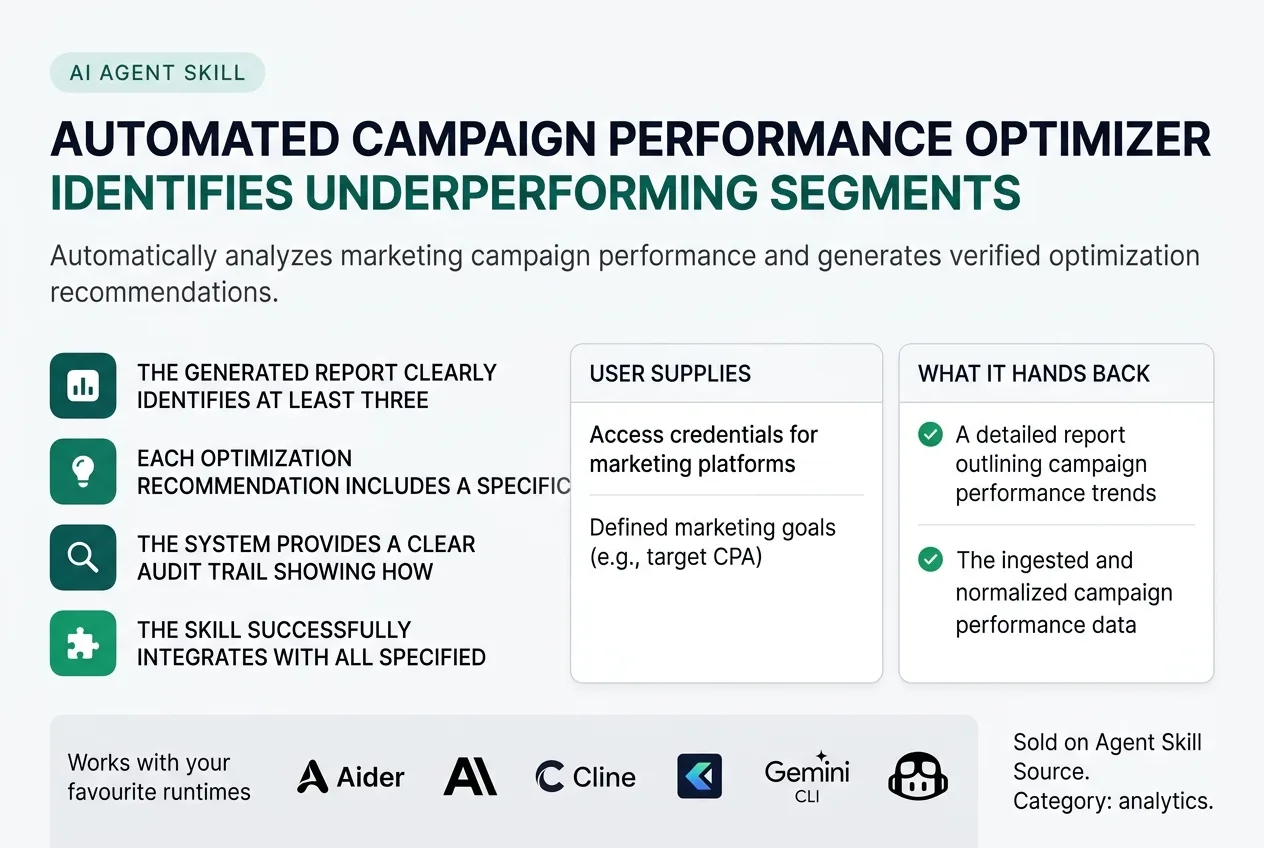
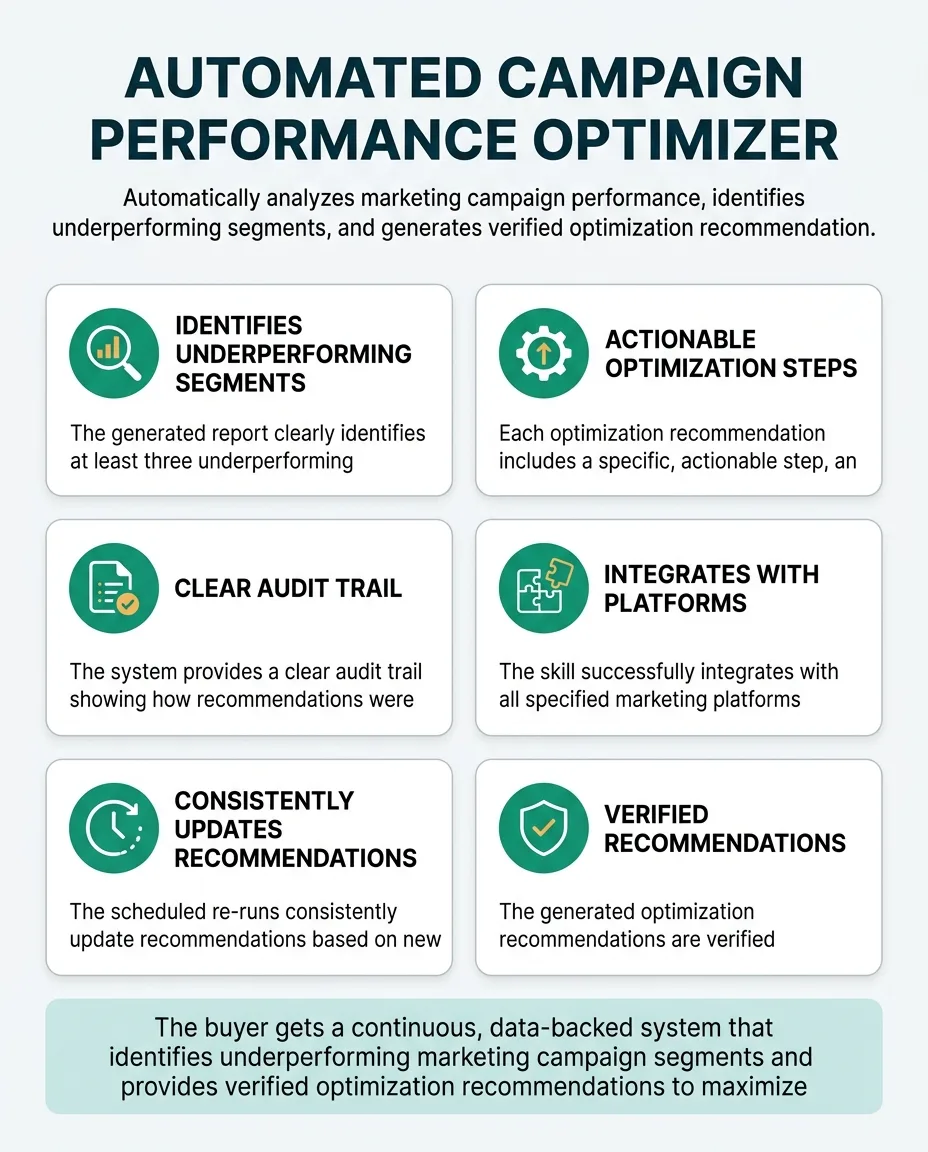
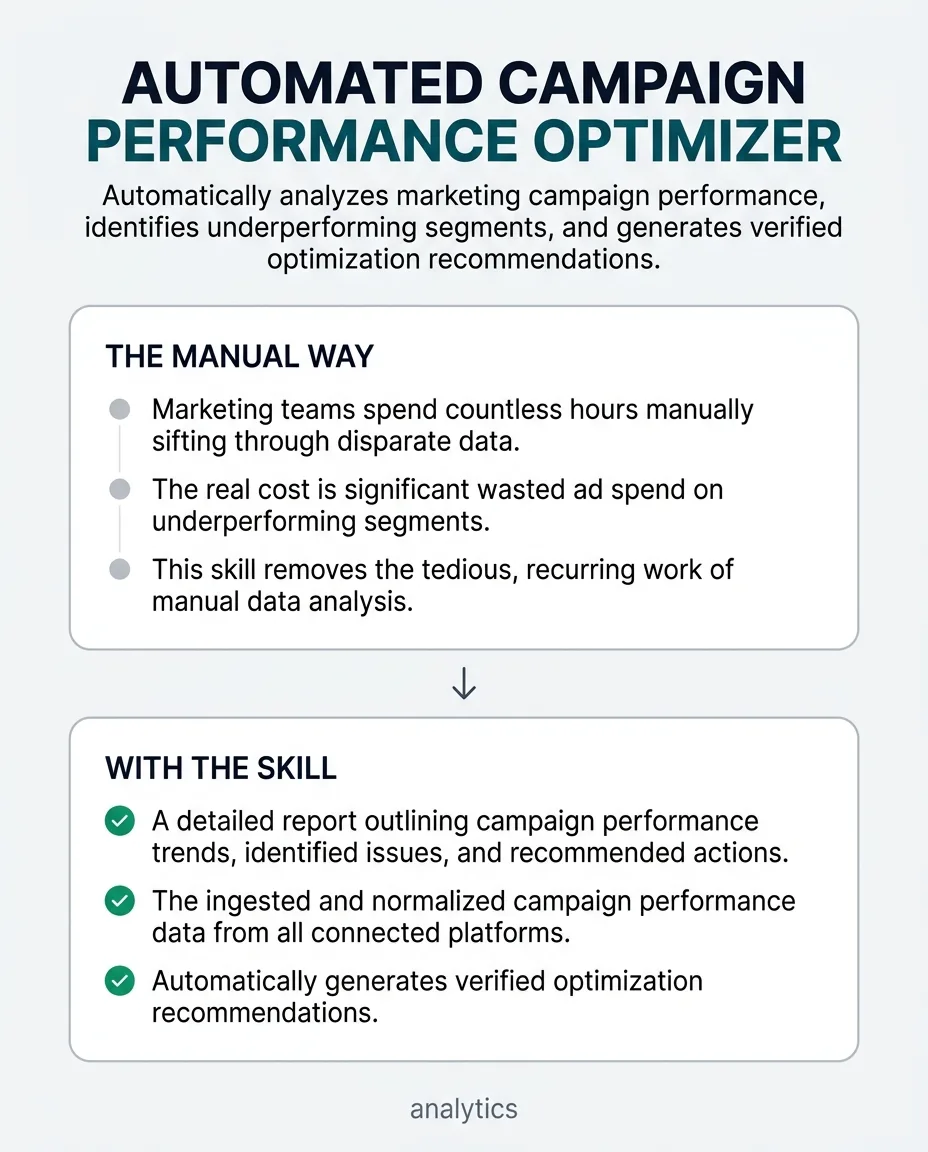
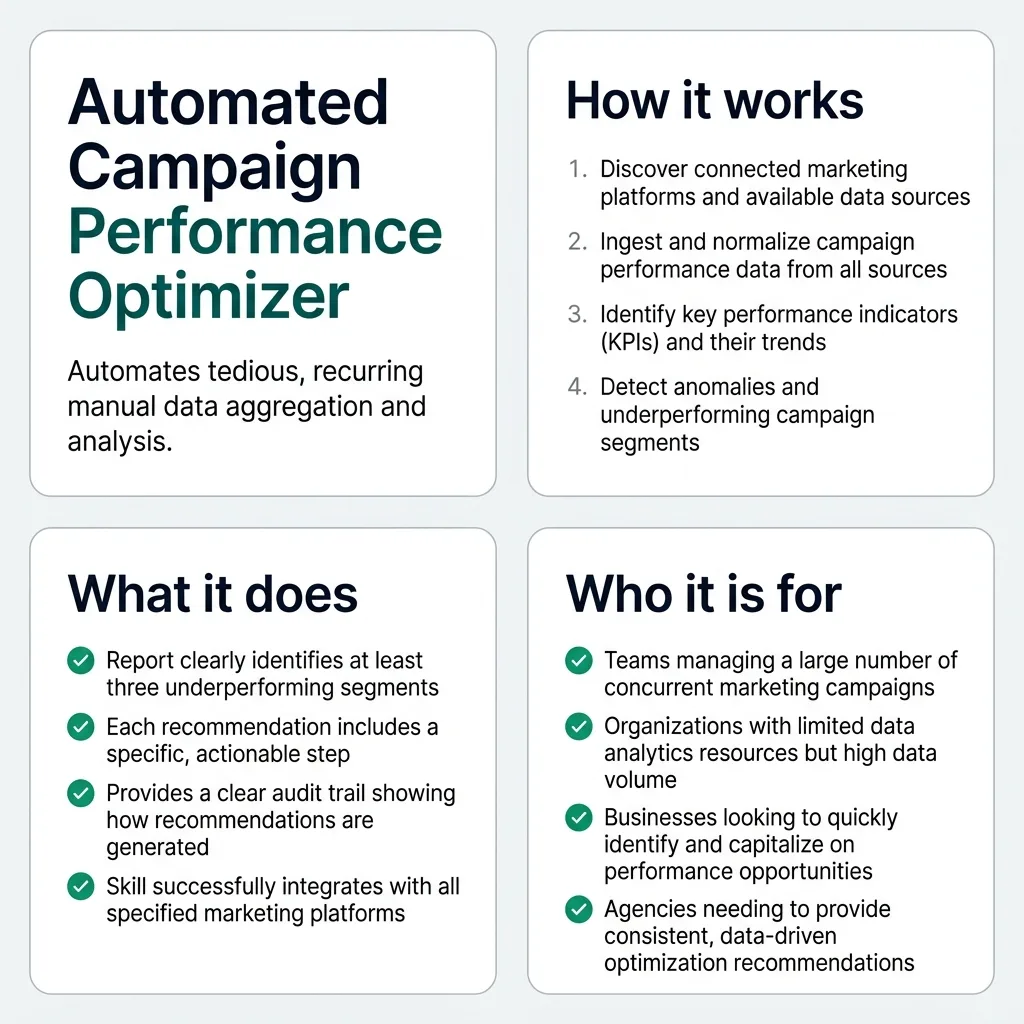
Users receive data-backed optimization recommendations for their marketing campaigns, identifying underperforming areas and simulating impact to improve ROI. This skill automates performance analysis across platforms, providing clear, actionable insights to maximize ad spend efficiency.
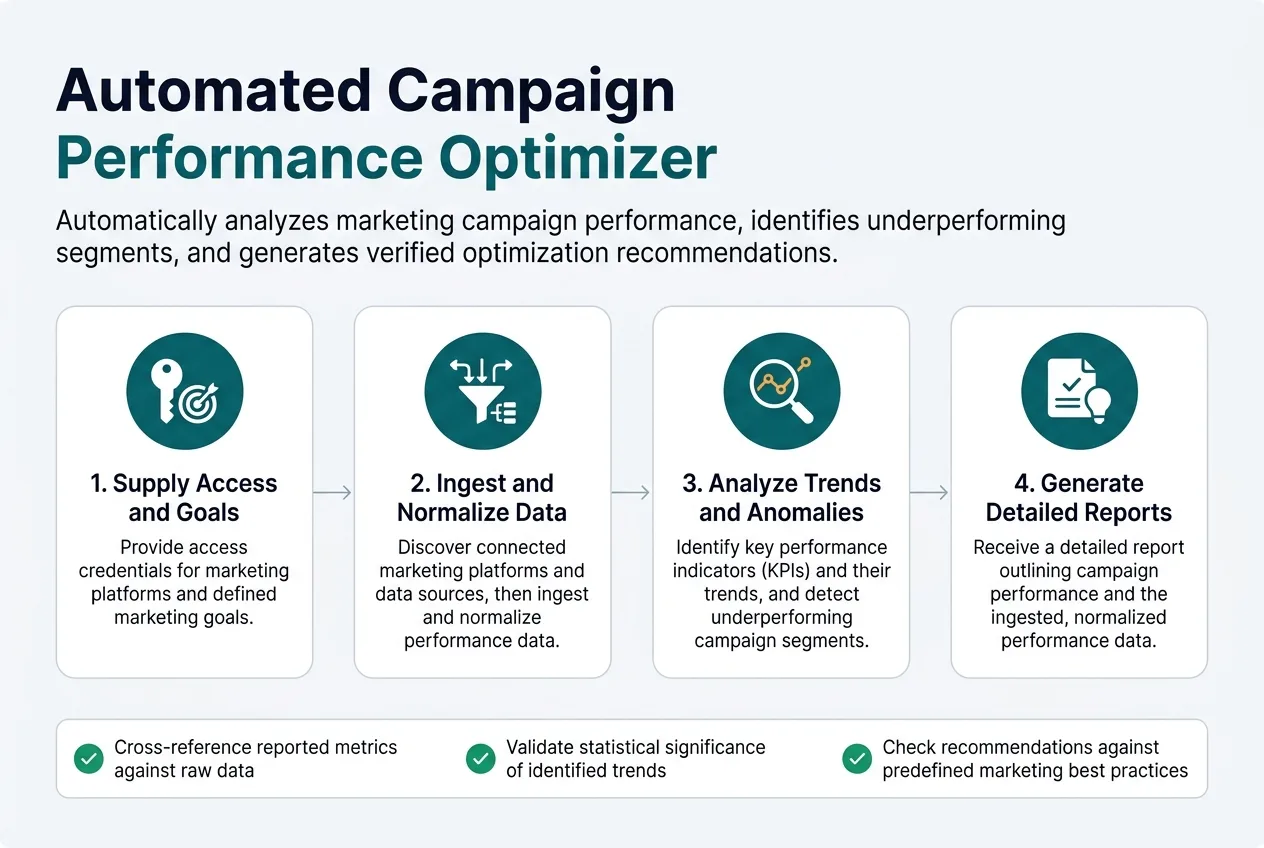
This skill automatically discovers connected marketing platforms and their available data, including campaign structures, ad groups, keywords, creatives, and performance metrics. It ingests this data, cleans it, and structures it for analysis. The skill produces a detailed performance report highlighting key trends, anomalies, and specific areas of underperformance. It then generates a list of actionable, data-backed optimization recommendations. Recommendations are verified by cross-referencing against historical campaign data, industry benchmarks, and established marketing best practices, with potential impact simulated using statistical models.
Marketing teams spend countless hours manually sifting through disparate campaign data, trying to identify performance trends and areas for improvement. This often leads to delayed insights and reactive decision-making.
The real cost is significant wasted ad spend on underperforming campaigns, missed opportunities for scaling successful initiatives, and the high labor cost of skilled analysts performing repetitive data crunching instead of strategic work.
This skill removes the tedious, recurring work of manual data aggregation, performance analysis, and recommendation generation from the marketing workflow, allowing teams to focus on strategic implementation and creative execution.
Marketing Managers, Digital Marketing Specialists, and Data Analysts in e-commerce businesses, agencies, and SaaS companies.
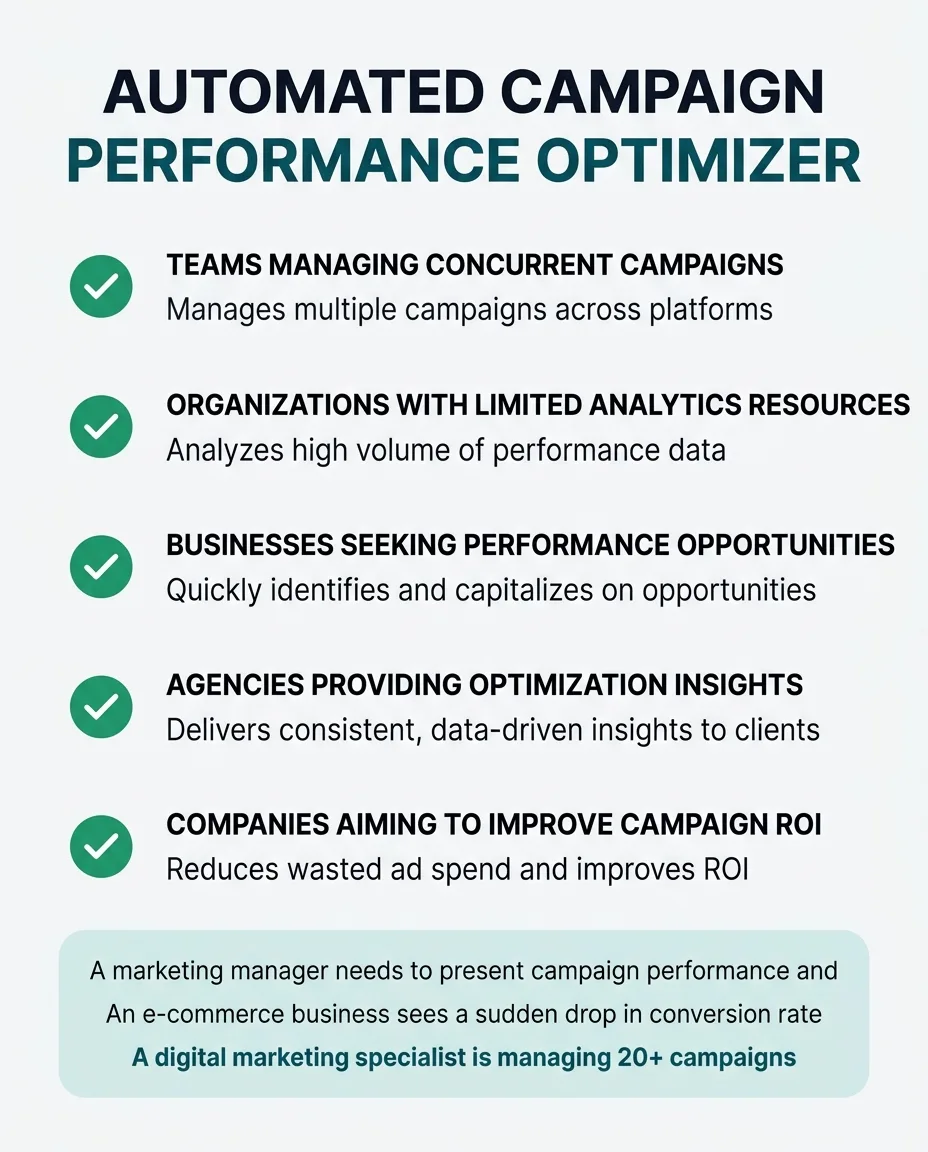
Especially valuable when:
This skill eliminates the recurring, tedious work of manually aggregating and analyzing disparate marketing campaign data across multiple platforms. Marketing teams often spend countless hours sifting through spreadsheets, trying to identify performance trends and areas for improvement, leading to delayed insights and reactive decision-making.
The value compounds over time by preventing significant wasted ad spend on underperforming campaigns and identifying missed opportunities for scaling successful initiatives. By providing continuous, data-backed optimization recommendations, it ensures marketing budgets are utilized more efficiently, directly impacting ROI.
Buyers pay for the sophisticated analytical engine, the statistical models that simulate impact, and the rigorous verification process that ensures recommendations are actionable and reliable. This goes beyond simple text generation, offering a strategic marketing asset that frees up skilled analysts to focus on higher-level strategy and creative execution, rather than repetitive data crunching.
One payment, yours permanently. Download it again at any time and get later versions free.
While mixpanel-automation and posthog-automation handle event data and google-analytics-automation manages Google Analytics, they focus on data collection and basic reporting or integration. This skill goes beyond mere data handling to perform deep, cross-platform performance analysis and generate actionable, verified optimization recommendations.
seo-keyword-strategist and seo-content-auditor focus on specific SEO aspects. This skill operates at the campaign performance level, integrating data from paid and organic channels to provide holistic optimization advice.
- A marketing manager needs to present campaign performance and justify budget allocation for the next quarter, but lacks consolidated data across platforms.
- An e-commerce business sees a sudden drop in conversion rate on a key ad campaign and needs to quickly diagnose the cause and find solutions.
- A digital marketing specialist is managing 20+ campaigns across Google Ads and Facebook, feeling overwhelmed by the manual data aggregation and analysis required.
- An agency client is questioning ad spend efficiency, requiring immediate, data-backed proof of optimization efforts and their impact.
- A new product launch campaign is underperforming its initial Cost Per Acquisition (CPA) targets, and the team needs actionable steps to improve Return On Ad Spend (ROAS).
Access Credentials: API keys or OAuth tokens for marketing platforms (e.g., Google Ads, Facebook Ads, LinkedIn Ads, CRM, Google Analytics).
Marketing Goals: Specific, quantifiable marketing objectives for the campaigns (e.g., target CPA, ROAS, lead volume, conversion rate).
Timeframe: The period for which campaign performance should be analyzed (e.g., 'last 30 days', 'Q3 2023').
Performance Optimization Report: A detailed report outlining campaign performance trends, identified underperforming segments, root cause analysis, and a prioritized list of verified optimization recommendations.
Raw Performance Data (Normalized): The ingested and normalized campaign performance data from all connected platforms, structured for further analysis.
Use API calls to identify connected marketing platforms and available data sources.
Done when: A list of accessible platforms and their data schemas is compiled.
If it cannot finish: Report inaccessible platforms and proceed with available data, marking affected sections as incomplete.
Fetch raw performance data (impressions, clicks, conversions, cost, targeting) from all discovered platforms via their APIs.
Done when: All available data from connected platforms is ingested, cleaned, and normalized into a unified schema.
If it cannot finish: Flag data sources with ingestion errors, continue with available data, and mark affected sections as incomplete.
Perform data integrity checks and reconcile metrics across platforms to ensure consistency and prevent isolated analysis.
Done when: Cross-platform data discrepancies are identified and resolved or clearly noted.
If it cannot finish: Report irreconcilable data conflicts and proceed with analysis, clearly stating data limitations.
Apply statistical methods to identify key performance indicators (KPIs), trends, and anomalies across all campaigns and segments.
Done when: Key trends, anomalies, and underperforming segments are identified and statistically validated.
If it cannot finish: Report insufficient data for trend analysis and halt further recommendation generation.
Investigate identified underperforming segments to determine the underlying reasons for performance deviations, cross-referencing with historical data.
Done when: Root causes for underperformance are identified and documented for each flagged segment.
If it cannot finish: Report inability to determine root causes for specific segments due to data limitations.
Formulate specific, data-backed optimization recommendations (e.g., bid adjustments, targeting refinements, creative changes) and simulate their potential impact using statistical models.
Done when: A list of actionable recommendations, each with a simulated impact (e.g., projected CPA reduction), is generated.
If it cannot finish: Report inability to generate reliable recommendations for specific segments or metrics.
Cross-reference each recommendation against user-defined marketing goals, historical campaign data, industry benchmarks, and established marketing best practices.
Done when: Each recommendation is verified and supported by clear evidence, or flagged for A/B testing if verification is inconclusive.
If it cannot finish: Mark unverified recommendations as "suggested for A/B testing" and explain the lack of conclusive evidence.
Compile a prioritized list of verified recommendations, including estimated impact, supporting data, and any stated assumptions or limitations, in a detailed report.
Done when: A comprehensive report with prioritized, actionable, and verified optimization recommendations is prepared.
If it cannot finish: Report failure to compile a complete report due to prior step failures.
| The mistake | What it costs | How the skill prevents it |
|---|---|---|
| Analyzing campaign performance using data from only one platform, ignoring interconnected campaigns on other channels. | Optimizations made in isolation can inadvertently shift problems or budget inefficiencies to other platforms, leading to a net zero or negative overall ROI, and a fragmented view of the customer journey. | Require data ingestion from all specified marketing platforms and perform a cross-platform data reconciliation and integrity check before commencing any performance analysis. |
| Recommending bid changes or targeting adjustments based on short-term performance fluctuations without statistical validation. | Reacting to random noise rather than genuine trends, leading to unnecessary and potentially detrimental campaign changes that destabilize performance, waste budget, and erode trust in optimization efforts. | Apply rigorous statistical significance tests (e.g., A/B test significance, confidence intervals) to all identified performance deviations and trends, only flagging those that meet a predefined statistical threshold for action. |
| Generating optimization recommendations that are generic, contradictory to stated marketing goals, or lack specific data-backed justification. | The recommendations are either ignored, lead to ineffective actions, or actively harm campaign performance by misaligning with strategic objectives, resulting in continued wasted ad spend and missed opportunities. | Verify each recommendation by cross-referencing it against the user's defined marketing goals, historical campaign performance data, and established marketing best practices, clearly citing the supporting evidence. |
| Failing to simulate the potential impact of a recommendation before suggesting its implementation. | Implementing changes blindly without understanding their likely effect, which can lead to unexpected negative outcomes, wasted resources on ineffective strategies, and an inability to justify the proposed actions. | Utilize statistical modeling to simulate the estimated impact (e.g., projected CPA reduction, ROAS increase) of each recommendation, providing a quantifiable expectation of improvement. |
| Not establishing a feedback loop to track the actual performance changes after recommendations are applied. | The team cannot confirm if optimizations were successful, leading to a lack of learning, repetition of ineffective strategies, and an inability to demonstrate the value of the optimization process. | Implement a continuous monitoring system that tracks campaign performance post-implementation, comparing actual results against the simulated impact and using this data to refine future recommendations. |
| Presenting data or recommendations without clearly stating underlying assumptions, data limitations, or potential external influences. | Users make decisions based on an incomplete understanding of the context, potentially misinterpreting results or applying recommendations in situations where they are not valid, leading to flawed strategic choices. | Explicitly state all data sources, any identified data quality issues, the confidence level of statistical analyses, and any known external factors (e.g., seasonality, market trends) that might influence the results. |
A small e-commerce business, "PetParadise", is running Google Ads and Facebook Ads campaigns for their new line of organic dog treats. Their target CPA is $20, and target ROAS is 3.0. They've noticed a recent dip in overall ROAS and want to understand why and get actionable steps to improve it.
{"access_credentials": {"google_ads": "ya29.a0AfB_...", "facebook_ads": "EAA...token"}, "marketing_goals": {"target_cpa": 20, "target_roas": 3.0, "min_lead_volume": null}, "timeframe": "last 30 days"}# Campaign Performance Optimization Report for PetParadise (Last 30 Days)
## Overview
Overall ROAS: 2.5 (down from 3.2 last period)
Overall CPA: $25 (up from $18 last period)
Total Spend: $15,000
## Key Trends & Anomalies
- Google Ads Search Campaign 'Organic Treats - Branded' saw a 15% increase in CPA ($22 to $25) despite stable conversion rate.
- Facebook Ads 'Retargeting - Cart Abandoners' campaign experienced a 20% drop in ROAS (4.0 to 3.2) with a significant increase in CPM.
- A new Google Ads Display campaign 'Organic Treats - Awareness' has very low conversion volume and high CPA ($70).
## Underperforming Segments & Root Causes
### 1. Google Ads Search: 'Organic Treats - Branded'
- **Segment**: Ad Group: 'Organic Treats - Branded Keywords'
- **Root Cause**: Increased competition for branded keywords, leading to higher CPCs (up 18%) without a proportional increase in conversion value. Competitor 'HealthyPaws' recently launched a similar product.
### 2. Facebook Ads: 'Retargeting - Cart Abandoners'
- **Segment**: Ad Set: 'Dynamic Product Ads - 7 Day Abandoners'
- **Root Cause**: Audience fatigue and creative staleness. The same ad creatives have been running for over 60 days, leading to declining CTR and rising CPMs.
### 3. Google Ads Display: 'Organic Treats - Awareness'
- **Segment**: Campaign: 'Organic Treats - Awareness'
- **Root Cause**: Broad targeting and irrelevant placements. The campaign is showing ads on websites with low relevance to pet owners, resulting in wasted impressions and clicks.
## Verified Optimization Recommendations
### 1. Adjust Google Ads Branded Bid Strategy
- **Action**: Implement a Target ROAS bid strategy for 'Organic Treats - Branded' campaign, setting target ROAS to 3.0.
- **Estimated Impact**: Projected 10-15% reduction in CPA, bringing it closer to the $20 target, while maintaining conversion volume.
- **Supporting Data**: Historical data shows branded keywords convert well but are sensitive to CPC fluctuations. Target ROAS strategy will automatically adjust bids to meet profitability goals.
- **Verification Status**: Verified against historical performance and marketing goal (target ROAS 3.0).
### 2. Refresh Facebook Retargeting Creatives
- **Action**: Develop and launch 3 new ad creative variations for the 'Retargeting - Cart Abandoners' ad set, focusing on different value propositions (e.g., free shipping, loyalty program).
- **Estimated Impact**: Projected 15-20% increase in ROAS for the retargeting campaign by improving CTR and reducing CPM.
- **Supporting Data**: Analysis shows creative performance typically declines after 45-60 days. New creatives often lead to a temporary boost in engagement and efficiency.
- **Verification Status**: Verified against marketing best practices for creative refresh cycles and historical performance trends.
### 3. Refine Google Ads Display Targeting
- **Action**: Narrow the targeting for 'Organic Treats - Awareness' campaign by adding specific audience segments (e.g., 'Pet Owners', 'Dog Lovers') and excluding irrelevant placements.
- **Estimated Impact**: Projected 50%+ reduction in CPA for the display campaign by focusing spend on more relevant audiences, leading to higher conversion rates.
- **Supporting Data**: Current broad targeting shows high impression volume but extremely low conversion rates. Refined targeting will improve ad relevance and efficiency.
- **Verification Status**: Verified against marketing best practices for display advertising and current campaign performance data.
## Assumptions & Limitations
- Analysis assumes accurate conversion tracking is implemented across both platforms.
- Industry benchmarks for organic dog treats were used where available, but specific competitor data is limited to observable market changes.
- External factors like seasonal demand or broader economic trends are not explicitly modeled but are acknowledged as potential influences.Why this output: The output directly addresses the user's problem by identifying specific underperforming areas (Google Ads branded, Facebook retargeting, Google Ads display) and their root causes. It provides concrete, actionable recommendations that are aligned with the stated marketing goals (target CPA $20, ROAS 3.0). Each recommendation includes a clear action, a quantifiable estimated impact, and the data-backed reasoning for its validity, fulfilling the verification requirement. The report also explicitly states assumptions and limitations, adhering to the "never invent facts" principle.
The skill schedules regular re-runs (e.g., daily, weekly) to ingest fresh data, re-evaluate campaign performance, and update optimization recommendations as market conditions or campaign results change. It can also be integrated into a CI/CD pipeline to trigger on significant performance shifts.
Copy SKILL.md to your skills directoryThe skill is designed to discover and integrate with any marketing platform that offers an accessible API for data extraction, such as Google Ads, Facebook Ads, LinkedIn Ads, and potentially CRM or web analytics platforms like Google Analytics. It dynamically adapts to the platforms you connect.
Recommendations are rigorously verified. They are cross-referenced against your defined marketing goals, historical campaign data, industry benchmarks, and established marketing best practices. Statistical models simulate potential impact, and any recommendation that cannot be conclusively verified is flagged for A/B testing.
No, the skill will not execute any changes directly on your marketing platforms. It generates a detailed report with actionable recommendations for you to review and implement manually or through your existing campaign management tools. You retain full control over your campaign adjustments.
The skill is designed to handle data quality issues gracefully. If it detects missing conversion tracking, inconsistent naming, or other data problems, it will flag these issues in the report and either proceed with available reliable data or refrain from making unverified recommendations based on unreliable information, clearly stating the limitations.
This skill is built for continuous optimization. It can be scheduled for regular re-runs (e.g., daily, weekly) to ingest fresh data, re-evaluate campaign performance, and update recommendations as market conditions or campaign results evolve, ensuring ongoing efficiency.
No ratings yet. If you have used this skill, yours would be the first.
Sign in to leave a rating
An account keeps your review with your name on it, and lets you edit it later. Sign in or create one free.
No reviews yet
This skill has not been rated. If you have run it, a short note about what you used it for helps the next person more than any description can.
Discover more AI agent skills in the same category to enhance your workflow automation.
Automated pull request reviews for security, logic, and style consistency across multiple languages.
Real-time security audit skill scanning for OWASP Top 10 vulnerabilities and infrastructure misconfigurations.
This skill provides continuous, verified insights into competitor marketing strategies by analyzing public data. It delivers detailed reports on channels, messaging, ad spend, and strategic gaps, enabling proactive de...
Automatically drafts, refines, and distributes relevant meeting agendas based on context, ensuring productive discussions.
Master essential Bash/Linux terminal patterns, including critical commands, piping, error handling, and scripting for macOS and Linux systems.
You receive comprehensive, SEO-optimized, and E-E-A-T compliant long-form articles and blog posts, fully researched and fact-verified, ready for publication.
Join the community and help AI agents learn new capabilities. Submit your skill and reach thousands of developers.