Images of Intent-Driven Content Strategy and Drafts
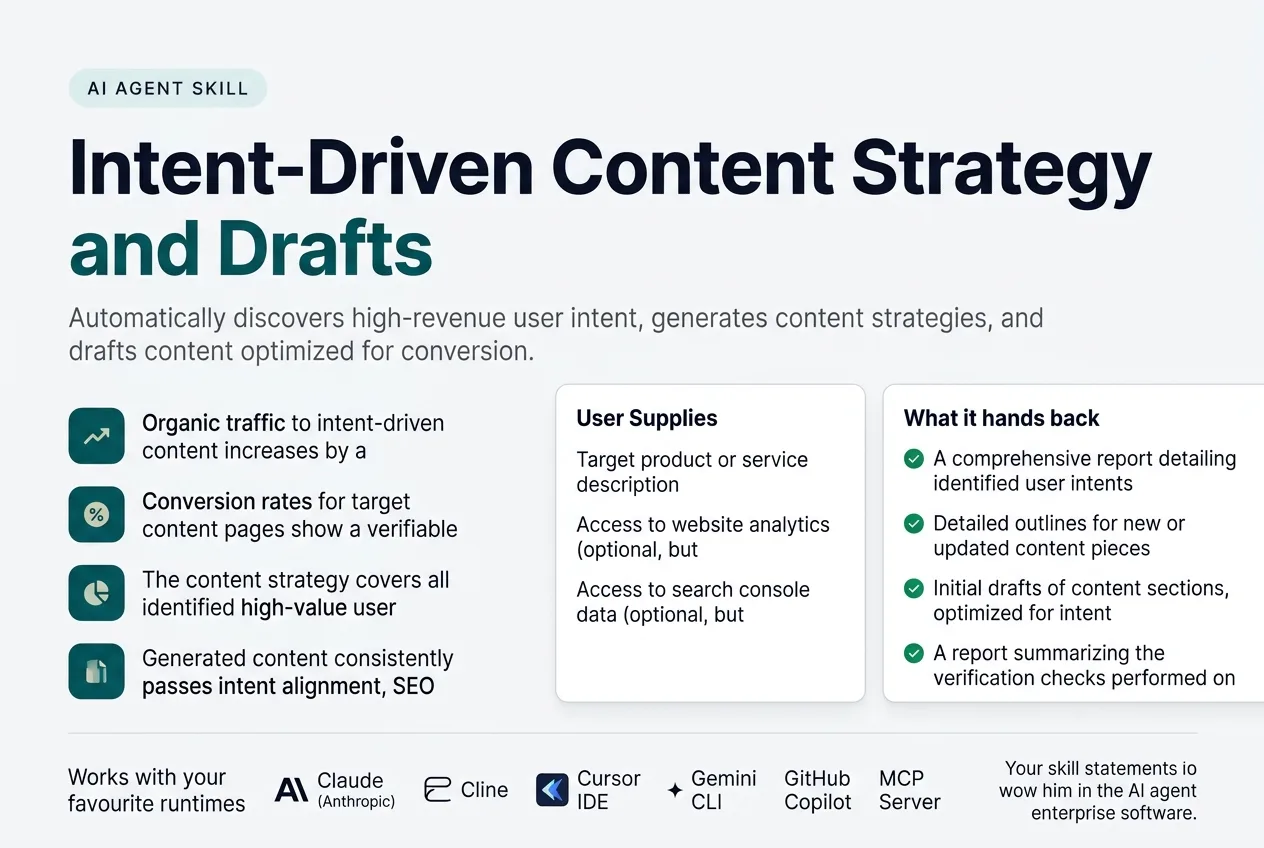
Featured imageThe one image that represents the skill in the gallery and in a social share.
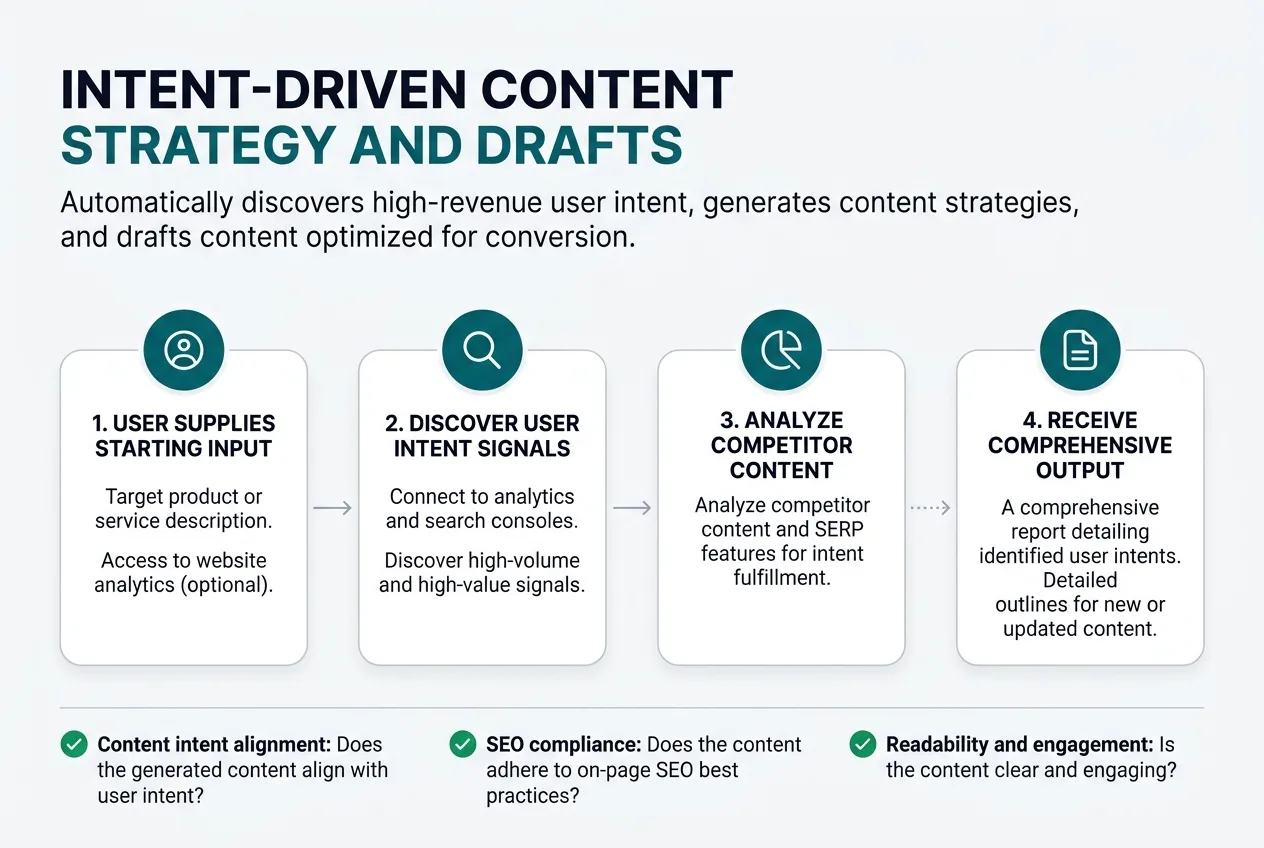
How it worksShows the path from what the user supplies to what they get back.
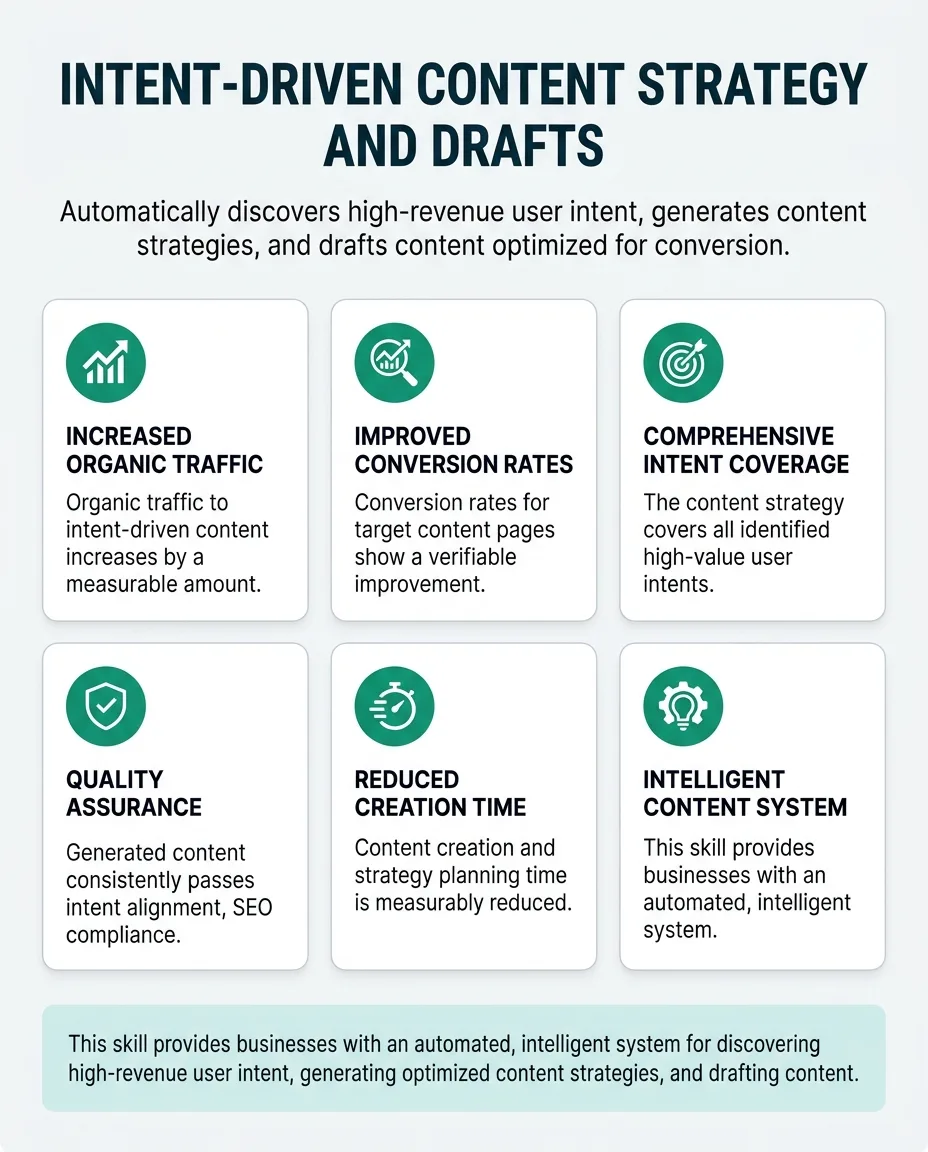
What it doesThe capability grid, for a reader scanning rather than reading.
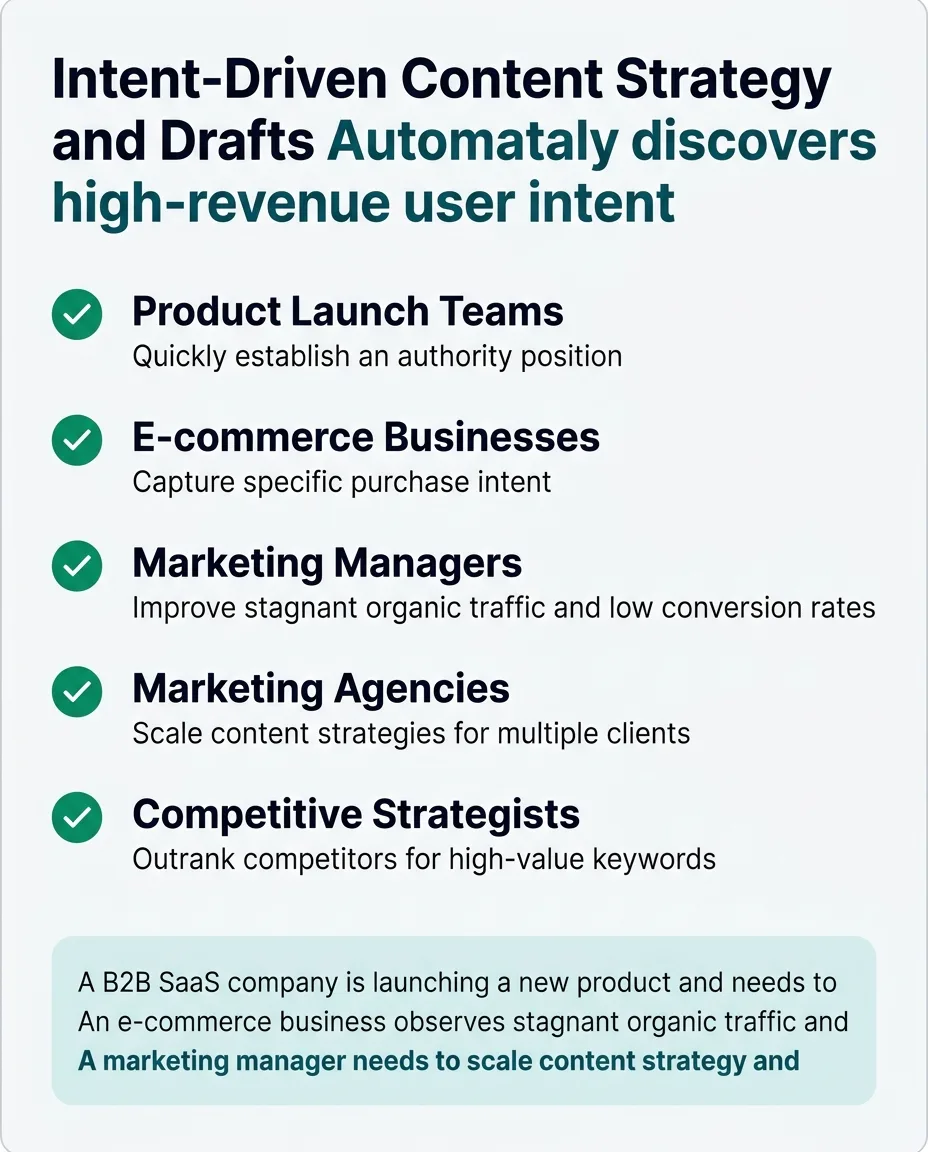
Who it is forLets a reader recognise themselves, which is what decides whether they keep reading.
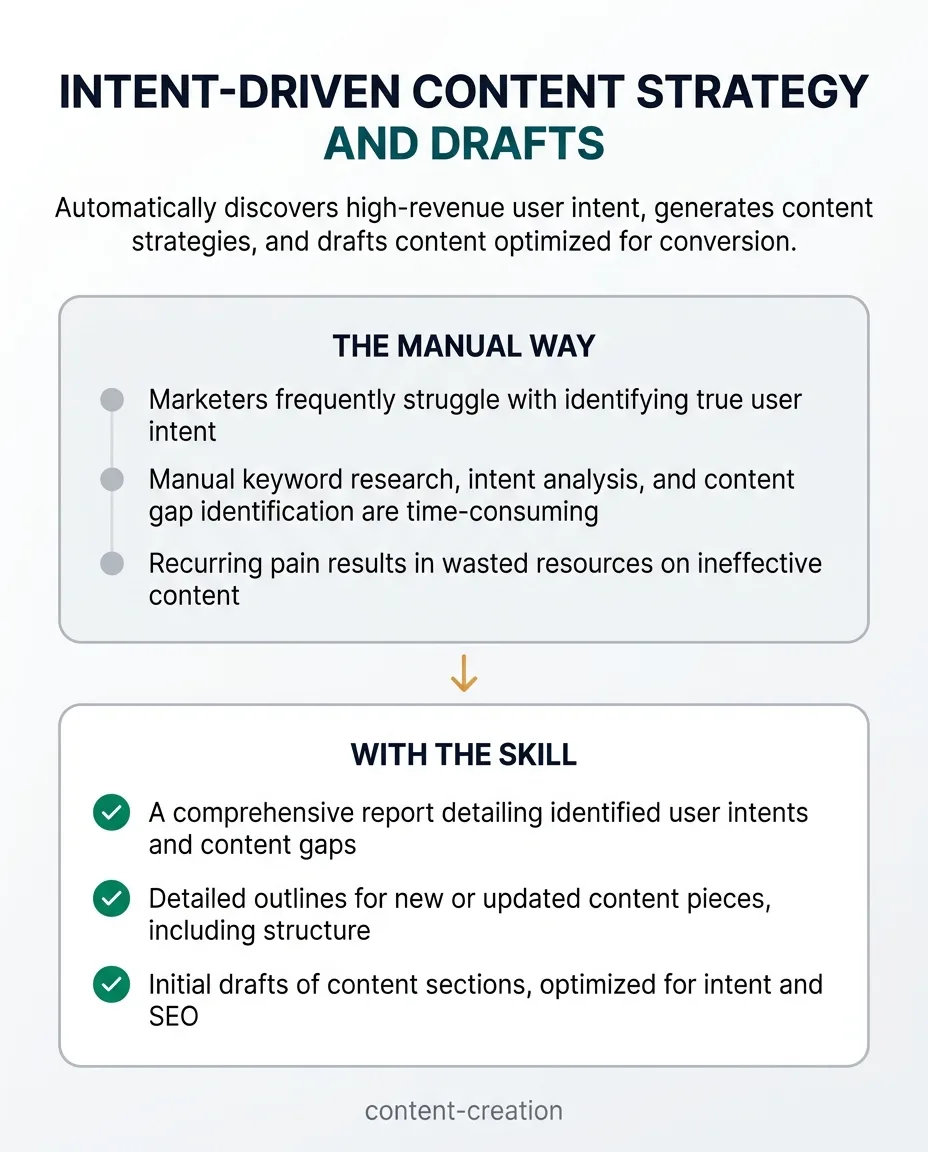
The change it makesContrasts the manual way with the skill, without claiming a measured result.
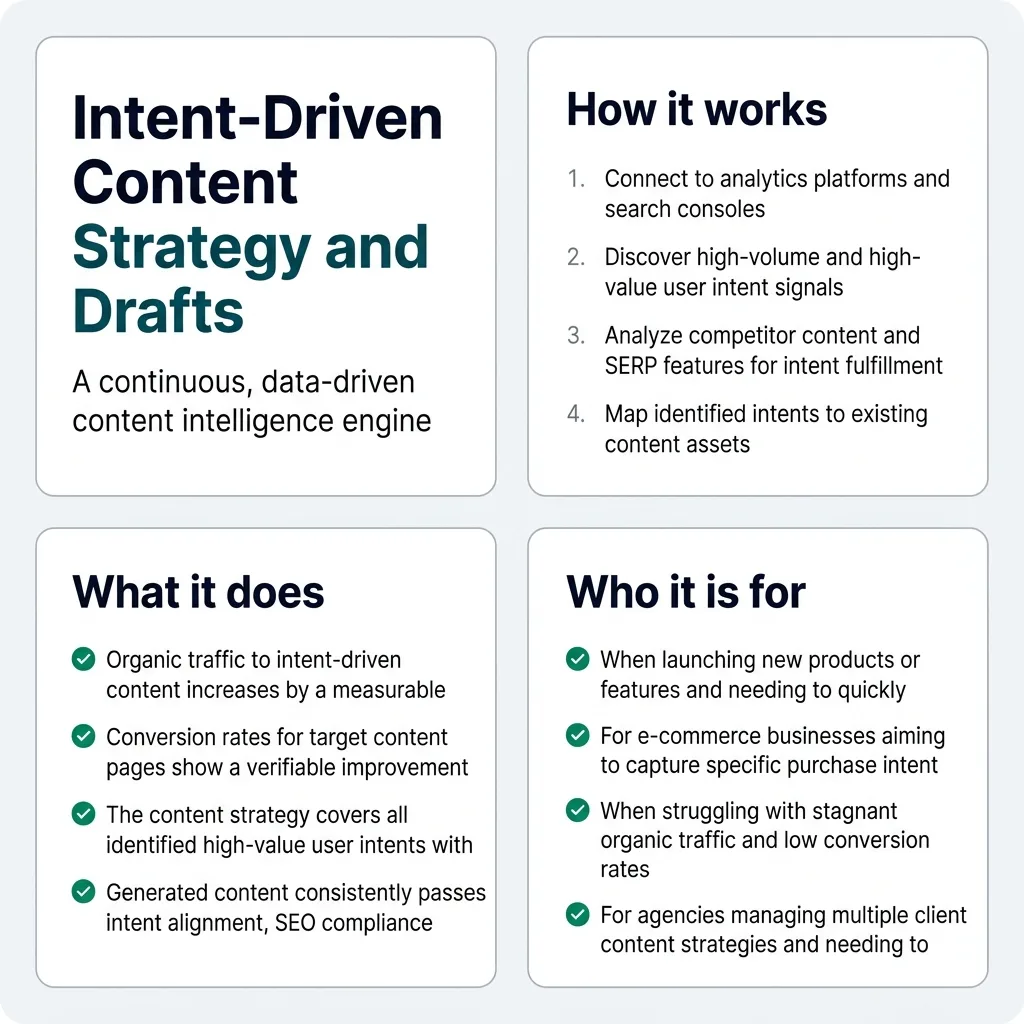
Summary sheetOne square image that carries the whole story, for a social share or a card.
1 of 6
This skill automatically discovers user intent signals from various data sources, including search queries, website analytics, and competitor content. It analyzes these signals to identify high-revenue opportunities and content gaps. The skill produces comprehensive content outlines and initial drafts, ensuring each piece directly addresses the identified user intent and adheres to SEO best practices. It verifies generated content against intent alignment, readability, and uniqueness, flagging any unverified details. The skill keeps the content strategy current by continuously monitoring search trends and content performance, suggesting and implementing updates as needed.
This skill automatically discovers user intent signals from various data sources, including search queries, website analytics, and competitor content. It analyzes these signals to identify high-revenue opportunities and content gaps. The skill produces comprehensive content outlines and initial drafts, ensuring each piece directly addresses the identified user intent and adheres to SEO best practices. It verifies generated content against intent alignment, readability, and uniqueness, flagging any unverified details. The skill keeps the content strategy current by continuously monitoring search trends and content performance, suggesting and implementing updates as needed.
The Problem It Removes
Marketers and content teams frequently struggle with identifying the true intent behind user searches, leading to content that misses the mark, generates low engagement, and fails to convert.
The manual process of keyword research, intent analysis, content gap identification, and content creation is time-consuming, prone to human bias, and often reactive rather than proactive.
This recurring pain results in wasted resources on ineffective content, missed revenue opportunities, and a constant backlog of content updates.
Who It Is For
This skill is for Content Strategists, SEO Specialists, and Marketing Managers in B2B SaaS, e-commerce, and digital marketing agencies.
Especially valuable when:
When launching new products or features and needing to quickly establish an intent-driven content presence.
For e-commerce businesses aiming to capture specific purchase intent with highly relevant product and category pages.
When struggling with stagnant organic traffic and low conversion rates from existing content.
For agencies managing multiple client content strategies and needing to scale their intent analysis capabilities.
When competitors are outranking for high-value keywords and a differentiated intent strategy is required.
For content teams that need to reduce the manual effort in content planning and initial drafting.
When expanding into new markets and needing to understand local user intent nuances.
For businesses looking to proactively adapt their content strategy to evolving search trends and user behaviors.
Why This Price
This skill addresses a critical and recurring pain point for marketing teams: the manual, time-consuming, and often ineffective process of content strategy and drafting. It replaces countless hours spent on keyword research, intent analysis, competitor audits, and initial content creation, allowing teams to focus on refinement and strategic oversight.
The value of this skill compounds over time because it not only generates initial content but also continuously monitors performance and evolving search trends. This proactive approach ensures your content remains relevant and high-performing, preventing the decay of organic traffic and conversions that often plague static content strategies.
Buyers are paying for more than just generated text; they are investing in a sophisticated, automated system that provides strategic insights, verified content outlines, and initial drafts optimized for conversion. This includes the intelligence to identify high-revenue opportunities, the safeguards to prevent factual errors, and the continuous adaptation necessary to maintain a competitive edge in a dynamic search landscape.
One payment, yours permanently. Download it again at any time and get later versions free.
How It Differs From Similar Skills
The seo-keyword-strategist skill focuses on keyword identification, and seo-content-planner creates outlines. This skill goes further by integrating real-time user intent discovery with content generation and continuous performance monitoring, ensuring the content not only ranks but also converts by directly addressing user needs. copywriting generates text, but this skill ensures that text is strategically aligned with specific, verified user intent for revenue. Nothing else is close.
When To Use
- A B2B SaaS company is launching a new product and needs to quickly establish an intent-driven content presence.
- An e-commerce business observes stagnant organic traffic and low conversion rates from existing product pages.
- A marketing manager needs to scale content strategy and initial drafting capabilities across multiple client accounts.
- A content strategist notices competitors outranking them for high-value keywords and requires a differentiated intent strategy.
- A business is expanding into a new market and needs to understand local user intent nuances for content localization.
Inputs
targetProductOrServiceDescription: A brief description of the product or service the content will be about.
websiteAnalyticsAccess: Credentials or API key for website analytics platforms (e.g., Google Analytics).
searchConsoleAccess: Credentials or API key for search console data (e.g., Google Search Console).
Outputs
contentStrategyReport: A comprehensive report detailing identified user intents, content gaps, and strategic recommendations.
contentOutlines: Detailed outlines for new or updated content pieces, including structure, headings, and key points.
initialContentDrafts: Initial drafts of content sections, optimized for intent and SEO, with unverified details clearly marked.
verificationReport: A report summarizing the verification checks performed on the content, including intent alignment, SEO compliance, readability, and uniqueness scores.
How It Works From Start To Finish
1Connect to analytics platforms and search consoles
2Discover high-volume and high-value user intent signals
3Analyze competitor content and SERP features for intent fulfillment
4Map identified intents to existing content assets
5Identify critical content gaps and optimization opportunities
6Generate detailed content outlines for new or updated content
7Draft initial content sections, ensuring intent alignment and SEO best practices
8Verify content accuracy, uniqueness, and readability against intent
9Suggest internal linking and topic cluster improvements
10Monitor content performance and search trend changes
11Propose and implement content updates for continuous relevance
What you supply
Target product or service description
Access to website analytics (optional, but recommended)
Access to search console data (optional, but recommended)
What it finds out on its own
Relevant user intent signals from search queries and website behavior
Competitor content strategies and targeted intents
Existing content assets and their performance
Content gaps and opportunities in the current strategy
SEO best practices and ranking factors for target keywords
Step By Step
1Connect Data Sources
Execute `connect_data_source` command with specified platform and credentials.
Done when: All specified data sources (e.g., Google Analytics, Google Search Console) are successfully authenticated and accessible.
If it cannot finish: Flag inaccessible data sources and proceed with publicly available data, providing a recovery path to connect missing sources.
2Discover User Intent and Gaps
Execute `analyze_intent_and_gaps` command using `search_query_data`, `website_analytics`, and `competitor_serp_data`.
Done when: A comprehensive report of identified user intents, content gaps, and high-revenue opportunities is generated.
If it cannot finish: If intent signals are ambiguous or conflicting, present the ambiguity and ask for human clarification, avoiding incorrect content generation.
3Generate Content Outlines
Execute `generate_content_outline` command with `identified_intent`, `target_keywords`, and `competitor_analysis`.
Done when: A detailed content outline, including structure, headings, and key points, is produced for each identified content opportunity.
If it cannot finish: If outline generation fails due to insufficient data, request additional context or examples for the target intent.
4Draft Initial Content
Execute `draft_content_sections` command with `content_outline`, `source_data`, and `seo_guidelines`.
Done when: Initial content drafts are generated for all sections specified in the outline.
If it cannot finish: If content generation fails to meet initial quality thresholds, regenerate the section with stricter adherence to guidelines.
5Verify Content Quality
Execute `verify_content` command with `drafted_content`, `identified_intent`, `seo_compliance_rules`, and `uniqueness_check`.
Done when: A verification report is produced, confirming intent alignment, SEO compliance, readability, and uniqueness, with any unverified details flagged.
If it cannot finish: If content fails verification checks, highlight specific issues and suggest revisions, preventing publication of suboptimal content.
6Suggest Improvements and Updates
Execute `suggest_content_improvements` command with `verified_content`, `site_structure_data`, and `performance_metrics`.
Done when: A list of actionable recommendations for content improvement, linking, and future updates is generated.
If it cannot finish: If improvement suggestions cannot be generated, provide a summary of the content's current state and request human input for strategic direction.
How It Checks Its Own Work
Checks before it delivers
Content intent alignment: Does the generated content directly address the discovered user intent?
SEO compliance: Does the content adhere to on-page SEO best practices (keywords, structure, meta data)?
Readability and engagement: Is the content clear, concise, and engaging for the target audience?
Uniqueness: Is the content original and free from plagiarism?
Fact-checking: Are all factual claims supported by verifiable sources or marked as unverified?
If something goes wrong
If analytics data is inaccessible, the skill will proceed with publicly available search data and flag the data gap, providing a recovery path to connect data sources.
If generated content fails verification checks, the skill will highlight specific issues and suggest revisions, preventing publication of suboptimal content.
If an intent is ambiguous or conflicting, the skill will present the ambiguity and ask for human clarification, avoiding incorrect content generation.
Mistakes It Prevents
The mistake
What it costs
How the skill prevents it
Misinterpreting user intent from ambiguous or limited data signals.
Content is created for the wrong stage of the buyer journey or addresses a different problem, leading to high bounce rates, low engagement, and no conversions.
Cross-reference intent signals from multiple sources (search queries, website behavior, competitor SERP analysis) and, if ambiguity persists, flag for human review with a clear explanation of conflicting signals.
Generating content that is keyword-rich but fails to deeply satisfy the identified user intent.
Content ranks but does not engage or convert users because it provides superficial answers or misses the core problem the user is trying to solve, wasting ranking potential.
Implement a content intent alignment score that evaluates the depth and breadth of intent fulfillment, not just keyword presence, by comparing generated content against top-ranking pages for comprehensive topic coverage and user query satisfaction.
Failing to identify critical content gaps by only looking at direct keyword matches, ignoring related or implied intents.
Missed opportunities to capture a broader audience or address adjacent user needs, allowing competitors to dominate related search landscapes and limiting organic growth.
Perform a semantic analysis of user queries and competitor content to uncover latent semantic indexing (LSI) keywords and related topics, ensuring comprehensive topic cluster coverage beyond exact match keywords.
Producing content that is technically correct but lacks originality or a unique value proposition compared to existing top-ranking content.
The content struggles to rank or gain traction because it offers no new insights or perspectives, becoming just another piece of 'me too' content in a crowded SERP.
Compare generated content against top-ranking articles for uniqueness of angle, depth of insight, and inclusion of proprietary data or unique examples, flagging content that is too similar in structure or argument.
Not continuously adapting the content strategy and existing content to evolving search trends and user behavior.
Previously high-performing content becomes outdated, loses relevance, and drops in rankings, leading to a decline in organic traffic and conversions over time.
Implement a continuous monitoring loop that tracks content performance, keyword ranking shifts, and emerging search trends, automatically triggering content refresh recommendations or new content generation tasks when performance declines or new opportunities arise.
Inventing or including unverified factual claims in the generated content.
Damages brand credibility, leads to misinformation, and can result in penalties from search engines or legal issues if false claims are made.
All factual statements in generated content must be cross-referenced against provided data sources or explicitly marked as 'unverified' with a placeholder for human review, preventing the publication of unsubstantiated information.
Edge Cases It Handles
Misinterpreting user intent from ambiguous or limited data signals.
Cross-reference intent signals from multiple sources (search queries, website behavior, competitor SERP analysis) and, if ambiguity persists, flag for human review with a clear explanation of conflicting signals.
Generating content that is keyword-rich but fails to deeply satisfy the identified user intent.
Implement a content intent alignment score that evaluates the depth and breadth of intent fulfillment, not just keyword presence, by comparing generated content against top-ranking pages for comprehensive topic coverage and user query satisfaction.
Failing to identify critical content gaps by only looking at direct keyword matches, ignoring related or implied intents.
Perform a semantic analysis of user queries and competitor content to uncover latent semantic indexing (LSI) keywords and related topics, ensuring comprehensive topic cluster coverage beyond exact match keywords.
Producing content that is technically correct but lacks originality or a unique value proposition compared to existing top-ranking content.
Compare generated content against top-ranking articles for uniqueness of angle, depth of insight, and inclusion of proprietary data or unique examples, flagging content that is too similar in structure or argument.
Not continuously adapting the content strategy and existing content to evolving search trends and user behavior.
Implement a continuous monitoring loop that tracks content performance, keyword ranking shifts, and emerging search trends, automatically triggering content refresh recommendations or new content generation tasks when performance declines or new opportunities arise.
Inventing or including unverified factual claims in the generated content.
All factual statements in generated content must be cross-referenced against provided data sources or explicitly marked as 'unverified' with a placeholder for human review, preventing the publication of unsubstantiated information.
A Worked Example
A B2B SaaS company, 'CloudConnect', is launching a new feature: 'Automated Data Sync for Salesforce'. They need content that targets users looking for seamless CRM data integration solutions.
Input
targetProductOrServiceDescription: 'CloudConnect's new feature, Automated Data Sync for Salesforce, provides real-time, bidirectional data synchronization between Salesforce and other business applications, eliminating manual data entry and ensuring data consistency.', websiteAnalyticsAccess: 'Connected', searchConsoleAccess: 'Connected'
Expected output
A content strategy report identifying 'Salesforce data integration solutions', 'CRM data sync tools', and 'automate Salesforce data entry' as high-value intents. Detailed content outlines for a blog post 'How CloudConnect Automates Salesforce Data Sync for Peak Efficiency' and a landing page 'Seamless Salesforce Integration with CloudConnect'. Initial drafts for both, with a verification report confirming high intent alignment and SEO compliance. Unverified claims about specific integration partners are marked for human review.
Why this output: The skill identified relevant user intents based on the product description and connected data. It then generated strategic content outlines and initial drafts tailored to these intents, ensuring SEO best practices. The output includes a verification report to confirm quality and flags unverified details, adhering to the 'never invent facts' principle.
Keeping It Current And Knowing Its Limits
Keeping it current
The skill continuously monitors search trends, content performance metrics, and competitor activity. It automatically re-evaluates intent alignment and content effectiveness, suggesting and implementing updates to content outlines and drafts to maintain relevance and performance.
What it will not do
It will not publish content directly to a CMS without explicit human approval and integration.
It will not invent product features or company policies; any such details must be provided or verified.
It relies on accessible data sources and cannot access private or restricted competitor information.
It never invents unverified details; any information that cannot be sourced or verified is explicitly marked as unresolved.
Limitations
- Access to website analytics data (e.g., Google Analytics, Adobe Analytics) is available or can be provided.
- Access to search console data (e.g., Google Search Console, Bing Webmaster Tools) is available or can be provided.
- A target product or service description is provided as a foundational context.
- The skill operates within the boundaries of publicly accessible data for competitor analysis.
- Human oversight and approval are part of the content publication workflow.
This skill requires access to your website analytics and search console data to function optimally. Ensure you understand the implications of sharing this data.
The skill performs competitor analysis using publicly available data only and will not attempt to access private or restricted information.
All generated content, especially factual claims, must be reviewed by a human for accuracy and verification before publication. The skill explicitly flags unverified details.
The skill does not publish content directly to a CMS; human approval and integration are always required.
Questions People Ask
How does this skill ensure content truly aligns with user intent?
The skill analyzes multiple data sources like search queries and website analytics to identify precise user intent. It then generates content outlines and drafts specifically designed to address these intents, and verifies alignment before delivery.
Can this skill publish content directly to my website?
No, the skill does not publish content directly to a CMS. It provides verified content drafts and strategies, but human approval and integration are always required for publication to ensure full control and accuracy.
What kind of data do I need to provide for this skill to work?
You need to provide a description of your product or service. For optimal results, you can also connect your website analytics (e.g., Google Analytics) and search console data (e.g., Google Search Console) to enable deeper insights.
How does the skill handle factual accuracy in generated content?
The skill is designed never to invent facts. All factual statements in generated content are either cross-referenced against provided data sources or explicitly marked as 'unverified' with a placeholder for human review, ensuring accuracy and preventing misinformation.
Will this skill help me find new content opportunities?
Yes, a core function of this skill is to perform comprehensive content gap analysis. It identifies topics and questions relevant to user intent that are not adequately addressed by your existing content, uncovering new opportunities for organic growth.
What people say, and where to get help
No ratings yet. If you have used this skill, yours would be the first.
Sign in to leave a rating
An account keeps your review with your name on it, and lets you edit it later.
Sign in
or create one free.
No reviews yet
This skill has not been rated. If you have run it, a short note about what you used it
for helps the next person more than any description can.
Related Skills You May Like
Discover more AI agent skills in the same category to enhance your workflow automation.
You receive comprehensive, SEO-optimized, and E-E-A-T compliant long-form articles and blog posts, fully researched and fact-verified, ready for publication.
Expert in building and selling Notion templates as a sustainable digital product business, covering design, pricing, marketing, and scaling for real revenue.
A curated collection of high-quality, battle-tested prompts for various AI agent use cases, including role-based, task-specific, and prompt refinement techniques.