Images of Dynamic Product Feature Prioritization and Roadmap
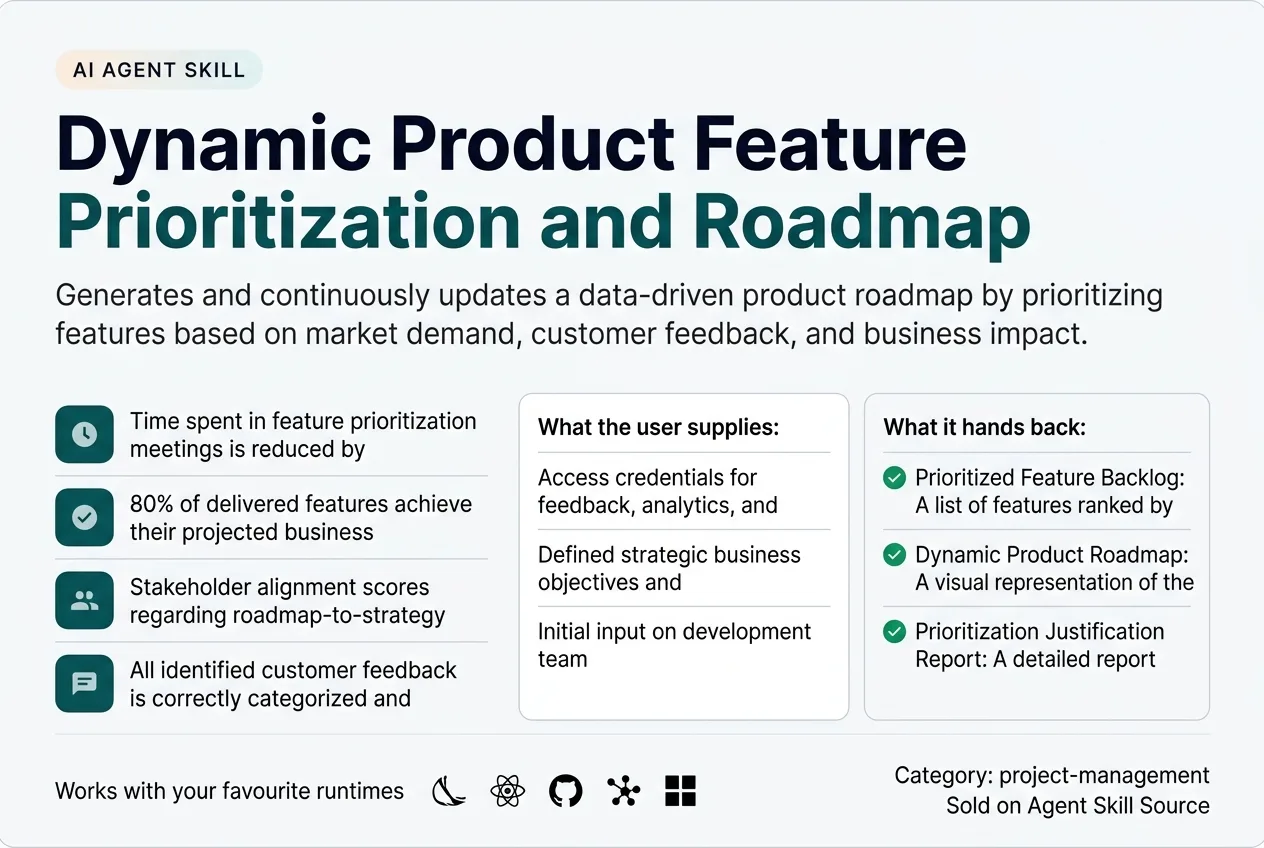
Featured imageThe one image that represents the skill in the gallery and in a social share.
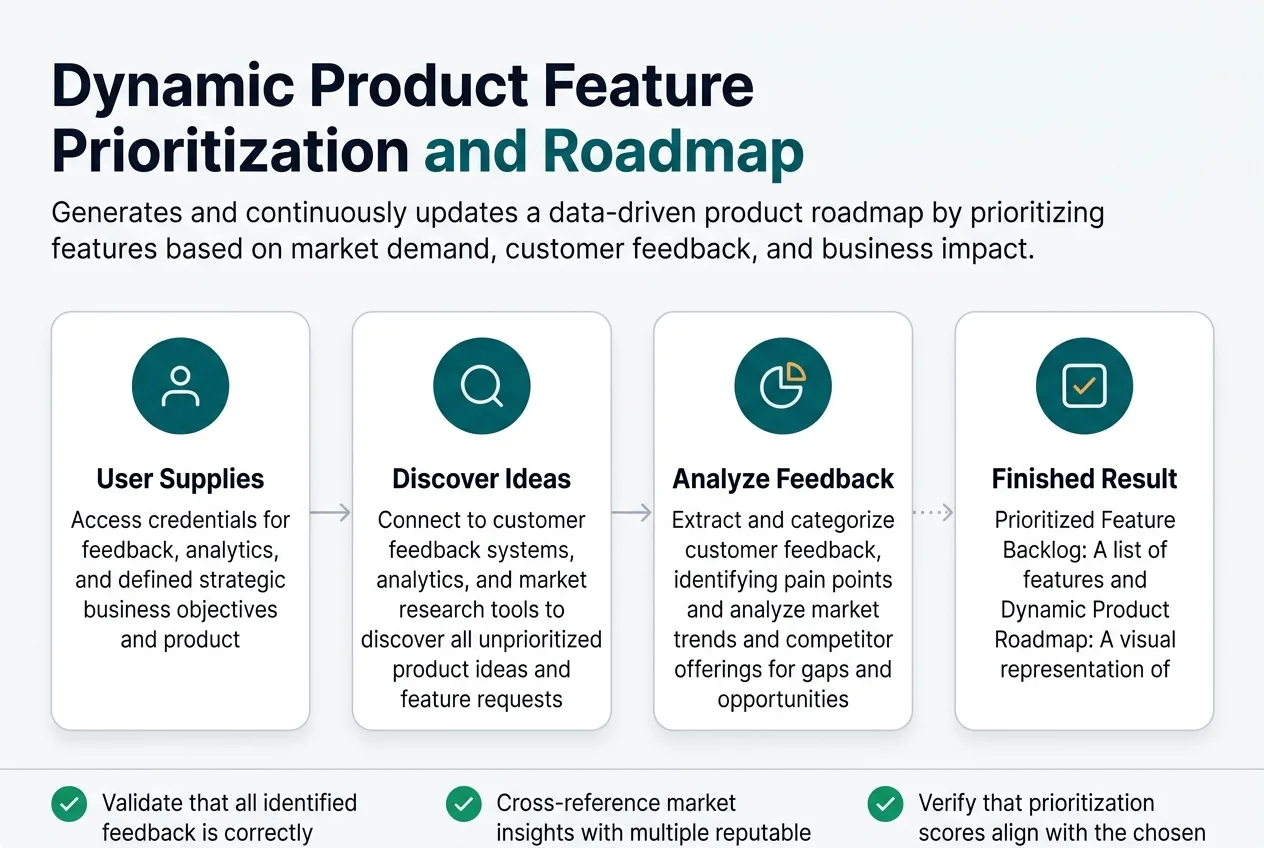
How it worksShows the path from what the user supplies to what they get back.
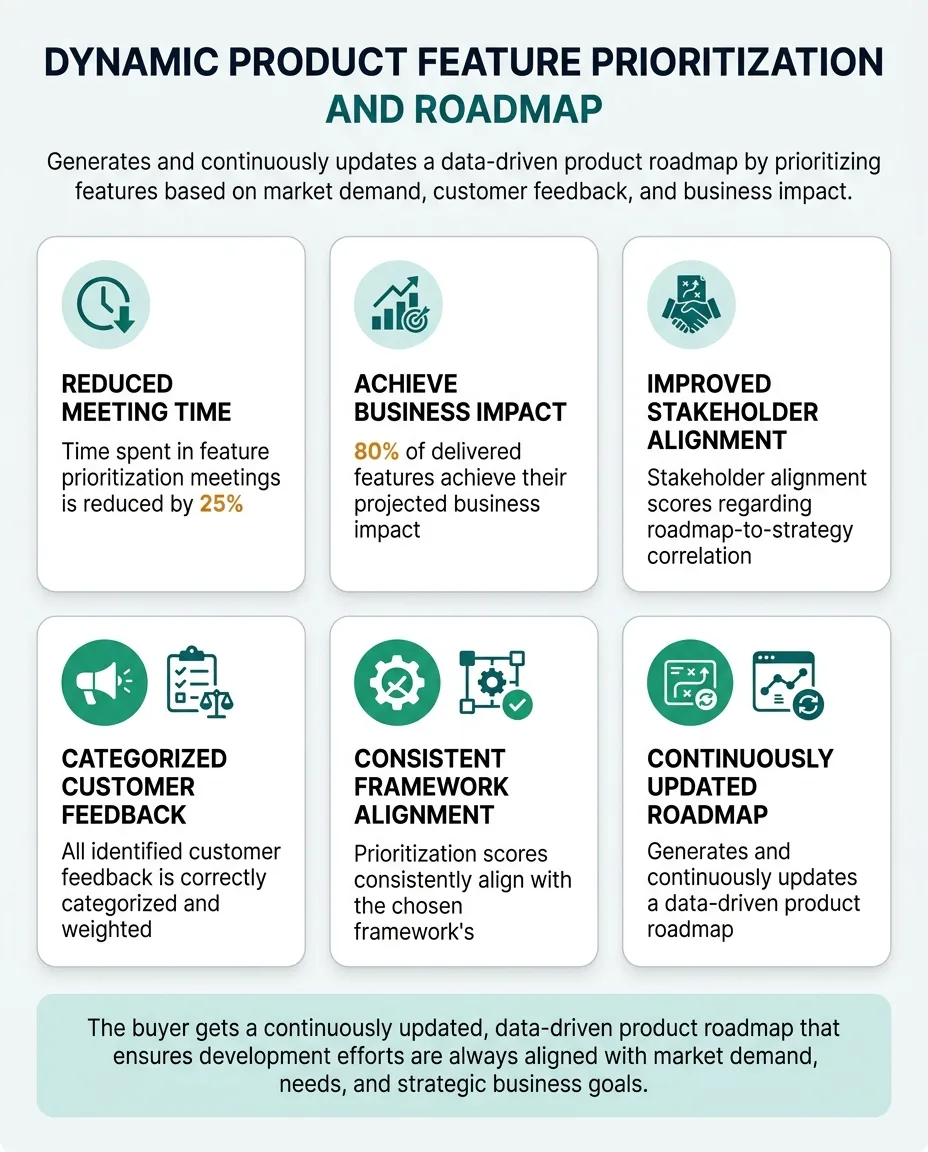
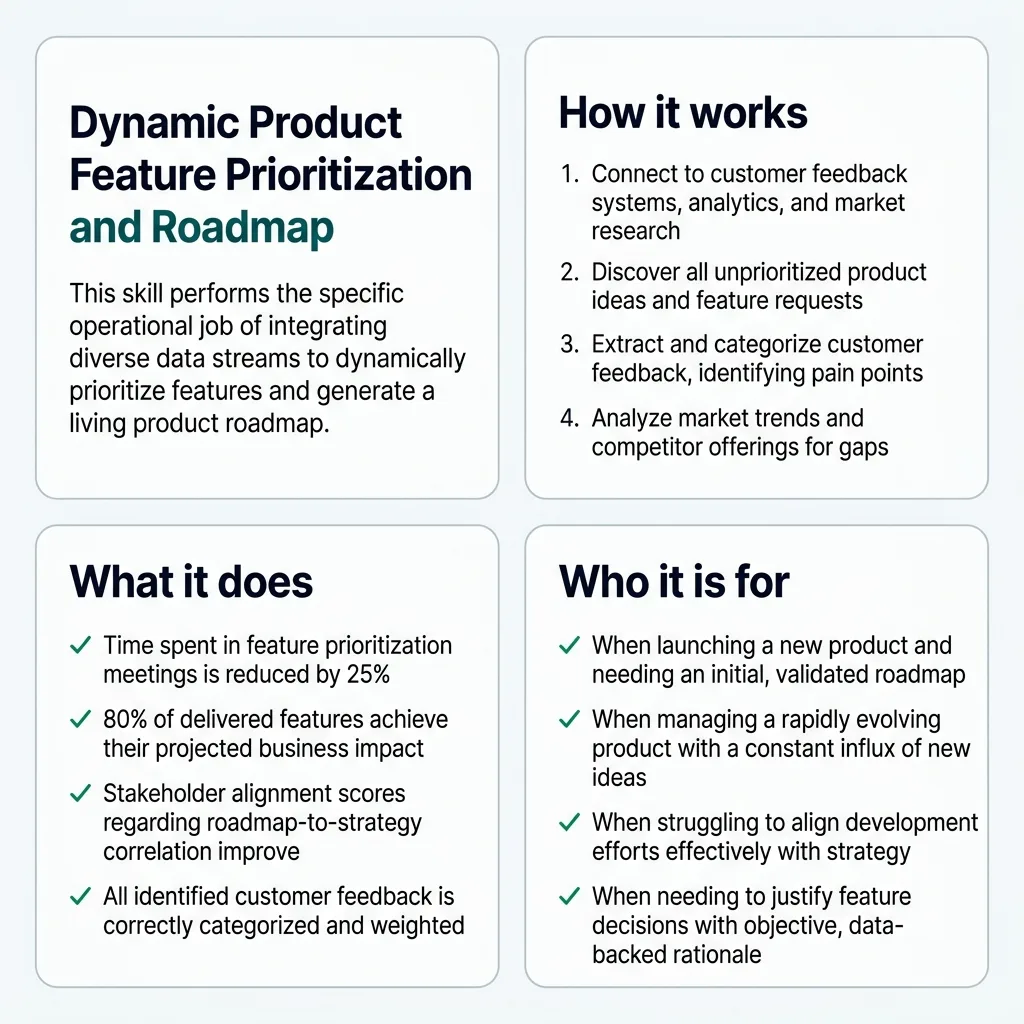
What it doesThe capability grid, for a reader scanning rather than reading.
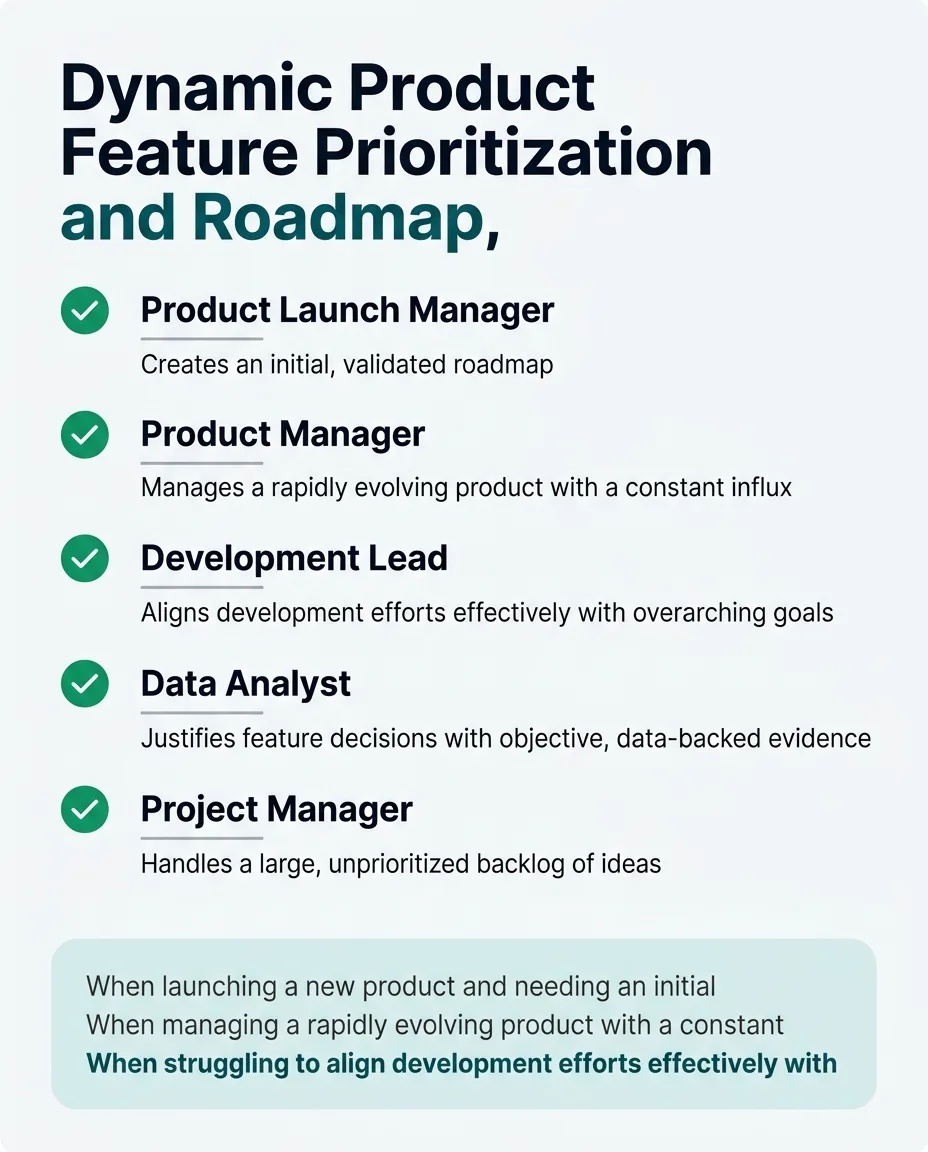
Who it is forLets a reader recognise themselves, which is what decides whether they keep reading.
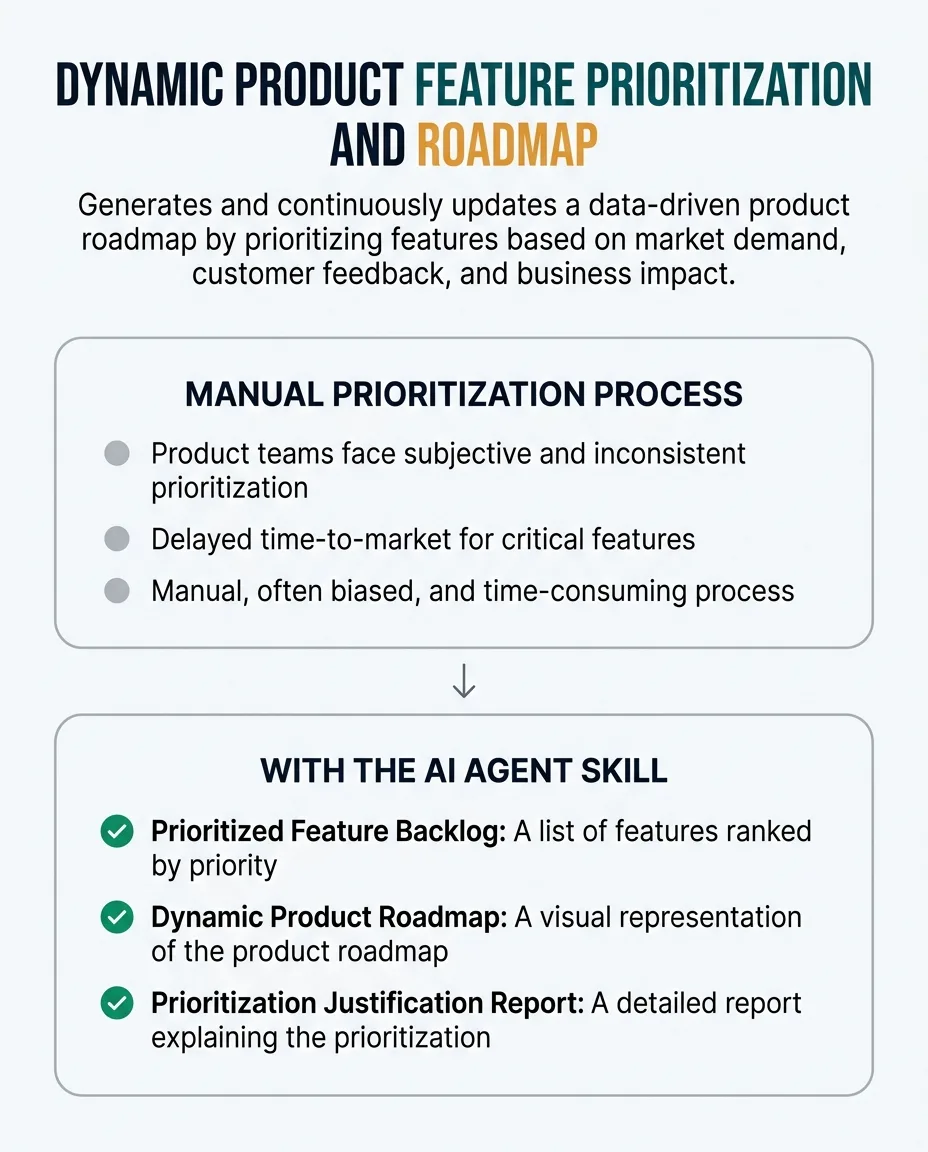
The change it makesContrasts the manual way with the skill, without claiming a measured result.
Summary sheetOne square image that carries the whole story, for a social share or a card.
1 of 6
This skill discovers product ideas, customer feedback, market trends, and competitor features from various connected sources like CRM, support tickets, analytics, and market research tools. It then produces a dynamically prioritized feature backlog and a living product roadmap, complete with estimated impact, effort, and strategic alignment. The skill verifies prioritization decisions against defined business objectives, available data, and chosen prioritization frameworks. This ensures the roadmap is data-informed and strategically sound. It keeps the roadmap current by continuously monitoring new incoming data and automatically re-evaluating priorities, never inventing unverified details and clearly marking any assumptions or unconfirmed data points for human review.
This skill discovers product ideas, customer feedback, market trends, and competitor features from various connected sources like CRM, support tickets, analytics, and market research tools. It then produces a dynamically prioritized feature backlog and a living product roadmap, complete with estimated impact, effort, and strategic alignment. The skill verifies prioritization decisions against defined business objectives, available data, and chosen prioritization frameworks. This ensures the roadmap is data-informed and strategically sound. It keeps the roadmap current by continuously monitoring new incoming data and automatically re-evaluating priorities, never inventing unverified details and clearly marking any assumptions or unconfirmed data points for human review.
The Problem It Removes
Product teams face the recurring pain of subjective and inconsistent feature prioritization, leading to wasted development effort on low-impact features and missed market opportunities. This often results from a lack of consolidated data, bias in decision-making, or an inability to quickly adapt to changing market conditions.
The real cost includes delayed time-to-market for critical features, low customer satisfaction due to misaligned product development, and inefficient resource allocation across engineering teams. These issues directly hinder scalable business growth and competitive advantage.
This skill removes the manual, often biased, and time-consuming process of prioritization by providing a data-driven, continuously updated roadmap. It frees product managers to focus on execution, stakeholder communication, and strategic thinking, rather than constant data gathering and re-prioritization.
Who It Is For
Product managers, product owners, and engineering leads in software companies, startups, and enterprise product divisions.
Especially valuable when:
When launching a new product and needing an initial, validated roadmap based on early market signals.
When managing a rapidly evolving product with a constant influx of new feature requests and changing priorities.
When struggling to align development efforts effectively with overarching strategic business goals.
When needing to justify feature decisions with objective, data-backed evidence to internal and external stakeholders.
When dealing with a large, unprioritized backlog of ideas that is overwhelming the product team.
Why This Price
This skill replaces countless hours of manual data gathering, analysis, and debate that product teams typically spend on feature prioritization. It automates the synthesis of customer feedback, market trends, and internal data, freeing product managers to focus on strategic execution rather than administrative overhead.
The value compounds over time as the skill continuously monitors new information, automatically re-evaluating priorities and keeping your roadmap current. This ensures your product remains aligned with market needs and business objectives, preventing costly missteps and maximizing development ROI.
Beyond generated text, you are paying for a sophisticated, always-on product strategy assistant. It provides a verifiable, data-backed framework for decision-making, reduces subjective bias, and offers a transparent justification for every roadmap item, fostering stakeholder confidence and alignment.
One payment, yours permanently. Download it again at any time and get later versions free.
How It Differs From Similar Skills
While product-manager-toolkit offers general tools and market-sizing-analysis provides market data, this skill performs the specific operational job of integrating diverse data streams to dynamically prioritize features and generate a living product roadmap. It constantly adapts to new information, acting as an active prioritization and roadmap generation engine, rather than just a static report or a collection of templates.
The situation it solves: Product teams face the recurring pain of subjective and inconsistent feature prioritization, leading to wasted development effort on low-impact features and missed market opportunities. This often results from a lack of consolidated data, bias in decision-making, or an inability to quickly adapt to changing market conditions.
When To Use
- When launching a new product and needing an initial, validated roadmap based on early market signals.
- When managing a rapidly evolving product with a constant influx of new feature requests and changing priorities.
- When struggling to align development efforts effectively with overarching strategic business goals.
- When needing to justify feature decisions with objective, data-backed evidence to internal and external stakeholders.
- When dealing with a large, unprioritized backlog of ideas that is overwhelming the product team.
Inputs
Access Credentials: Credentials for CRM, support, analytics, and market research platforms.
Strategic Business Objectives: Clearly defined, measurable business goals the product roadmap should support.
Prioritization Framework: The chosen framework (e.g., RICE, MoSCoW) and its specific definitions/scoring guidelines.
Development Team Capacity: Estimated capacity of the development team for upcoming periods.
Outputs
Prioritized Feature Backlog: A list of features ranked by priority, including estimated impact and effort.
Dynamic Product Roadmap: A visual representation of the product roadmap with timelines, dependencies, and justifications.
Prioritization Justification Report: A detailed report explaining the data, framework, assumptions, and trade-offs behind the prioritization decisions.
How It Works From Start To Finish
1Connect to customer feedback systems, analytics, and market research tools
2Discover all unprioritized product ideas and feature requests
3Extract and categorize customer feedback, identifying pain points and desires
4Analyze market trends and competitor offerings for gaps and opportunities
5Estimate potential business impact (revenue, retention) for each feature
6Estimate development effort and technical feasibility (requires dev team input)
7Apply a customizable prioritization framework (e.g., RICE, MoSCoW)
8Generate a prioritized feature backlog
9Construct a dynamic product roadmap with timelines and dependencies
10Verify prioritization against strategic business objectives
11Present the roadmap with clear justifications for each feature
12Continuously monitor new data sources and re-evaluate priorities
13Alert on significant shifts requiring roadmap adjustments
What you supply
Access credentials for feedback, analytics, and market research platforms
Defined strategic business objectives and product vision
Initial input on development team capacity/effort estimates
What it finds out on its own
Customer feedback from various channels (e.g., surveys, support tickets, app reviews)
Market trends and competitor analysis from public sources or subscribed services
Existing product usage data and analytics (e.g., feature adoption, engagement)
Internal product ideas, technical debt items, and architectural considerations
Current sprint velocity and team capacity (if available from project management tools)
Step By Step
1Connect Data Sources
Connect to specified CRM, support, analytics, and market research platforms using provided credentials.
Done when: All specified data sources are successfully connected and accessible.
If it cannot finish: Report specific connection failure, log the incident, and proceed with available data, clearly noting the missing input.
2Discover and Categorize Product Data
Extract all unprioritized product ideas, feature requests, customer feedback, market trends, and competitor offerings from connected sources.
Done when: All product ideas, feature requests, customer feedback, market trends, and competitor offerings are extracted and categorized.
If it cannot finish: Flag any inaccessible data sources and continue processing with available data, noting the gap.
3Define Prioritization Context
Establish clear, measurable strategic business objectives and explicit definitions/scoring guidelines for the chosen prioritization framework (e.g., RICE, MoSCoW).
Done when: Strategic business objectives are clearly defined, and the chosen prioritization framework has explicit, agreed-upon definitions for its components.
If it cannot finish: Prompt the user for missing business objectives or framework definitions, pausing until provided.
4Estimate Feature Impact and Effort
Estimate potential business impact for each feature, linking it to SMART objectives, and gather preliminary development effort estimates from engineering.
Done when: Each feature has an estimated business impact (linked to SMART objectives) and a preliminary development effort estimate from engineering.
If it cannot finish: If effort estimates are missing or incomplete, prompt the user for input or use default assumptions, clearly stating them in the output.
5Prioritize Features and Generate Roadmap
Apply the chosen prioritization framework to generate a prioritized feature backlog and construct a dynamic product roadmap with timelines and dependencies.
Done when: A dynamically prioritized feature backlog and a living product roadmap with timelines and dependencies are generated.
If it cannot finish: If prioritization logic encounters inconsistencies, flag conflicting data points for human review and suggest reconciliation strategies.
6Verify Roadmap Against Objectives and Constraints
Check the generated roadmap for internal consistency, feasibility within development capacity, alignment with strategic business objectives, and transparently mark all assumptions.
Done when: The generated roadmap is verified for internal consistency, feasibility within capacity, alignment with strategic objectives, and all assumptions are clearly marked.
If it cannot finish: Identify specific inconsistencies (e.g., over-capacity, misaligned feature), report them, and suggest adjustments for user review.
7Present and Document Roadmap
Prepare a comprehensive roadmap presentation detailing the key data points, the applied prioritization framework, strategic objectives addressed, and any significant assumptions or trade-offs.
Done when: A comprehensive roadmap presentation is prepared, detailing data points, framework, objectives, and trade-offs.
If it cannot finish: If critical justification data is missing, flag it and request user input before finalizing the presentation.
8Monitor and Re-evaluate Priorities
Continuously monitor incoming customer feedback, market data, and product usage analytics for significant changes.
Done when: A continuous monitoring system is active, flagging significant changes in customer feedback, market trends, or competitive landscape, triggering re-evaluation.
If it cannot finish: If the monitoring system fails, alert the user and log the incident, recommending manual checks until restored.
How It Checks Its Own Work
Checks before it delivers
Validate that all identified feedback is correctly categorized and weighted according to sentiment and impact.
Cross-reference market insights with multiple reputable sources to ensure accuracy and breadth.
Verify that prioritization scores align with the chosen framework's logic and business objectives.
Check that the generated roadmap is internally consistent, feasible within given constraints, and addresses dependencies.
Confirm that proposed features address identified customer pain points or validated market opportunities.
If something goes wrong
If a data source is inaccessible, report the specific failure, log the incident, and continue with available data, clearly noting the missing input.
If conflicting data points are found (e.g., contradictory feedback), flag them for human review and suggest reconciliation strategies.
If effort estimates are missing or incomplete, prompt the user for input or use default assumptions, clearly stating them in the output.
If a critical business objective changes, pause execution, alert the user for updated guidance, and initiate a re-prioritization cycle.
Mistakes It Prevents
The mistake
What it costs
How the skill prevents it
Prioritizing features based solely on internal stakeholder requests without validating against external customer data or market demand.
Development resources are allocated to features that solve internal problems or personal preferences, leading to low customer adoption, wasted effort, and missed market opportunities.
Require that every high-priority feature has supporting evidence from at least two external data sources, such as customer interviews, usage analytics, or market research, before it is placed on the roadmap.
Generating a roadmap that is technically unfeasible or exceeds the development team's capacity.
The roadmap becomes an aspirational document rather than an actionable plan, leading to constant delays, missed commitments, team burnout, and a loss of trust with stakeholders.
Mandate that all features on the roadmap include a preliminary effort estimate from engineering and that the total estimated effort for any given period does not exceed 80% of the known team capacity.
Using a prioritization framework, such as RICE or MoSCoW, inconsistently or without clear, agreed-upon definitions for its components.
Prioritization scores become arbitrary and indefensible, leading to subjective debates, a lack of transparency, and an inability to objectively compare feature value.
Before prioritization, require explicit definitions and scoring guidelines for each component of the chosen framework, ensuring all team members apply them uniformly, and verify consistency through spot checks.
Failing to establish clear, measurable business objectives against which feature impact can be assessed.
Features are developed without a clear understanding of their intended value, making it impossible to measure success, learn from outcomes, or justify investment.
Insist that every feature considered for the roadmap is linked to at least one specific, measurable, achievable, relevant, and time-bound (SMART) business objective.
Allowing the roadmap to become static, failing to adapt to new information or changing market conditions.
The product loses relevance, competitive advantage erodes, and development efforts continue on features that are no longer optimal, leading to significant opportunity costs.
Implement a continuous monitoring system that automatically flags significant changes in customer feedback, market trends, or competitive landscape, triggering a mandatory re-evaluation of relevant roadmap items.
Presenting a roadmap to stakeholders without transparently explaining the data, assumptions, and trade-offs behind the prioritization decisions.
Stakeholders lack confidence in the product direction, leading to constant challenges, re-litigation of decisions, and difficulty securing necessary resources or buy-in.
Require that every roadmap presentation includes a dedicated section detailing the key data points, the prioritization framework applied, the strategic objectives addressed, and any significant assumptions or trade-offs made.
Edge Cases It Handles
Prioritizing features based solely on internal stakeholder requests without external validation.
Require supporting evidence from at least two external data sources (e.g., customer interviews, usage analytics) for every high-priority feature.
Generating a roadmap that is technically unfeasible or exceeds development capacity.
Mandate preliminary effort estimates from engineering for all features and ensure total estimated effort does not exceed 80% of known team capacity.
Using a prioritization framework inconsistently or without clear definitions.
Require explicit definitions and scoring guidelines for each framework component, verifying uniform application through spot checks.
Failing to establish clear, measurable business objectives for feature impact assessment.
Insist that every feature considered for the roadmap is linked to at least one specific, measurable, achievable, relevant, and time-bound (SMART) business objective.
The roadmap becomes static, failing to adapt to new information or changing market conditions.
Implement a continuous monitoring system that automatically flags significant changes in data, triggering a mandatory re-evaluation of relevant roadmap items.
Presenting a roadmap to stakeholders without transparently explaining data, assumptions, and trade-offs.
Require every roadmap presentation to include a dedicated section detailing key data points, the applied framework, strategic objectives, and any significant assumptions or trade-offs.
Conflicting data points are found (e.g., contradictory customer feedback).
Flag conflicting data for human review and suggest reconciliation strategies, clearly marking the unresolved conflict in the output.
A critical data source becomes inaccessible or provides corrupted data.
Report the specific failure, log the incident, and continue with available data, clearly noting the missing or corrupted input and its potential impact on prioritization.
A Worked Example
A SaaS company, 'InnovateCo', wants to prioritize features for its Q3 product roadmap. They have customer feedback in Zendesk, usage data in Mixpanel, and market research reports. Their strategic objective is to 'Increase user engagement by 15% by end of Q3'. They use the RICE framework.
Input
{"Access Credentials": {"zendesk": {"api_key": "abc"}, "mixpanel": {"project_token": "123"}, "market_research_tool": {"auth_token": "def"}}, "Strategic Business Objectives": ["Increase user engagement by 15% by end of Q3", "Reduce churn by 5% in Q3"], "Prioritization Framework": {"name": "RICE", "reach_definition": "Number of active users impacted per month", "impact_scale": "1 (minimal) to 5 (massive)", "confidence_scale": "1 (low) to 100 (high) percent", "effort_scale": "1 (days) to 10 (months)"}, "Development Team Capacity": {"Q3": "100 story points"}}
Expected output
{"prioritized_backlog": [{"feature": "In-app tutorial for new users", "RICE_score": 250, "impact": "High", "effort": "Medium"}, {"feature": "Advanced analytics dashboard", "RICE_score": 180, "impact": "Medium", "effort": "High"}, {"feature": "Integrate with Slack for notifications", "RICE_score": 120, "impact": "Medium", "effort": "Medium"}, {"feature": "Customizable reporting module", "RICE_score": 90, "impact": "Low", "effort": "High"}], "roadmap_summary": "Q3 roadmap focuses on user engagement and onboarding. Key features: In-app tutorial (July), Slack integration (August), Advanced analytics (September). Customizable reporting deferred to Q4 due to lower RICE score and high effort.", "justification_report_excerpt": "The 'In-app tutorial' feature scored highest (RICE: 250) due to high reach (all new users), high impact on engagement (customer feedback indicates onboarding friction), and medium effort. It directly supports the 'Increase user engagement' objective. Development effort for 'Advanced analytics dashboard' is high, pushing it later in Q3, despite medium impact. All effort estimates provided by engineering lead. Assumptions: 1.5x increase in tutorial completion leads to 5% increase in 30-day retention."}
Why this output: The output prioritizes features based on the RICE framework, aligning with the 'Increase user engagement' objective. The 'In-app tutorial' is prioritized first due to its high RICE score, directly addressing customer feedback on onboarding. Features with lower scores or higher effort are placed later or deferred, ensuring the roadmap fits within the Q3 capacity. The justification report transparently explains the scores, data sources, and assumptions, addressing potential stakeholder questions.
Keeping It Current And Knowing Its Limits
Keeping it current
Continuously monitors incoming customer feedback, market data, and product usage analytics, automatically re-running the prioritization engine and suggesting updates to the product roadmap as new information becomes available, ensuring its ongoing relevance.
What it will not do
It will not invent customer feedback, market data, or development effort estimates; all inputs must be verifiable or provided.
It cannot directly execute development tasks, make hiring decisions, or manage engineering teams.
It requires explicit access to all designated data sources and relies on human input for effort estimates and high-level strategic guidance.
It will never invent unverified details, marking any assumptions or unconfirmed data points clearly for review.
Limitations
- Access credentials for feedback, analytics, and market research platforms are provided and valid.
- Defined strategic business objectives and a clear product vision are available as foundational guidance.
- Initial input on development team capacity and effort estimates can be obtained from engineering teams.
- The user has the necessary permissions to access all designated data sources for discovery and monitoring.
This skill requires access to sensitive business data, including customer feedback, usage analytics, and potentially proprietary market research. Ensure that the provided API keys and tokens have the minimum necessary permissions to perform their functions.
The skill makes outbound network requests to various third-party platforms. Review the specific endpoints accessed to ensure compliance with your organization's security policies.
The skill processes and generates strategic product roadmap information. Protect the output as it may contain sensitive business plans.
Questions People Ask
How does this skill ensure the roadmap is data-driven?
It connects to your CRM, analytics, and market research tools to gather real-time data on customer feedback, usage patterns, and market trends. All prioritization decisions are explicitly linked to this verifiable data and defined business objectives.
Can this skill integrate with my existing project management tools?
While it generates the roadmap and backlog, direct integration for task management is not within its scope. You can export the prioritized backlog and roadmap summary to import into your project management system.
What happens if my strategic objectives change?
The skill is designed for continuous adaptation. If your strategic objectives are updated, you can re-run the prioritization process with the new objectives, and the roadmap will be re-evaluated and adjusted accordingly.
Does it invent feature ideas or market data?
No, the skill explicitly states it will not invent any unverified details. All product ideas, customer feedback, and market data must come from connected, verifiable sources or be provided by the user. Any assumptions are clearly marked.
What people say, and where to get help
No ratings yet. If you have used this skill, yours would be the first.
Sign in to leave a rating
An account keeps your review with your name on it, and lets you edit it later.
Sign in
or create one free.
No reviews yet
This skill has not been rated. If you have run it, a short note about what you used it
for helps the next person more than any description can.
Related Skills You May Like
Discover more AI agent skills in the same category to enhance your workflow automation.
Expert in building and selling Notion templates as a sustainable digital product business, covering design, pricing, marketing, and scaling for real revenue.
Enables real-time, bidirectional voice conversations with AI assistants in Java applications using the Azure AI VoiceLive SDK and WebSocket technology.