

Craft portfolios that convert visitors into opportunities by showcasing work and creating memorable experiences for developers, designers, and creatives.
Premium skill
Automated AI Product Analytics & UX Metric Validator
Images of Automated AI Product Analytics & UX Metric Validator
-
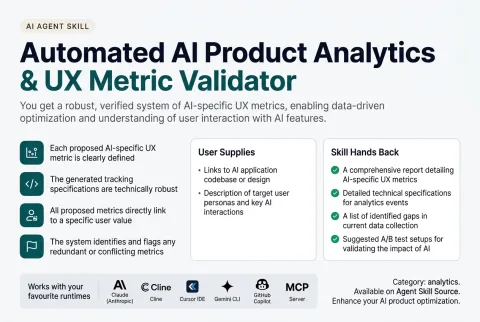
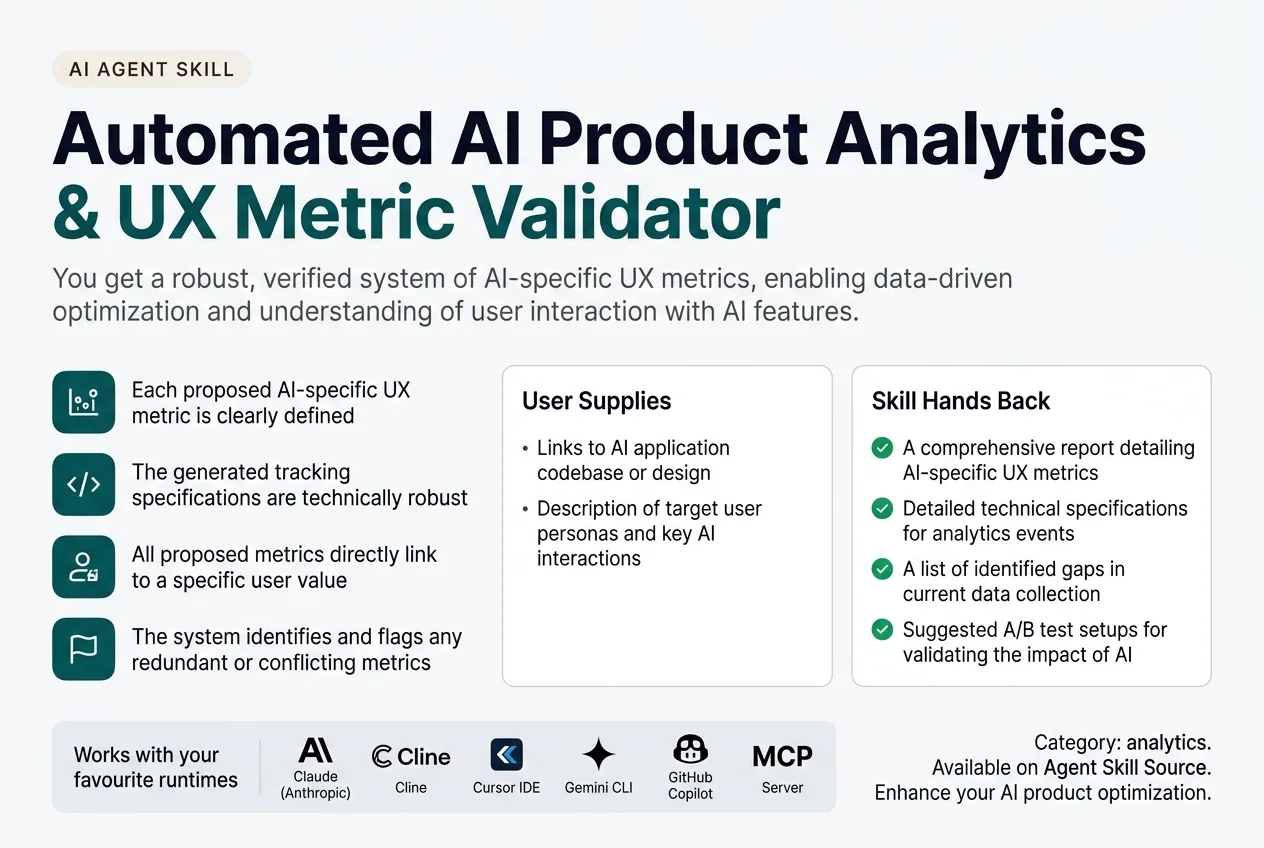
Featured image The one image that represents the skill in the gallery and in a social share. -
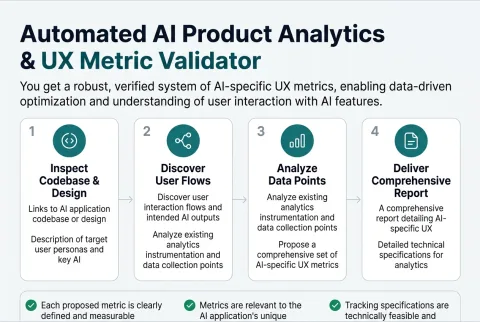
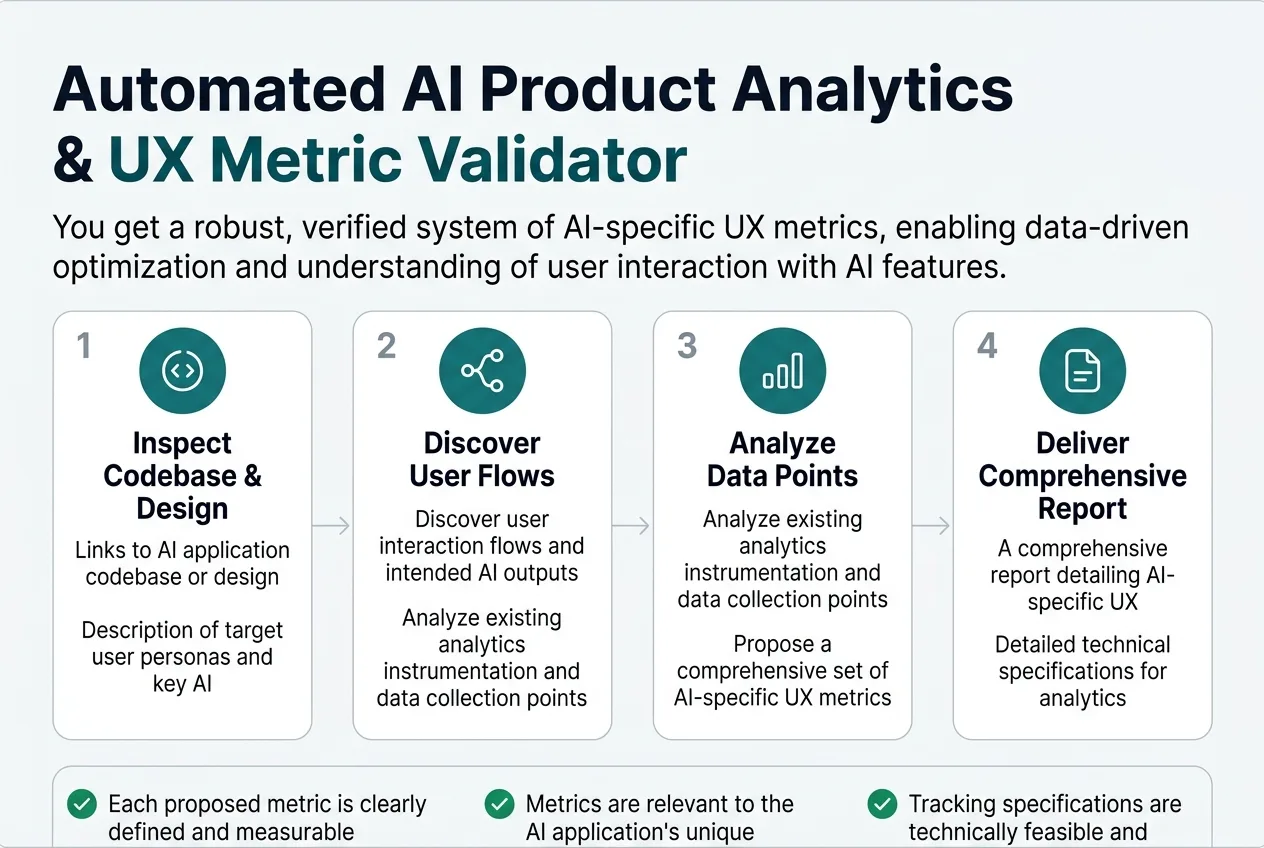
How it works Shows the path from what the user supplies to what they get back. -
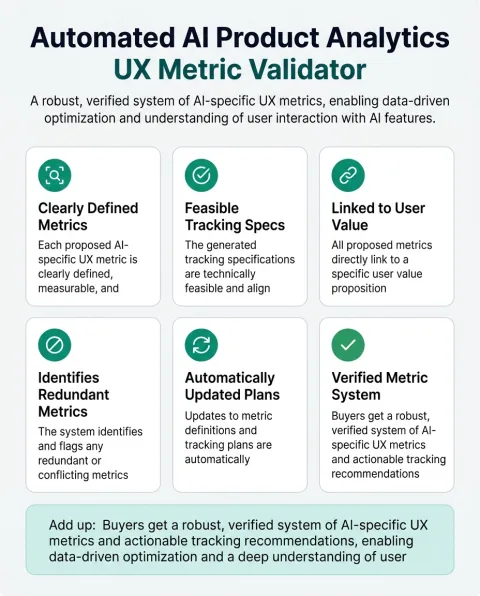
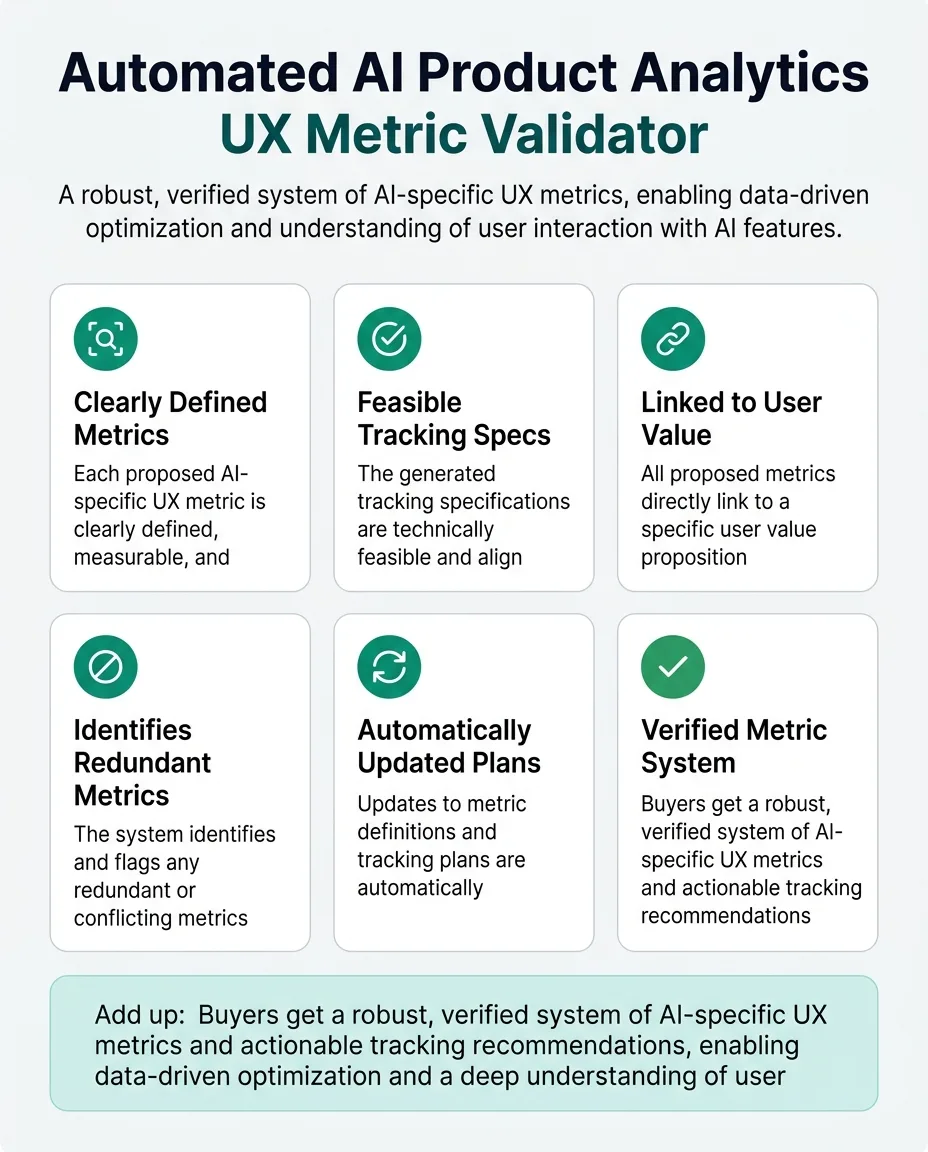
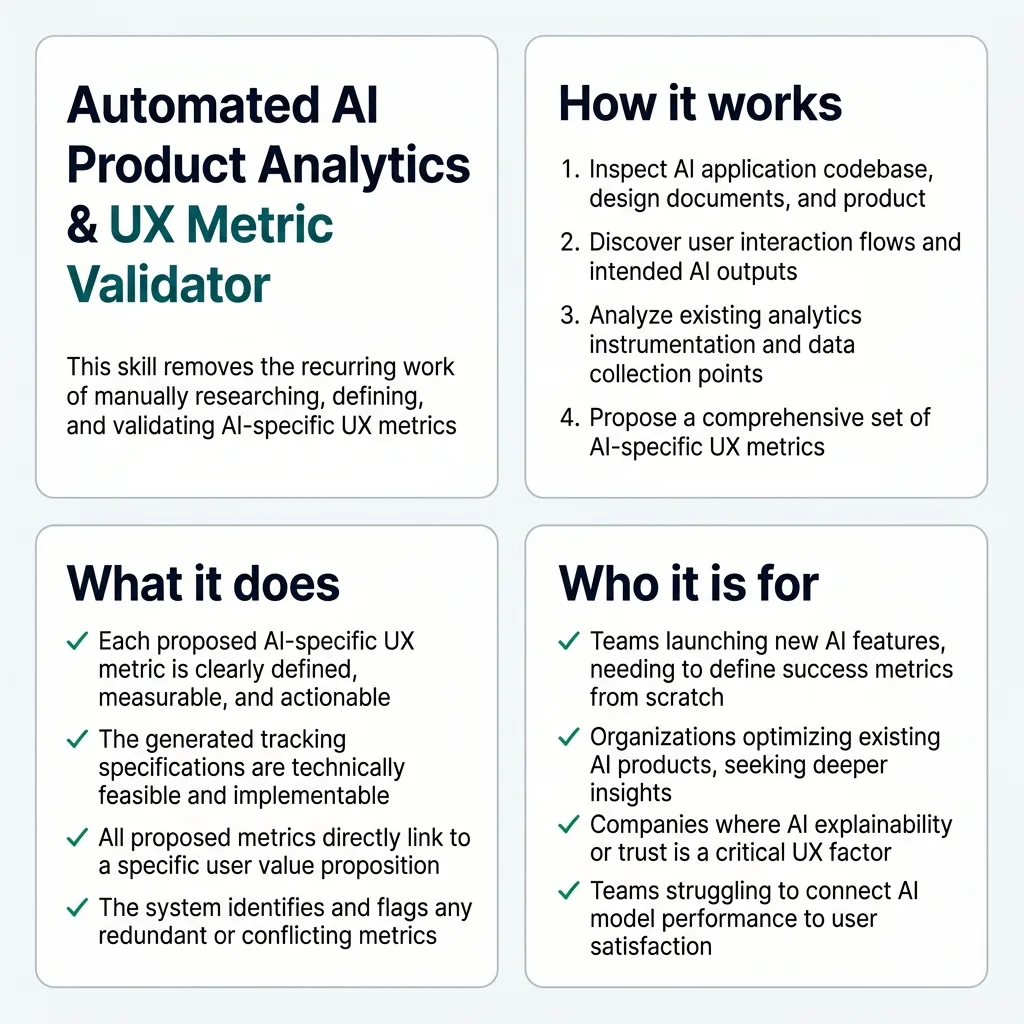
What it does The capability grid, for a reader scanning rather than reading. -
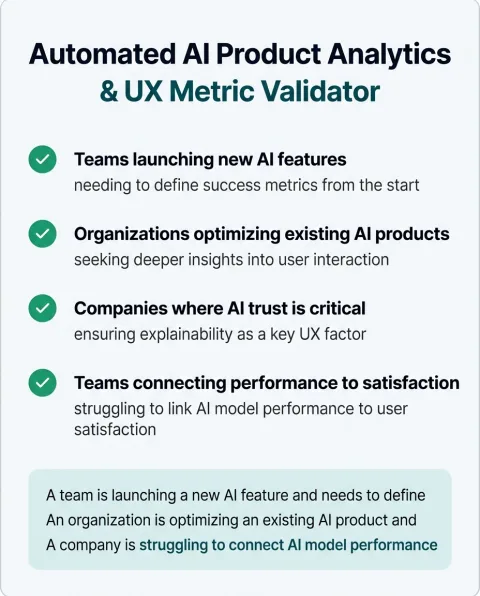
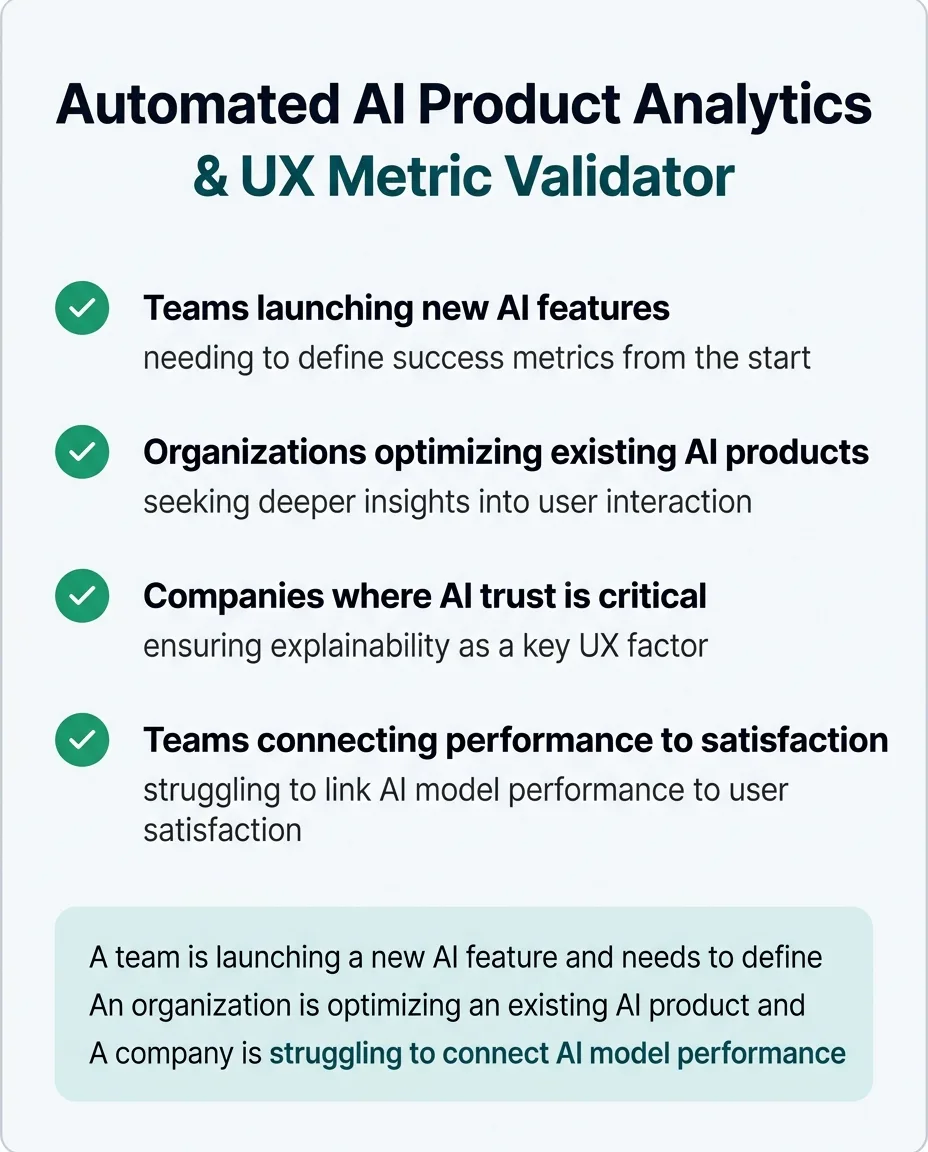
Who it is for Lets a reader recognise themselves, which is what decides whether they keep reading. -
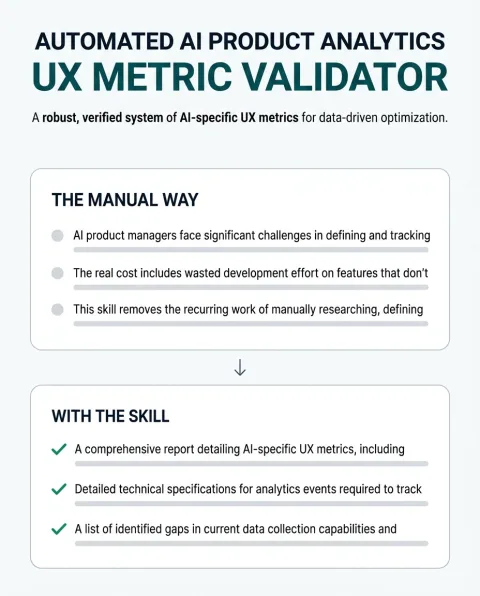
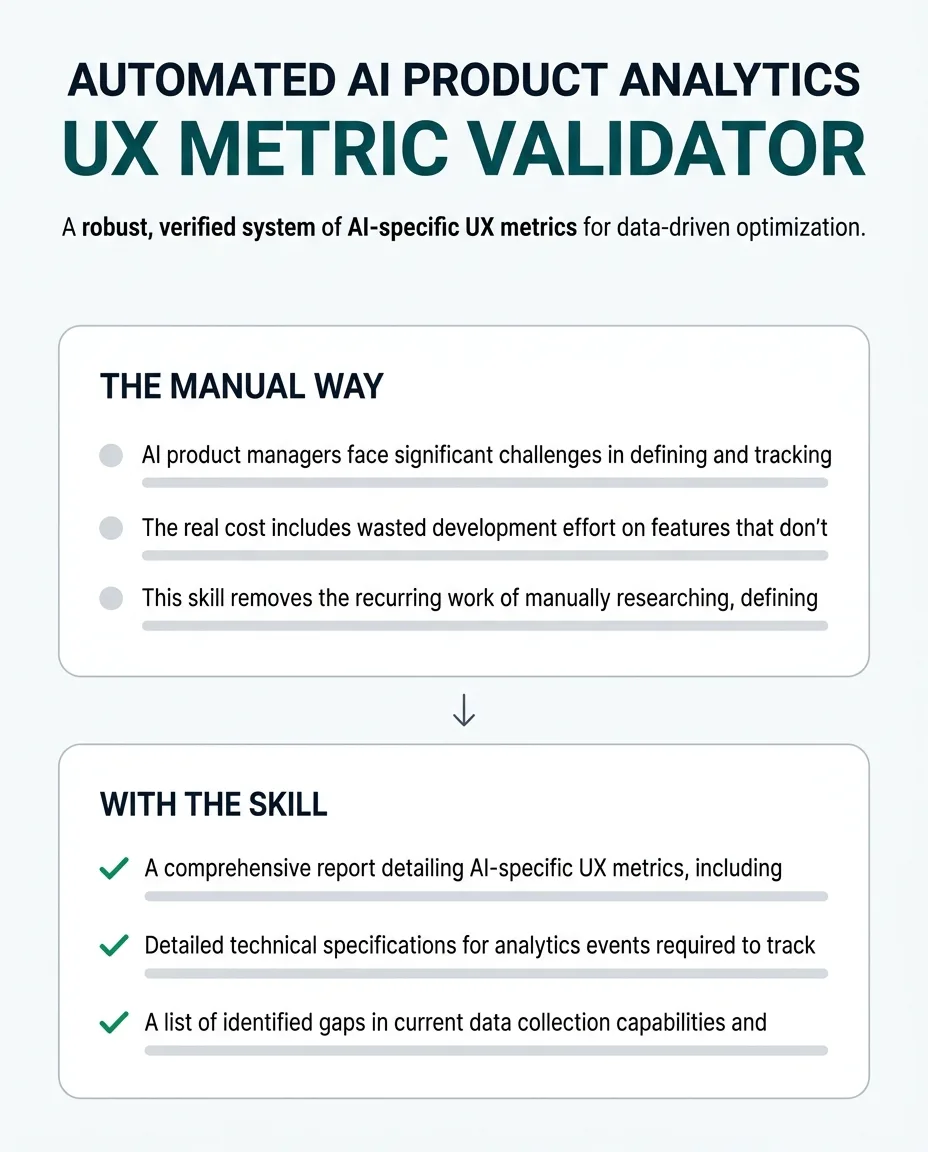
The change it makes Contrasts the manual way with the skill, without claiming a measured result. -
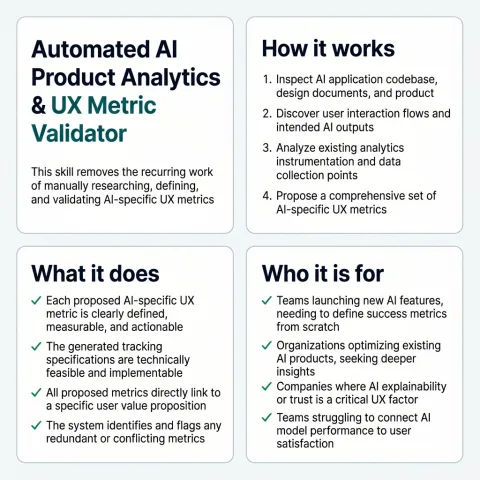
Summary sheet One square image that carries the whole story, for a social share or a card.
This skill discovers the AI application's user interaction flows, intended outputs, and existing analytics instrumentation from codebases, design documents, and product specifications. It analyzes these to understand the unique UX challenges and opportunities of the AI. It produces a comprehensive set of AI-specific UX metrics, including definitions, measurement methodologies, and suggested tracking events. These metrics capture AI model confidence, explainability, personalization, and interaction patterns with generative outputs. The skill verifies the proposed metrics against the current analytics setup, identifying gaps in data collection capabilities, and validates if the metrics truly reflect the intended user experience and business value of the AI features.
See the Automated AI Product Analytics & UX Metric Validator in action
Provide your AI application's context
You provide links to your AI application's codebase and design documents, along with descriptions of target user personas and key AI features. For example: codebase_links: 'https://github.com/content-ai/generator', design_spec_links: 'https://miro.com/app/board/content-ai-ux', user_personas_description: 'Marketing content creators who need to quickly generate drafts and refine them with AI assistance.', key_ai_features_description: 'Generates blog post drafts, suggests rephrasing, and offers tone adjustments. Users can accept/reject suggestions and edit generated text.'
Validating metrics for relevance and feasibility
The skill checks that each proposed metric is clearly defined and measurable. It verifies metrics are relevant to the AI application's unique interaction patterns. Tracking specifications are checked for technical feasibility and alignment with existing analytics. Metrics must directly link to user value or business objectives. The skill ensures no redundant or conflicting metrics are proposed. Gaps in data collection are clearly identified with actionable recommendations.
A comprehensive report with AI-specific UX metrics and tracking specifications
You receive a comprehensive report detailing AI-specific UX metrics, including definitions, measurement methodologies, success criteria, and prioritization. Detailed technical specifications for analytics events are provided, aligned with existing infrastructure. A list of identified data collection gaps and actionable recommendations for their resolution is also included. For example, a report might include metrics like 'Suggestion Acceptance Rate' (percentage of AI suggestions accepted), 'AI Edit Efficiency' (time to edit AI-generated drafts), and 'Explainability Usage' (frequency of 'Why this suggestion?' clicks), along with their definitions, measurement, and success criteria.
The output below is an example from the skill definition.
- Runs in
- Claude (Anthropic), OpenAI Codex, GitHub Copilot, Cursor IDE
- How it runs
- MCP Backed
- Licence
- One time purchase
- What ships
- SKILL.md and 1 supporting file, README, licence
What It Does
This skill discovers the AI application's user interaction flows, intended outputs, and existing analytics instrumentation from codebases, design documents, and product specifications. It analyzes these to understand the unique UX challenges and opportunities of the AI. It produces a comprehensive set of AI-specific UX metrics, including definitions, measurement methodologies, and suggested tracking events. These metrics capture AI model confidence, explainability, personalization, and interaction patterns with generative outputs. The skill verifies the proposed metrics against the current analytics setup, identifying gaps in data collection capabilities, and validates if the metrics truly reflect the intended user experience and business value of the AI features.
The Problem It Removes
AI product managers face significant challenges in defining and tracking meaningful UX metrics for AI applications. Standard UX metrics often fail to capture the unique aspects of AI interactions, leading to misinterpretation of user behavior, suboptimal product iterations, and difficulty in demonstrating AI value.
The real cost includes wasted development effort on features that don't improve the user experience, delayed product improvements due to unclear performance signals, and a lack of data-driven decision-making for AI features. This also leads to a disconnect between AI model performance and actual user satisfaction.
This skill removes the recurring work of manually researching, defining, and validating AI-specific UX metrics. It ensures that product managers have a robust, verified system for understanding how users interact with and perceive the AI, enabling faster, more effective product iterations.
Who It Is For
This skill is for AI Product Managers, UX Researchers, and Data Analysts in companies building AI-driven products.
Especially valuable when:
- Teams launching new AI features, needing to define success metrics from the outset.
- Organizations optimizing existing AI products, seeking deeper insights into user interaction.
- Companies where AI explainability or trust is a critical UX factor.
- Teams struggling to connect AI model performance to user satisfaction.
- Environments with complex AI-human interaction patterns, such as conversational AI.
- Startups needing to quickly establish a data-driven approach to AI product development.
Why This Price
AI product managers face a recurring challenge in defining and tracking meaningful UX metrics for AI applications, often leading to misinterpretation of user behavior and suboptimal product iterations. This skill removes the significant, ongoing manual effort of researching, defining, and validating AI-specific UX metrics, which can take days or weeks for each new feature or product iteration.
The value compounds as the skill continuously monitors your application for changes, ensuring your metrics remain relevant and accurate over time, preventing reliance on stale data that leads to flawed decisions. It acts as an always-on analytics consultant, adapting to your product's evolution without additional manual intervention.
Buyers are paying for a robust, verified system that provides actionable, data-driven insights specifically tailored for AI products. This goes beyond simple text generation; it's about establishing a foundational analytics strategy that directly impacts product success, user satisfaction, and the ability to demonstrate the true business value of AI features. It prevents costly mistakes from tracking irrelevant metrics and accelerates product development cycles.
One payment, yours permanently. Download it again at any time and get later versions free.
How It Differs From Similar Skills
kpi-dashboard-design focuses on dashboard creation, not the fundamental definition and validation of AI-specific UX metrics. analytics-tracking is a generic tracking skill, lacking the AI-specific context and validation.
llm-evaluation focuses on model performance, not the user experience of the application integrating the LLM. This skill bridges the gap between model output and user perception, providing an operational job of defining and validating the human-AI interaction.
When To Use
- A team is launching a new AI feature and needs to define clear success metrics from the outset.
- An organization is optimizing an existing AI product and seeks deeper insights into unique user interaction patterns.
- A company is struggling to connect AI model performance metrics directly to actual user satisfaction and product value.
- A team is working in an environment where AI explainability or user trust is a critical factor for user adoption and retention.
- A startup needs to quickly establish a data-driven approach to AI product development without extensive manual research.
Inputs
codebase_links: Links to the AI application's source code repositories.
design_spec_links: Links to design documents, wireframes, or product specifications for the AI application.
user_personas_description: A description of the target user personas for the AI application.
key_ai_features_description: A description of the core AI features and their intended user interactions.
Outputs
ai_ux_metrics_report: A comprehensive report detailing AI-specific UX metrics, including definitions, measurement methodologies, success criteria, and prioritization.
tracking_specifications: Detailed technical specifications for analytics events required to track the proposed metrics, aligned with existing analytics infrastructure.
data_collection_gaps_recommendations: A list of identified gaps in current data collection capabilities and actionable recommendations for their resolution.
ab_test_setups: Suggested A/B test setups for validating the impact of AI features based on the defined metrics.
How It Works From Start To Finish
- Inspect AI application codebase, design documents, and product specifications
- Discover user interaction flows and intended AI outputs
- Analyze existing analytics instrumentation and data collection points
- Propose a comprehensive set of AI-specific UX metrics (e.g., confidence interaction rate, explainability usage)
- Define measurement methodologies and success criteria for each metric
- Generate detailed tracking specifications for analytics events
- Validate proposed metrics against intended user experience and business value
- Verify if existing analytics infrastructure can capture all proposed metrics
- Identify gaps in data collection and suggest implementation steps
- Generate A/B test setups for validating metric impact
- Open a pull request or update documentation with metric definitions and tracking plans
- Monitor application changes and suggest updates to metric definitions
What you supply
- Links to AI application codebase or design specifications
- Description of target user personas and key AI features
What it finds out on its own
- User interface components and interaction patterns
- AI model inputs, outputs, and confidence scores
- Existing analytics events and data schemas
- Product documentation outlining user journeys
- A/B testing frameworks in use
Step By Step
-
Discover AI Application Context
Inspect AI application codebase, design documents, and product specifications.
Done when: User interaction flows, intended AI outputs, and existing analytics instrumentation are documented.
If it cannot finish: Request missing documentation or codebase access, marking related insights as inferred.
-
Analyze Existing Analytics
Analyze existing analytics instrumentation and data collection points.
Done when: A comprehensive understanding of current data collection capabilities and limitations is established.
If it cannot finish: Report inability to fully audit existing setup and proceed with assumptions, flagging potential gaps.
-
Propose AI-Specific UX Metrics
Generate a comprehensive set of AI-specific UX metrics, including definitions, measurement methodologies, and suggested tracking events, accounting for AI model confidence, explainability, and generative outputs.
Done when: A detailed list of AI-specific UX metrics with clear definitions and measurement strategies is produced.
If it cannot finish: Request clarification on AI application's core purpose or user personas if metric generation is ambiguous.
-
Validate Metrics for Relevance and Feasibility
Verify if proposed metrics reflect the intended user experience and business value, and if the existing analytics infrastructure can capture them.
Done when: Each metric is confirmed to be relevant, valuable, and technically feasible to track, or gaps are clearly identified.
If it cannot finish: Flag metrics that are not trackable or do not align with user value, providing reasons and alternative suggestions.
-
Generate Tracking Specifications
Produce detailed tracking specifications for analytics events based on the validated metrics.
Done when: A complete set of tracking specifications, including event names, properties, and triggers, is generated.
If it cannot finish: Report inability to generate specifications for metrics lacking clear tracking paths, requesting further input.
-
Identify Gaps and Recommend Actions
Identify gaps in data collection capabilities and suggest concrete implementation steps to address them.
Done when: A prioritized list of data collection gaps and actionable recommendations for their resolution is provided.
If it cannot finish: Report if no actionable recommendations can be formed due to severe infrastructure limitations.
-
Document and Propose Updates
Generate documentation with metric definitions, tracking plans, and suggested A/B test setups, then propose updates (e.g., via pull request or documentation update).
Done when: Metric definitions, tracking plans, and A/B test setups are documented and proposed for integration.
If it cannot finish: Report if integration into existing systems (e.g., PR creation) is not possible due to permission issues.
How It Checks Its Own Work
Checks before it delivers
- Each proposed metric is clearly defined and measurable.
- Metrics are relevant to the AI application's unique interaction patterns.
- Tracking specifications are technically feasible and align with existing analytics.
- Metrics directly link to user value or business objectives.
- No redundant or conflicting metrics are proposed.
- Gaps in data collection are clearly identified with actionable recommendations.
If something goes wrong
- If design documents are unavailable, it proceeds with codebase analysis, marking design-related insights as inferred or unverified.
- If existing analytics infrastructure cannot support a key metric, it flags the metric as un-trackable and suggests necessary infrastructure changes.
- If user interaction patterns are ambiguous, it highlights the ambiguity and requests clarification, providing multiple metric options.
- If the AI application's purpose is unclear, it requests a product vision statement to align metric suggestions.
Mistakes It Prevents
| The mistake | What it costs | How the skill prevents it |
|---|---|---|
| Applying traditional UX metrics (e.g., click-through rate, time on page) directly to AI interactions without adaptation. | Misinterpretation of user behavior, as these metrics fail to capture unique AI aspects like model confidence, explainability, or interaction with generative outputs, leading to suboptimal product iterations. | Each proposed metric must explicitly define how it accounts for AI-specific interaction patterns and be validated against the AI application's unique user journey. |
| Defining AI-specific metrics without verifying if the existing analytics infrastructure can actually capture the necessary data points. | Significant development effort wasted on defining metrics that cannot be tracked, resulting in a lack of actionable data and delayed product insights. | A technical audit of the current analytics setup must be performed to confirm the feasibility of tracking each proposed event and data point before finalization. |
| Creating metrics that measure AI model performance (e.g., accuracy, F1 score) but do not directly reflect the user's experience or business value. | A disconnect between technical AI performance and actual user satisfaction, leading to features that perform well technically but fail to deliver user value or business impact. | Each metric must be explicitly linked to a user value proposition or a specific business objective, demonstrating how its improvement translates to a better user outcome or business result. |
| Allowing AI-specific UX metric definitions and tracking plans to become outdated as the AI application's features or user interaction patterns evolve. | Relying on stale data that no longer accurately reflects the current product, leading to flawed decision-making and a loss of trust in the analytics system. | Implement a continuous monitoring process that automatically re-evaluates metric relevance and measurability whenever changes are detected in the codebase or design specifications. |
| Proposing a large number of metrics without clear prioritization or understanding of their relative importance. | Overwhelm for product teams, diluted focus, and difficulty in identifying the most impactful areas for improvement, leading to analysis paralysis. | Each metric must be categorized by its impact on core user journeys or business objectives, and a clear hierarchy or prioritization scheme must be provided. |
| Failing to define clear success criteria or thresholds for AI-specific UX metrics. | Metrics become observational rather than actionable, making it difficult to determine if a feature is performing well or poorly, and hindering data-driven decision-making. | For each key metric, establish a baseline, target, or range that signifies successful performance, ideally linked to A/B test setups or product goals. |
Edge Cases It Handles
- AI application has no existing analytics instrumentation.
- The skill will propose a complete greenfield analytics tracking plan, highlighting the need for initial setup.
- Design documents are outdated or incomplete.
- The skill will prioritize insights from the codebase and user persona descriptions, marking design-related metric suggestions as inferred or requiring human validation.
- Existing analytics infrastructure uses a proprietary or unsupported system.
- The skill will generate tracking specifications in a generic format (e.g., JSON schema) and flag the need for manual adaptation to the proprietary system.
- User interaction patterns with the AI are highly ambiguous or experimental.
- The skill will propose multiple alternative metrics and measurement approaches, highlighting the ambiguity and recommending A/B testing to determine the most relevant ones.
- The AI application's core purpose or business value is not clearly articulated.
- The skill will request a clear product vision statement or business objectives to ensure metrics are aligned with strategic goals, providing generic suggestions in the interim.
- Proposed metrics conflict with existing, established organizational KPIs.
- The skill will identify the conflicts and provide a rationale for the AI-specific metrics, suggesting a review process to reconcile or differentiate them.
- The codebase is too large or complex for a full automated scan.
- The skill will focus on key modules identified by the user or through initial analysis, flagging areas that could not be fully inspected and their potential impact on metric coverage.
- No A/B testing framework is detected in the environment.
- The skill will still generate A/B test setups but will explicitly state that manual implementation or a new framework setup is required.
A Worked Example
A startup is launching a new AI-powered content generation tool for marketing teams. They need to define UX metrics to understand how users interact with the generated content and the AI's suggestions, beyond just content quality.
Input
codebase_links: 'https://github.com/content-ai/generator', design_spec_links: 'https://miro.com/app/board/content-ai-ux', user_personas_description: 'Marketing content creators who need to quickly generate drafts and refine them with AI assistance.', key_ai_features_description: 'Generates blog post drafts, suggests rephrasing, and offers tone adjustments. Users can accept/reject suggestions and edit generated text.'Expected output
AI UX Metrics Report:
- Metric: 'Suggestion Acceptance Rate'
 - Definition: Percentage of AI-generated rephrasing or tone adjustment suggestions accepted by the user.
 - Measurement: Track 'suggestion_accepted' event.
 - Success Criteria: >70% acceptance rate indicates high relevance.
- Metric: 'AI Edit Efficiency'
 - Definition: Time taken by user to edit an AI-generated draft compared to a human-written draft (baseline).
 - Measurement: Track 'draft_edit_start' and 'draft_edit_end' events, categorize by AI/human origin.
 - Success Criteria: AI-generated drafts reduce edit time by 20%.
- Metric: 'Explainability Usage'
 - Definition: Frequency with which users click on 'Why this suggestion?' feature.
 - Measurement: Track 'explainability_clicked' event.
 - Success Criteria: >15% usage indicates value in transparency.
Tracking Specifications (JSON):
{ 'events': [ { 'name': 'suggestion_accepted', 'properties': { 'suggestion_type': 'rephrase|tone', 'content_id': 'uuid' } }, { 'name': 'draft_edit_start', 'properties': { 'draft_origin': 'ai|human', 'content_id': 'uuid' } }, { 'name': 'draft_edit_end', 'properties': { 'draft_origin': 'ai|human', 'content_id': 'uuid', 'edit_duration_seconds': 'number' } }, { 'name': 'explainability_clicked', 'properties': { 'suggestion_id': 'uuid', 'content_id': 'uuid' } } ] }
Data Collection Gaps & Recommendations:
- Gap: No existing event for 'suggestion_accepted'. Recommendation: Implement 'suggestion_accepted' event with 'suggestion_type' and 'content_id' properties.
- Gap: No clear way to differentiate AI-generated vs. human-written drafts in current tracking. Recommendation: Add 'draft_origin' property to 'draft_edit_start' and 'draft_edit_end' events.
A/B Test Setups:
- Test: Impact of improved AI suggestion quality on 'Suggestion Acceptance Rate'.
- Test: Effect of enhanced explainability UI on 'Explainability Usage'.
Why this output: The output provides specific, measurable metrics that go beyond generic content quality, focusing on the unique human-AI interaction patterns of accepting suggestions, editing AI output, and seeking explanations. It defines how to measure these, identifies where current tracking falls short, and suggests concrete steps to implement the necessary data collection, directly addressing the problem of understanding AI-specific UX.
Keeping It Current And Knowing Its Limits
Keeping it current
The skill continuously monitors the AI application's codebase and design specifications for changes in features or user interaction patterns. Upon detecting updates, it re-evaluates the relevance and measurability of existing UX metrics, flags outdated definitions, and suggests necessary adjustments to the tracking plan.
What it will not do
- It will not implement analytics code or make design changes to the UI.
- It cannot predict future user behavior, only define metrics to measure it.
- It never invents unverified details, always flagging them for human review.
Limitations
Installation
Copy to ~/.claude/skills/Configure in API settingsAdd to Copilot workspace settingsAdd to .cursor/skills/Add to .vscode/skills/Add to Cline skills directoryConfigure in .aider.conf.ymlAdd to Windsurf skillsAdd to ~/.gemini/skills/Register as MCP toolBefore You Run It
Security notes
- This skill requires read access to your AI application's codebase and design documents, which may contain sensitive intellectual property.
- It also requires network outbound access to fetch these resources and potentially to propose updates to documentation systems or version control (e.g., GitHub).
- Ensure that the environment where this skill runs has appropriate access controls and that any provided API tokens or credentials have the minimum necessary permissions.
Questions People Ask
How does this skill differ from traditional UX analytics tools?
Traditional tools often fall short in capturing the unique nuances of AI interactions, such as model confidence, explainability, and engagement with generative outputs. This skill specifically designs and validates metrics that account for these AI-specific aspects, providing deeper, more relevant insights.
What if my AI application has no existing analytics setup?
The skill is designed to handle greenfield scenarios. It will propose a complete, tailored analytics tracking plan from scratch, outlining all necessary events and data points for your AI features.
Can this skill integrate with my existing analytics platform?
Yes, the skill analyzes your current analytics infrastructure to generate tracking specifications that align with your existing setup. If your system is proprietary, it will provide generic specifications and flag the need for manual adaptation.
How does the skill ensure the metrics are actually valuable?
Each proposed metric is rigorously validated against your AI application's intended user experience and business objectives. The skill explicitly links metric improvements to user value or business impact, ensuring you track what truly matters.
Is my codebase and design documentation secure when used with this skill?
The skill requires read access to these resources for analysis. It operates within a secure environment, and any sensitive information is processed locally or through secure, ephemeral connections. Always ensure you understand and approve the access permissions granted.
Why AI product managers struggle with UX metrics
AI product managers face significant challenges in defining and tracking meaningful UX metrics for AI applications. Standard UX metrics often fail to capture the unique aspects of AI interactions, leading to misinterpretation of user behavior, suboptimal product iterations, and difficulty in demonstrating AI value.
The real cost includes wasted development effort on features that don't improve the user experience, delayed product improvements due to unclear performance signals, and a lack of data-driven decision-making for AI features.
- Initial
Standard metrics fall short
Traditional UX metrics do not capture the unique aspects of AI interactions, leading to a poor understanding of user behavior.
- Consequence
Suboptimal product iterations
Misinterpretation of user behavior results in product changes that do not effectively improve the user experience.
- Impact
Difficulty demonstrating AI value
Without relevant metrics, it becomes hard to show the real impact and value of AI features to stakeholders.
How the skill delivers precise AI UX metrics
The Automated AI Product Analytics & UX Metric Validator skill discovers your AI application's user interaction flows, intended outputs, and existing analytics instrumentation from codebases, design documents, and product specifications. It then analyzes these to understand the unique UX challenges and opportunities of your AI, producing a comprehensive set of AI-specific UX metrics.
- 01
User Interaction Flows
Codebase, design documents, product specs
How do users interact with the AI application and its intended outputs?
- 02
AI Model Behavior
Codebase analysis
What are the AI model's inputs, outputs, and confidence scores?
- 03
Existing Analytics
Analytics instrumentation, data schemas
What data is currently being collected, and what are the gaps?
By combining insights from user interaction flows, AI model behavior, and existing analytics, the skill synthesizes a comprehensive set of AI-specific UX metrics. These include definitions, measurement methodologies, and suggested tracking events, ensuring they capture AI model confidence.
From generic metrics to actionable AI insights
Defining AI UX metrics manually
- Applying traditional UX metrics that miss unique AI aspects like model confidence or explainability.
- Defining metrics without verifying if the existing analytics infrastructure can actually capture the necessary data.
- Creating metrics that measure AI model performance but do not directly reflect the user's experience.
- Spending significant development effort on metrics that cannot be tracked, leading to a lack of actionable data.
With the Automated AI Product Analytics & UX Metric
- Get a comprehensive set of AI-specific UX metrics that capture model confidence, explainability, and generative outputs.
- Receive detailed technical specifications for analytics events aligned with your existing infrastructure.
- Identify data collection gaps and get actionable recommendations for their resolution.
- Ensure metrics directly link to user value or business objectives, avoiding a disconnect between performance and satisfaction.
What the skill does for your AI product
- 01
Discover AI Interaction Context
The skill inspects your AI application's codebase, design documents, and product specifications to understand user interaction flows and intended AI outputs.
- Analyzes codebase for AI features
- Reviews design documents for user journeys
- Examines product specifications
What this means for you: You get a clear understanding of how users engage with your AI, forming the basis for relevant metrics.
- 02
Generate AI-Specific UX Metrics
It produces a comprehensive set of UX metrics tailored for AI, including definitions, measurement methodologies, and suggested tracking events.
- Defines metrics for AI model confidence
- Includes explainability and personalization metrics
- Suggests tracking for generative outputs
What this means for you: You gain metrics that truly reflect the unique aspects of AI-human interaction.
- 03
Validate Metric Feasibility
The skill verifies if proposed metrics are relevant to your AI application's interaction patterns and technically feasible with your existing analytics infrastructure.
- Checks metric relevance to AI UX
- Assesses technical feasibility for tracking
- Identifies alignment with existing analytics
What this means for you: You avoid wasted effort on metrics that cannot be tracked or do not provide meaningful insights.
- 04
Provide Detailed Tracking Specifications
You receive detailed technical specifications for analytics events required to track the proposed metrics, aligned with your current analytics infrastructure.
- Specifies event names and properties
- Suggests triggers for data collection
- Aligns with your existing data schemas
What this means for you: Your engineering team gets clear instructions for implementing accurate data collection.
- 05
Identify Data Collection Gaps
The skill identifies any gaps in your current data collection capabilities and provides actionable recommendations for their resolution.
- Highlights missing tracking events
- Recommends infrastructure changes
- Prioritizes gap resolution steps
What this means for you: You can proactively address data blind spots to ensure comprehensive AI UX understanding.
Avoid common pitfalls in AI UX analytics
| The mistake | What it costs | How the skill prevents it |
|---|---|---|
| Applying traditional UX metrics directly to AI interactions without adaptation. | Misinterpretation of user behavior, as these metrics fail to capture unique AI aspects, leading to suboptimal product iterations. | The skill specifically designs and validates metrics that account for AI-specific aspects like model confidence and explainability. |
| Defining AI-specific metrics without verifying if the existing analytics infrastructure can actually capture the necessary data points. | Significant development effort wasted on metrics that cannot be tracked, resulting in a lack of actionable data and delayed product insights. | The skill checks if tracking specifications are technically feasible and align with your existing analytics infrastructure. |
| Creating metrics that measure AI model performance but do not directly reflect the user's experience or business value. | A disconnect between technical AI performance and actual user satisfaction, leading to features that perform well technically but fail to deliver user value. | The skill ensures metrics directly link to user value or business objectives, avoiding this disconnect. |
| Allowing AI-specific UX metric definitions and tracking plans to become outdated as the AI application evolves. | Relying on stale data that no longer accurately reflects the current product, leading to flawed decision-making. | The skill provides a robust, verified system of metrics designed for longevity, with clear definitions and measurement strategies. |
| Proposing a large number of metrics without clear prioritization or understanding of their relative importance. | Overwhelm for product teams and difficulty in identifying the most impactful areas for improvement, leading to analysis paralysis. | The skill includes prioritization in its comprehensive report, focusing on metrics relevant to core user journeys or business objectives. |
| Failing to define clear success criteria or thresholds for AI-specific UX metrics. | Metrics become observational rather than actionable, hindering data-driven decision-making and making it difficult to determine performance. | The skill's report includes success criteria for each metric, establishing baselines or targets that signify successful performance. |
Who this skill is for and what you need
AI Product Managers
Define and track meaningful UX metrics for AI applications to enable data-driven optimization and understand user interaction with AI features.
UX Researchers
Establish AI-specific metrics and ensure the existing analytics infrastructure can capture the necessary data points, avoiding wasted development effort.
Data Analysts
Gain deeper insights into user interaction with AI products and connect AI model performance to user satisfaction.
Who should not buy it
- Teams who believe traditional UX metrics are sufficient for AI applications.
- Organizations unwilling to provide access to their codebase or design documents for analysis.
- Those who do not see the value in AI-specific UX metrics for product optimization.
What you need first
- Access to your AI application's codebase, design documents, and product specifications for analysis.
- A description of your target user personas and key AI features.
- An existing analytics infrastructure, even if it requires modifications for new AI-specific metrics.
How to get AI UX metrics in 7 steps
Discover AI Application Context
Inspect AI application codebase, design documents, and product specifications.
User interaction flows, intended AI outputs, and existing analytics instrumentation are documented.
Analyze Existing Analytics
Analyze existing analytics instrumentation and data collection points.
A comprehensive understanding of current data collection capabilities and limitations is established.
Propose AI-Specific UX Metrics
Generate a comprehensive set of AI-specific UX metrics, including definitions, measurement methodologies, and suggested tracking events, accounting for AI model confidence, explainability, and generative outputs.
A detailed list of AI-specific UX metrics with clear definitions and measurement strategies is produced.
Validate Metrics for Relevance and Feasibility
Verify if proposed metrics reflect the intended user experience and business value, and if the existing analytics infrastructure can capture them.
Each metric is confirmed to be relevant, valuable, and technically feasible to track, or gaps are clearly identified.
Generate Tracking Specifications
Produce detailed tracking specifications for analytics events based on the validated metrics.
A complete set of tracking specifications, including event names, properties, and triggers, is generated.
Identify Gaps and Recommend Actions
Identify gaps in data collection capabilities and suggest concrete implementation steps to address them.
A prioritized list of data collection gaps and actionable recommendations for their resolution is provided.
What you get
SKILL.mdREADME.mdLICENSEmcp-config.json- Later versions of the skill, at no extra cost
- Unlimited downloads from your purchases page
Gain clarity on your AI's user experience
The Automated AI Product Analytics & UX Metric Validator provides a robust, verified system of AI-specific UX metrics. This enables data-driven optimization and a deep understanding of user interaction with AI features.
- $49.99 one time
- Later versions included
- 4 files in the download
$49.99, paid once. Later versions included. Non refundable digital download.
What people say, and where to get help
No ratings yet. If you have used this skill, yours would be the first.
Sign in to leave a rating
An account keeps your review with your name on it, and lets you edit it later. Sign in or create one free.
No reviews yet
This skill has not been rated. If you have run it, a short note about what you used it for helps the next person more than any description can.
Related Skills You May Like
Discover more AI agent skills in the same category to enhance your workflow automation.
Builds immersive scroll-driven experiences like parallax storytelling and scroll animations for engaging web experiences.
Display HTML content on connected OpenClaw nodes (Mac, iOS, Android) for games, visualizations, dashboards, and interactive demos.
Create distinctive, production-grade frontend interfaces with intentional aesthetics, high craft, and a non-generic visual identity.
Expertise in user onboarding and activation, focusing on time-to-value, defining the 'aha' moment, and designing effective onboarding flows.
Expert in optimizing in-app paywalls & upgrade flows to convert free users to paid or upgrade to higher tiers, focusing on value & frictionless paths.
Have a Skill to Share?
Join the community and help AI agents learn new capabilities. Submit your skill and reach thousands of developers.