
Verified skill
Real-time security audit skill scanning for OWASP Top 10 vulnerabilities and infrastructure misconfigurations.
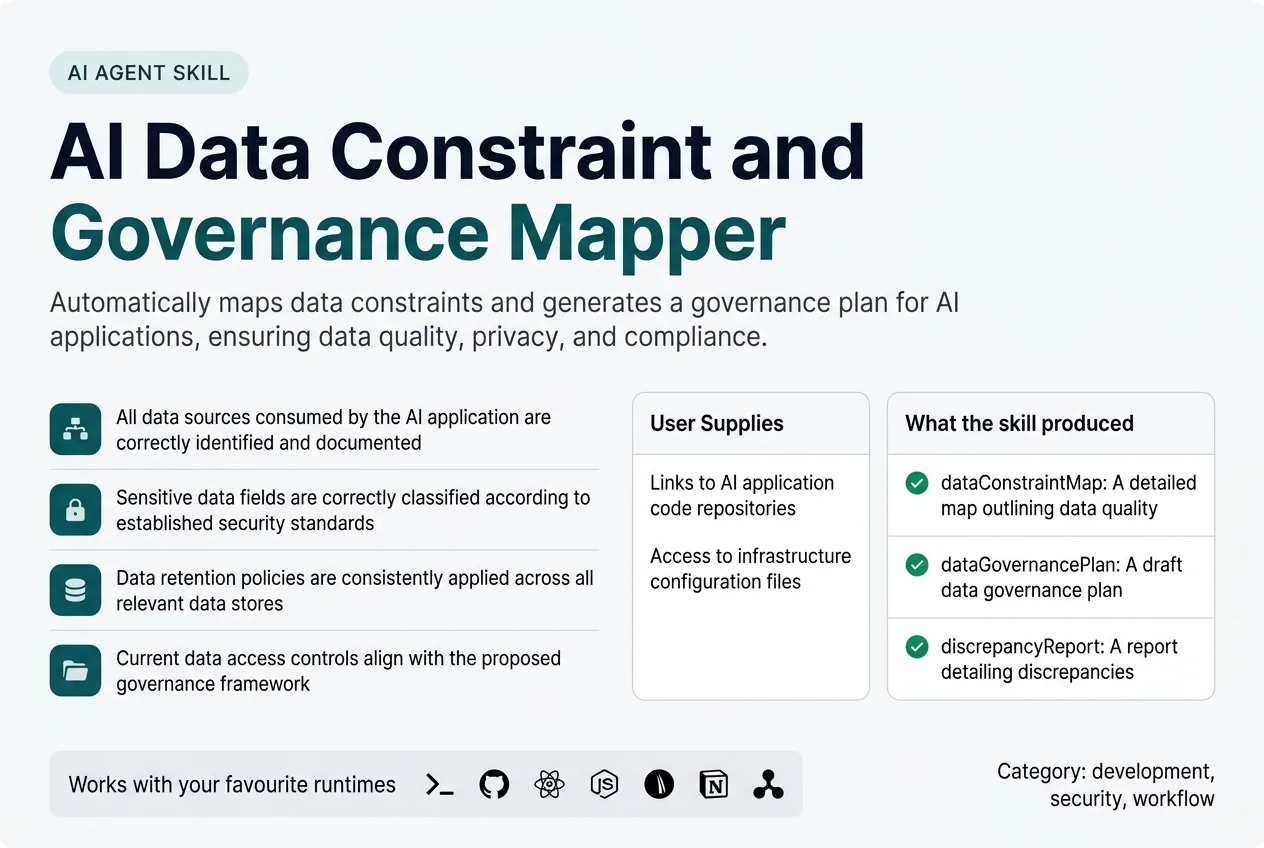
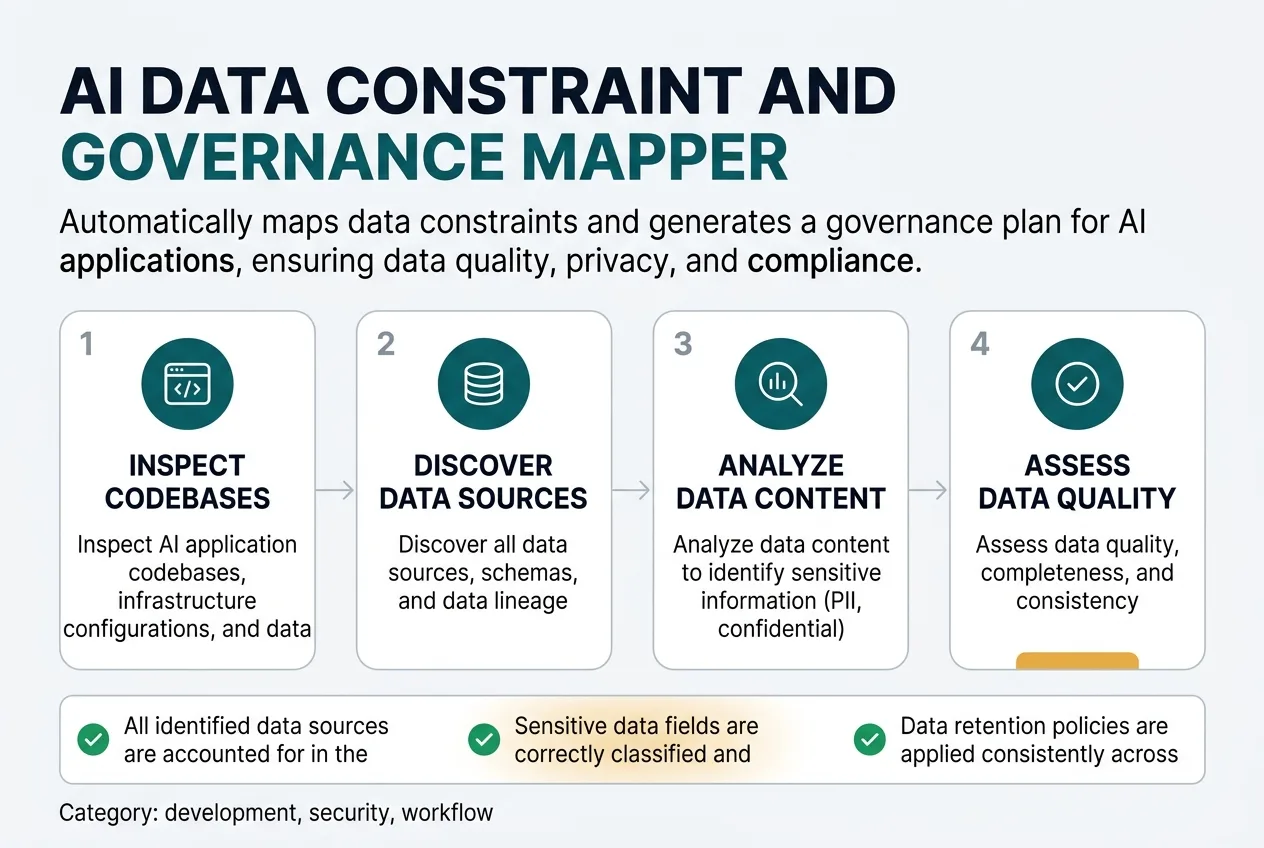
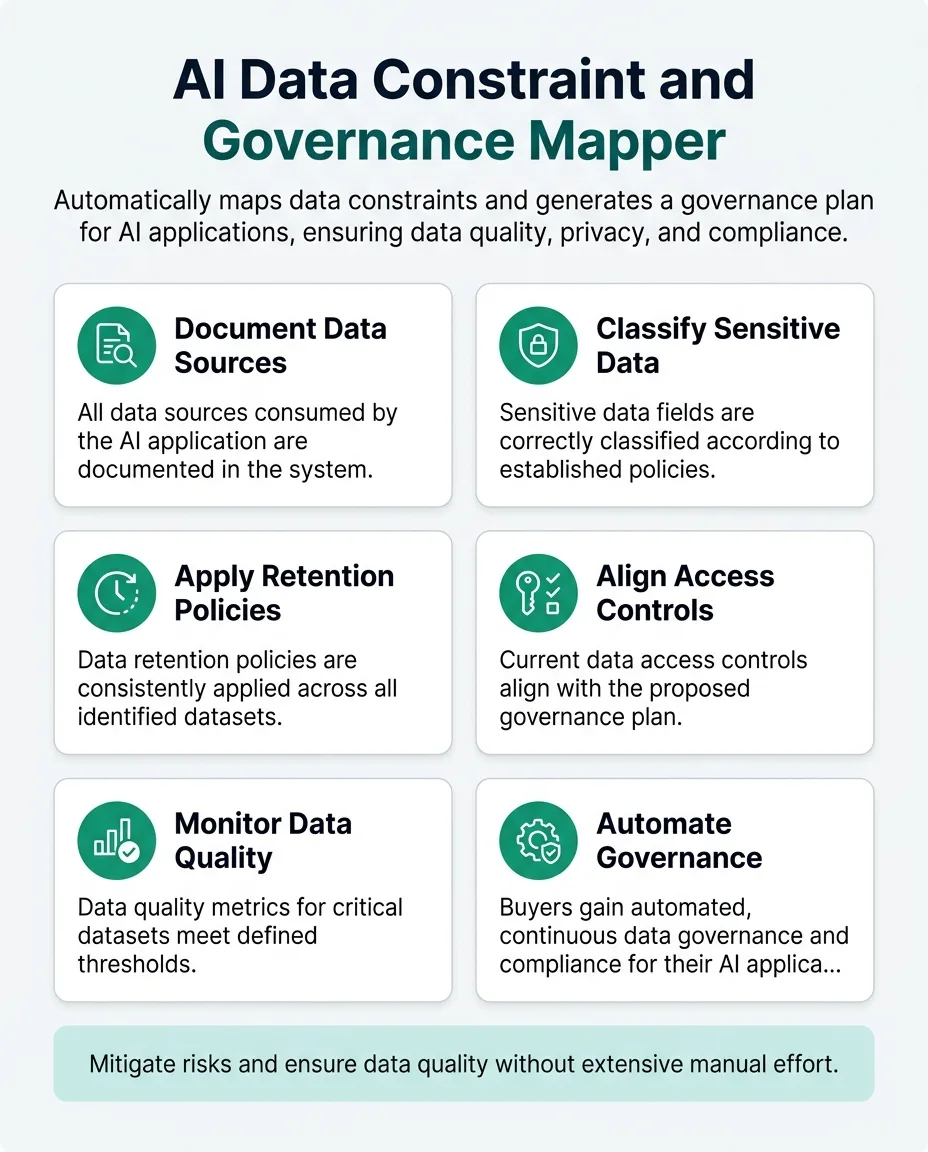
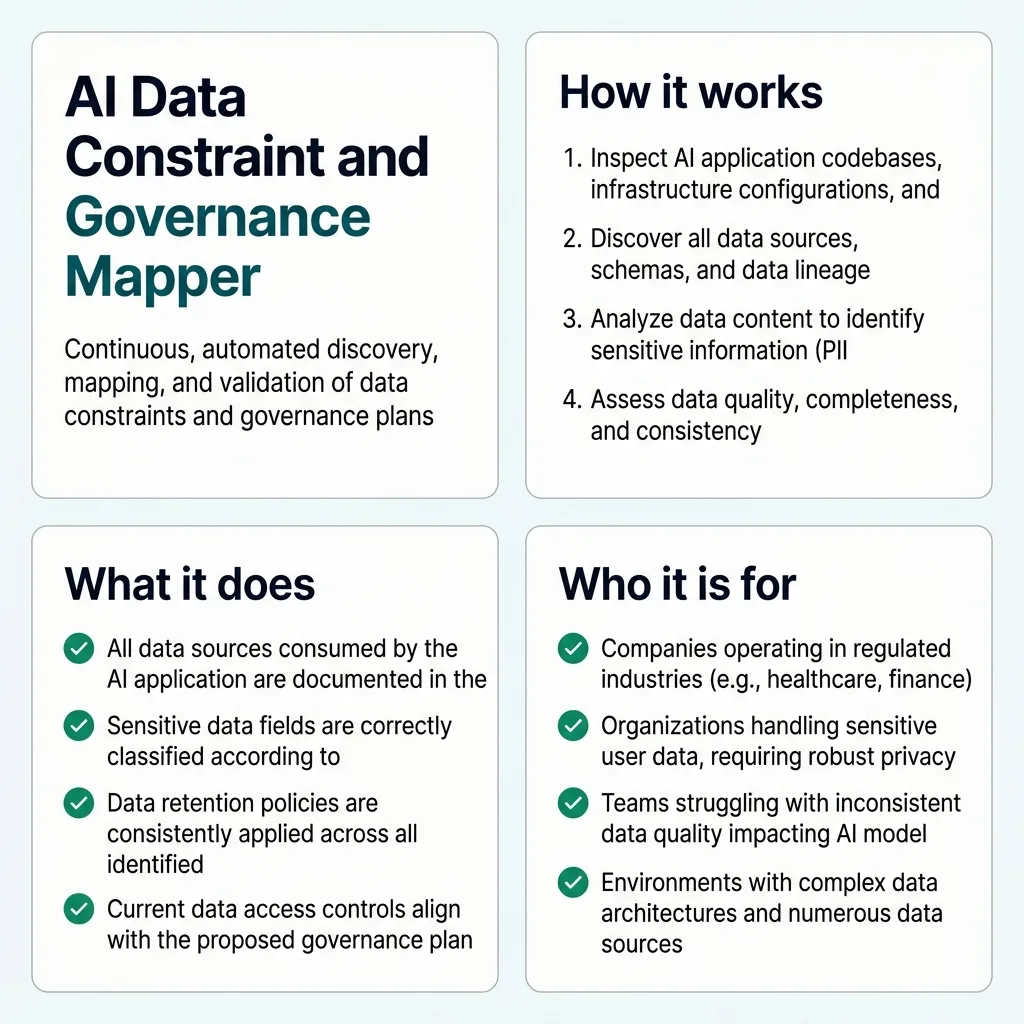
Discovers all data sources consumed by an AI application, including databases, APIs, file storage, and streaming services, by inspecting code repositories and infrastructure configurations. It identifies data schemas, lineage, and usage patterns. It produces a detailed data constraint map, outlining data quality requirements, privacy classifications, and compliance obligations. It also generates a draft data governance plan, including access controls, retention policies, and audit trails. The skill verifies current data pipelines and storage solutions against the identified constraints and governance plan, flagging discrepancies, potential compliance risks, and data quality issues.
The skill takes links to your AI application's code repositories and access to infrastructure configuration files. For example, 'https://github.com/example/sentiment-ai' and 's3://example-configs/k8s-sentiment-app.yaml'.
The skill checks that all identified data sources are accounted for in the constraint map. It verifies sensitive data fields are correctly classified and protected. Data retention policies are applied consistently, and data quality metrics meet defined thresholds. It also ensures current data access controls align with the proposed governance plan and verifies compliance with identified regulations for each data flow.
You receive a detailed data constraint map outlining data quality requirements, privacy classifications, and compliance obligations for all discovered data sources. A draft data governance plan includes access controls, retention policies, and audit trails. Additionally, a discrepancy report details potential compliance risks. For instance, a map detailing PII fields, a plan for access controls and retention, and a report flagging broad S3 bucket access.
The output below is an example from the skill definition, demonstrating its capabilities with a real-world scenario.
Discovers all data sources consumed by an AI application, including databases, APIs, file storage, and streaming services, by inspecting code repositories and infrastructure configurations. It identifies data schemas, lineage, and usage patterns. It produces a detailed data constraint map, outlining data quality requirements, privacy classifications, and compliance obligations. It also generates a draft data governance plan, including access controls, retention policies, and audit trails. The skill verifies current data pipelines and storage solutions against the identified constraints and governance plan, flagging discrepancies, potential compliance risks, and data quality issues.
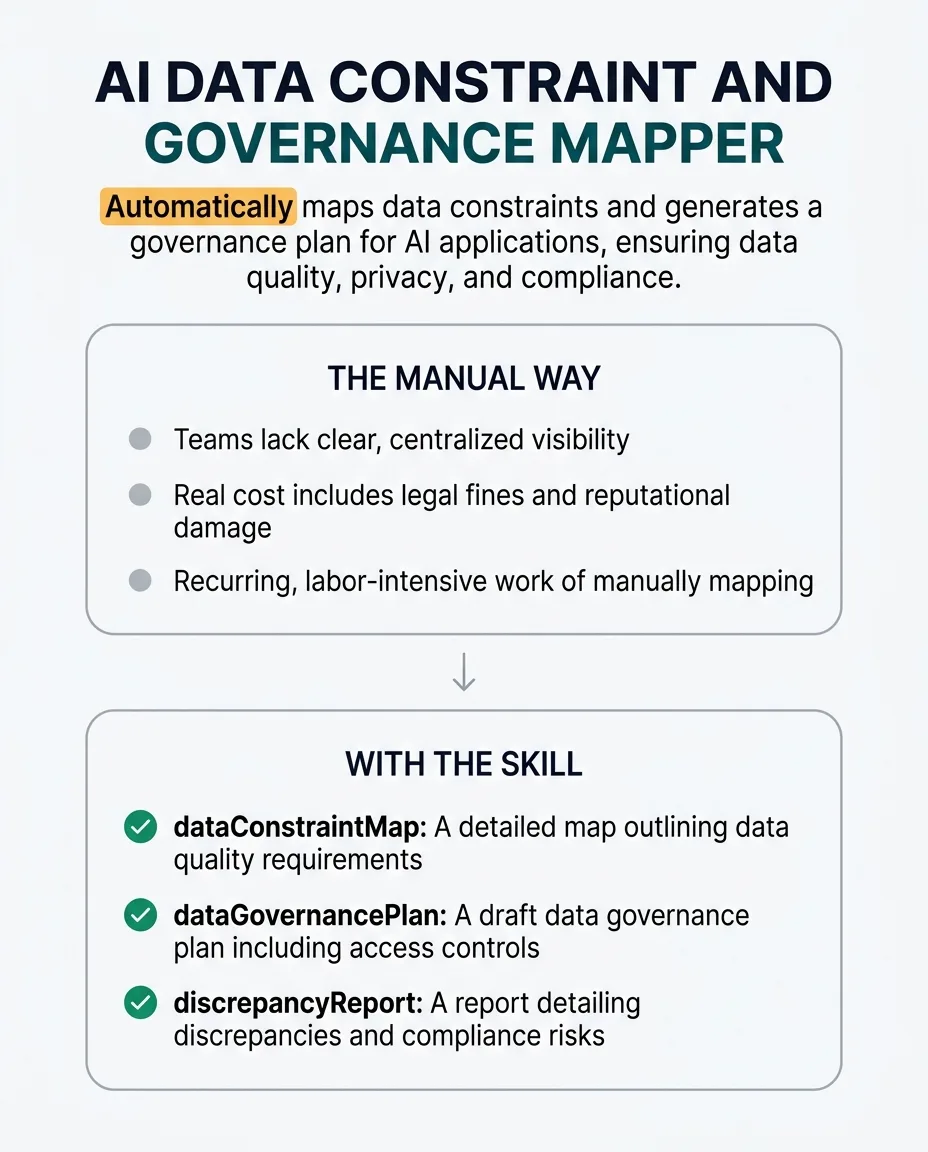
AI product managers and data teams often lack a clear, centralized understanding of the data constraints and governance requirements for their AI applications. This leads to data quality issues, privacy breaches, non-compliance with regulations, and significant delays in product development.
The real cost includes legal fines for non-compliance, reputational damage from data breaches, poor AI model performance due to low-quality data, and substantial manual effort spent on data auditing and policy enforcement. This also creates a bottleneck in scaling AI initiatives.
This skill removes the recurring, labor-intensive work of manually mapping data sources, assessing quality, identifying compliance needs, and drafting governance policies. It ensures the AI application's data foundation is robust, compliant, and continuously monitored, mitigating risks and accelerating safe AI deployment.
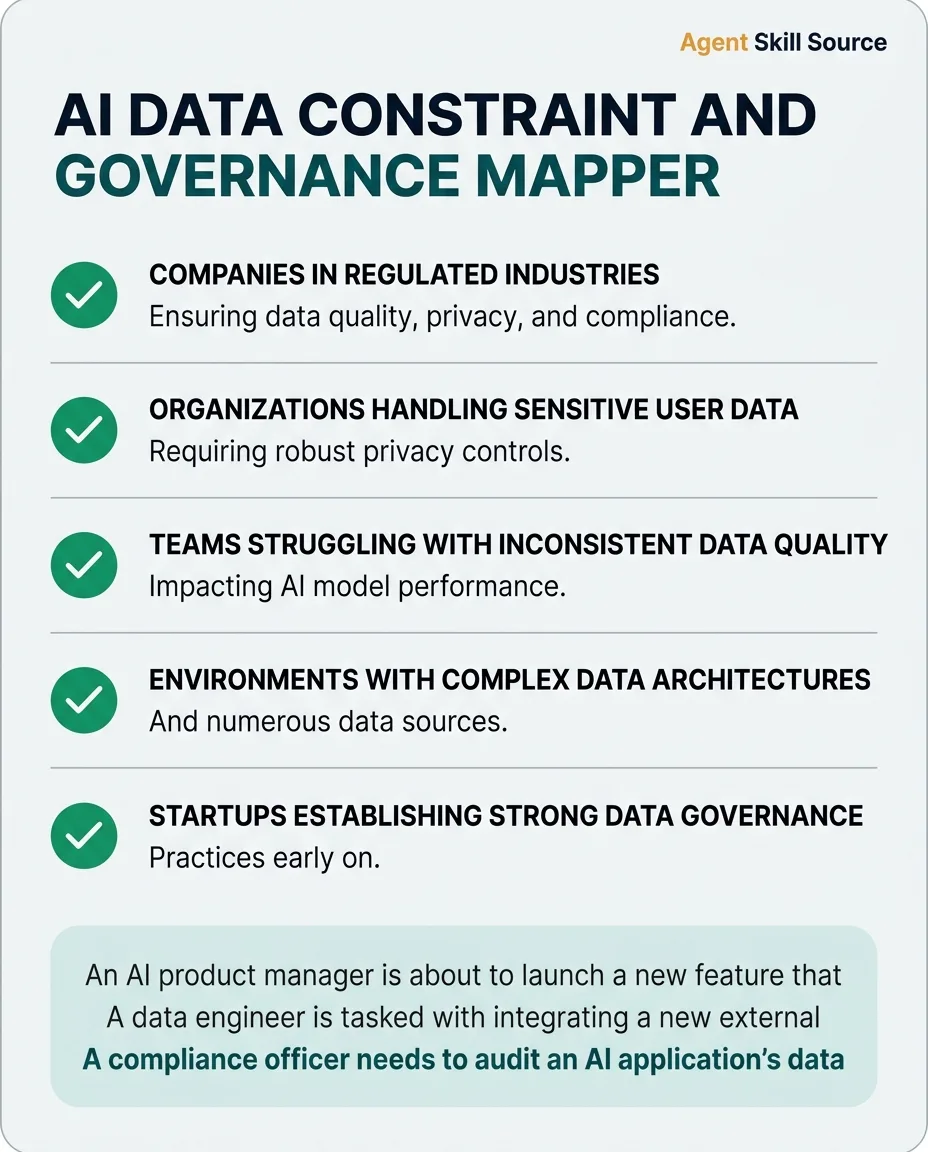
AI Product Managers, Data Engineers, Compliance Officers, and Legal Teams in organizations developing data-intensive AI applications.
Especially valuable when:
This skill replaces the recurring, labor-intensive work of manually mapping data sources, assessing quality, identifying compliance needs, and drafting governance policies for AI applications. This manual process is prone to human error, time-consuming, and often requires specialized expertise across legal, data, and engineering domains.
The value compounds over time as the skill continuously monitors for changes in data schemas, code, and regulatory landscapes. This proactive approach prevents the data constraint map and governance plan from becoming outdated, thereby mitigating new compliance gaps, data quality degradation, and increased risk exposure. It ensures your AI applications remain compliant and robust without constant manual oversight.
Buyers are paying for automated risk mitigation, continuous compliance assurance, and the acceleration of safe AI deployment. Beyond generated text, they receive a verified, actionable data governance framework that protects against costly legal fines, reputational damage from data breaches, and poor AI model performance due to low-quality data, ultimately enabling faster and more secure AI innovation.
One payment, yours permanently. Download it again at any time and get later versions free.
gdpr-data-handling is specific to GDPR and does not encompass a comprehensive data constraint mapping, quality assessment, or full governance plan generation across all data types and regulations. data-quality-frameworks provides frameworks but doesn't automate the discovery, mapping, and validation.
database-design focuses on database schema design, not the broader data governance and constraint mapping for an AI application's entire data landscape. This skill performs the operational job of continuous discovery, validation, and policy generation for all data aspects relevant to AI.
- An AI product manager is about to launch a new feature that consumes novel data sources.
- A data engineer is tasked with integrating a new external dataset into an existing AI application.
- A compliance officer needs to audit an AI application's data handling practices for an upcoming regulatory review.
- A legal team is reviewing the data privacy implications of an AI model before deployment.
- An organization is expanding its AI initiatives and needs to standardize data governance across multiple products.
codeRepositoryLinks: Links to the AI application's code repositories.
infrastructureConfigurationFiles: Access to infrastructure configuration files (e.g., Terraform, Kubernetes manifests).
dataConstraintMap: A detailed map outlining data quality requirements, privacy classifications, and compliance obligations for all discovered data sources.
dataGovernancePlan: A draft data governance plan including access controls, retention policies, and audit trails.
discrepancyReport: A report detailing discrepancies, potential compliance risks, and data quality issues found during verification.
Inspect code repositories and infrastructure configurations to identify all data sources consumed by the AI application.
Done when: All data sources consumed by the AI application are identified and listed.
If it cannot finish: Report inaccessible repositories or configurations and mark affected data sources as unverified.
Analyze discovered data sources to identify data schemas, trace data lineage, and understand usage patterns.
Done when: Detailed schemas, lineage, and usage patterns are documented for each data source.
If it cannot finish: Mark data sources with unresolvable schemas or lineage as partially mapped and flag for manual review.
Analyze data content to classify sensitive information (e.g., PII) and identify relevant data privacy regulations applicable to the AI application.
Done when: All data fields are classified by sensitivity and mapped to relevant compliance obligations.
If it cannot finish: Highlight ambiguous data classifications or regulatory requirements and request clarification.
Profile data for completeness, consistency, and validity by running automated data profiling and validation checks.
Done when: Data quality metrics for critical datasets are calculated and compared against defined thresholds.
If it cannot finish: Flag specific data quality issues, their location, and suggest potential remediation strategies.
Draft a comprehensive data governance plan including proposed access controls, data retention policies, and audit trails.
Done when: A comprehensive draft data governance plan is generated.
If it cannot finish: Report any missing policy components due to insufficient information and request input.
Compare existing data access controls and pipeline configurations with the proposed data governance plan.
Done when: Discrepancies between current data handling and the proposed governance plan are identified.
If it cannot finish: Detail non-compliant aspects and suggest corrective actions without modifying existing configurations.
Propose remediation steps for identified governance gaps and deliver the data constraint map and governance plan via a pull request or documentation update.
Done when: Remediation steps are proposed, and the data constraint map and governance plan are delivered to the specified destination.
If it cannot finish: Report inability to deliver output to specified destination and provide documents for manual delivery.
Establish automated monitoring on code repositories, data sources, and regulatory databases to detect changes.
Done when: Automated monitoring is established to detect changes in data, code, or regulations.
If it cannot finish: Report monitoring setup failure and advise manual periodic re-evaluation.
| The mistake | What it costs | How the skill prevents it |
|---|---|---|
| Failing to identify all data sources consumed by an AI application. | Undocumented data flows lead to hidden compliance risks, data quality issues, and potential privacy breaches. | Cross-reference discovered data sources with application code dependencies, infrastructure configurations, and network traffic logs to ensure comprehensive coverage. |
| Incorrectly classifying sensitive data (e.g., PII) within a dataset. | Over-classification can hinder legitimate data use, while under-classification can result in severe privacy violations and regulatory fines. | Apply a combination of pattern matching, dictionary lookups, and machine learning models to data samples, then cross-validate classifications with predefined organizational data policies. |
| Applying generic data retention policies without considering specific regulatory or business requirements. | Data is either deleted prematurely, leading to loss of valuable historical context, or retained too long, increasing storage costs and compliance liabilities. | Map each data field to its specific regulatory (e.g., GDPR, HIPAA) and business retention requirements, ensuring the most stringent applicable policy is enforced. |
| Not verifying that existing data access controls align with the identified governance plan. | Unauthorized access to sensitive data, leading to data breaches, or legitimate users being blocked, causing operational delays. | Compare the proposed access control matrix with actual IAM roles and permissions configured in data stores and APIs, flagging any discrepancies for review. |
| Overlooking data quality issues in source data before it's used by an AI model. | Poor data quality (e.g., missing values, inconsistencies, outliers) directly degrades AI model performance, leading to inaccurate predictions and unreliable outcomes. | Implement automated data profiling and validation checks (e.g., completeness, uniqueness, consistency, validity) against defined schema and business rules for all ingested data. |
| Failing to continuously monitor for changes in data schemas, code, or regulatory landscapes. | The data constraint map and governance plan quickly become outdated, leading to new compliance gaps, data quality degradation, and increased risk exposure over time. | Establish automated monitoring triggers on code repositories, infrastructure configurations, and relevant regulatory databases, prompting re-evaluation and updates when changes are detected. |
An AI product manager is launching a new customer sentiment analysis feature that uses customer support tickets and CRM data. They need to ensure GDPR compliance and data quality.
codeRepositoryLinks: 'https://github.com/example/sentiment-ai', infrastructureConfigurationFiles: 's3://example-configs/k8s-sentiment-app.yaml'A data constraint map detailing that 'customer_name' and 'email' fields from CRM are PII, requiring pseudonymization. A governance plan specifying access controls for support ticket data, a 2-year retention policy for sentiment analysis results, and an audit trail for all data access. A report flagging that current S3 bucket policies allow broader access than required for the sentiment model.Why this output: The skill identified the data sources (support tickets, CRM), classified sensitive fields (PII), determined GDPR applicability, and generated a governance plan. It then verified existing infrastructure, finding an access policy discrepancy that needs remediation to align with the new governance plan.
The skill continuously monitors data sources, code repositories, and relevant regulatory updates. Upon detecting changes in data schemas, usage patterns, or legal requirements, it re-evaluates the data constraint map and governance plan, flags new risks, and suggests necessary adjustments to maintain compliance and data quality.
Copy to ~/.claude/skills/Configure in API settingsAdd to Copilot workspace settingsAdd to .cursor/skills/Add to .vscode/skills/Add to Cline skills directoryConfigure in .aider.conf.ymlAdd to Windsurf skillsAdd to ~/.gemini/skills/Register as MCP toolThe skill analyzes data content to classify sensitive information like PII and maps it against relevant data privacy regulations such as GDPR or HIPAA. It then generates a governance plan with appropriate access controls and retention policies, and verifies your current setup for discrepancies.
No, this skill operates strictly in a read-only mode. It inspects your code, configurations, and data sources to identify issues and propose solutions, but it will never modify your data, code, or infrastructure directly. All suggested changes require your explicit approval and manual implementation.
The skill will report any inaccessible repositories or configurations and mark affected data sources as unverified. For data with unresolvable schemas or lineage, it will flag them for manual review, ensuring you are aware of any gaps in the automated mapping process.
The skill establishes automated monitoring on code repositories, data sources, and relevant regulatory databases. Upon detecting changes, it re-evaluates the data constraint map and governance plan, flags new risks, and suggests necessary adjustments to maintain continuous compliance and data quality.
AI product managers and data teams often struggle with a lack of clear, centralized understanding of data constraints and governance requirements for their AI applications. This leads to persistent data quality issues, potential privacy breaches, and non-compliance with critical regulations. The resulting delays in product development and launch can be substantial, creating a bottleneck that hinders the scaling of AI initiatives across the organization.
The real cost includes significant legal fines for non-compliance, reputational damage from data breaches, and poor AI model performance due to low-quality data. Substantial manual effort is spent on data auditing and policy enforcement, diverting resources and slowing down innovation.
An AI product manager is about to launch a new feature that consumes novel data sources, but the data constraints and governance needs are not clearly understood.
A data engineer is tasked with integrating a new external dataset into an existing AI application, facing challenges in ensuring data quality and tracing lineage without clear policies.
A compliance officer needs to audit an AI application's data handling practices for an upcoming regulatory review, or a legal team is assessing data privacy implications before deployment.
The AI Data Constraint and Governance Mapper works by systematically inspecting your AI application's environment to understand its data landscape. It combines deep analysis of your code and infrastructure with an understanding of regulatory requirements to build a complete picture of your data constraints and governance needs. This automated approach reduces manual effort and ensures consistency.
Code repositories and infrastructure configurations
What data sources does the AI application consume, and what are their schemas, lineage, and usage patterns?
Data content and project context
Which data fields are sensitive (e.g., PII), and what regulatory frameworks apply to the project (e.g., region, industry)?
Existing policies and data quality metrics
Do current data access controls, retention policies, and data quality meet defined thresholds and compliance obligations?
By synthesizing insights from code, infrastructure, data content, and regulatory context, the skill generates a detailed data constraint map and a draft data governance plan. It also identifies discrepancies, providing a clear path to achieving and maintaining robust data governance.
The skill inspects code repositories and infrastructure configurations to discover all data sources consumed by an AI application. This includes databases, APIs, file storage, and streaming services, ensuring no data point is overlooked.
What this means for you: You get a complete inventory of data sources without manual effort, reducing the risk of hidden compliance gaps.
It identifies data schemas, traces data lineage, and understands usage patterns across your AI applications. This provides a clear view of how data flows and transforms, which is crucial for data quality and auditing.
What this means for you: You gain deep visibility into your data's journey, making it easier to pinpoint issues and ensure data integrity for your AI models.
The skill produces a detailed data constraint map, outlining privacy classifications for sensitive data and compliance obligations. It identifies relevant regulatory frameworks based on project context, such as GDPR or HIPAA.
What this means for you: You can confidently meet regulatory requirements, protecting sensitive user data and avoiding costly legal fines and reputational damage.
It generates a draft data governance plan, including proposed access controls, data retention policies, and audit trails. This provides a structured foundation for managing data throughout its lifecycle within your AI applications.
What this means for you: You get a ready-to-implement governance plan, accelerating policy implementation and standardizing data management across your AI initiatives.
The skill generates a discrepancy report detailing potential compliance risks and suggests remediation. It also establishes automated monitoring to detect changes in data schemas, code, or regulatory landscapes, ensuring continuous compliance.
What this means for you: You maintain continuous compliance and data quality, proactively addressing new risks as your AI applications evolve and regulations change.
| The mistake | What it costs | How the skill prevents it |
|---|---|---|
| Failing to identify all data sources consumed by an AI application. | Undocumented data flows lead to hidden compliance risks, data quality issues, and potential privacy breaches. | The skill cross-references discovered data sources with application code dependencies, infrastructure configurations, and network traffic logs to ensure comprehensive coverage. |
| Incorrectly classifying sensitive data (e.g., PII) within a dataset. | Over-classification can hinder legitimate data use, while under-classification can result in severe privacy violations and regulatory fines. | The skill applies a combination of pattern matching, dictionary lookups, and machine learning models to data samples, then cross-validates classifications with predefined organizational data policies. |
| Applying generic data retention policies without considering specific regulatory or business requirements. | Data is either deleted prematurely, leading to loss of valuable historical context, or retained too long, increasing storage costs and compliance liabilities. | The skill maps each data field to its specific regulatory (e.g., GDPR, HIPAA) and business retention requirements, ensuring the most stringent applicable policy is enforced. |
| Not verifying that existing data access controls align with the identified governance plan. | Unauthorized access to sensitive data, leading to data breaches, or legitimate users being blocked, causing operational delays. | The skill compares the proposed access control matrix with actual IAM roles and permissions configured in data stores and APIs, flagging any discrepancies for review. |
| Overlooking data quality issues in source data before it's used by an AI model. | Poor data quality directly degrades AI model performance, leading to inaccurate predictions and unreliable outcomes. | The skill implements automated data profiling and validation checks (e.g., completeness, uniqueness, consistency, validity) against defined schema and business rules for all ingested data. |
| Failing to continuously monitor for changes in data schemas, code, or regulatory landscapes. | The data constraint map and governance plan quickly become outdated, leading to new compliance gaps, data quality degradation, and increased risk exposure over time. | The skill establishes automated monitoring triggers on code repositories, infrastructure configurations, and relevant regulatory databases. |
Gain a clear, centralized understanding of data constraints and governance requirements for AI applications, preventing legal fines and improving model performance.
Efficiently integrate new datasets, ensure consistent data quality, and maintain clear data lineage, standardizing data governance across multiple products.
Audit AI application data handling practices for regulatory reviews and ensure adherence to data privacy and quality standards.
Review data privacy implications of AI models before deployment and mitigate legal risks associated with data handling.
The skill inspects code repositories and infrastructure configurations to identify all data sources consumed by your AI application.
All data sources consumed by the AI application are identified and listed.
It analyzes discovered data sources to identify data schemas, trace data lineage, and understand usage patterns.
Detailed schemas, lineage, and usage patterns are documented for each data source.
The skill analyzes data content to classify sensitive information and identify relevant data privacy regulations applicable to your AI application.
All data fields are classified by sensitivity and mapped to relevant compliance obligations.
A comprehensive data governance plan is drafted, including proposed access controls, data retention policies, and audit trails.
A comprehensive draft data governance plan is generated.
The skill compares existing data access controls and pipeline configurations with the proposed data governance plan.
Discrepancies between current data handling and the proposed governance plan are identified.
Establish automated monitoring on code repositories, data sources, and regulatory databases to detect changes.
Automated monitoring is established to detect changes in data, code, or regulations.
SKILL.mdREADME.mdLICENSEmcp-config.jsonThe AI Data Constraint and Governance Mapper provides an automated, systematic approach to understanding and managing data constraints. It helps ensure compliance, improve data quality, and accelerate AI development by giving you a clear, actionable governance plan.
$170.00, paid once. Later versions included. Non refundable digital download.
No ratings yet. If you have used this skill, yours would be the first.
Sign in to leave a rating
An account keeps your review with your name on it, and lets you edit it later. Sign in or create one free.
No reviews yet
This skill has not been rated. If you have run it, a short note about what you used it for helps the next person more than any description can.
Discover more AI agent skills in the same category to enhance your workflow automation.
Real-time security audit skill scanning for OWASP Top 10 vulnerabilities and infrastructure misconfigurations.
Leverages AI-assisted debugging and multi-agent orchestration to systematically diagnose, resolve, and prevent production issues, reducing Mean Time To Recovery (MTTR).
Manage Apple Notes from the command line to create, view, edit, delete, search, move, and export notes.
Automatically maps data constraints and generates a governance plan for AI applications, ensuring data quality, privacy, and compliance.
Automatically identifies, prioritizes, and remediates security vulnerabilities in code, verifying fixes and preventing regressions to maintain a secure.
Use the Gemini CLI for one-shot Q&A, summaries, and content generation directly from your terminal.
Join the community and help AI agents learn new capabilities. Submit your skill and reach thousands of developers.