

Master essential Bash/Linux terminal patterns, including critical commands, piping, error handling, and scripting for macOS and Linux systems.
Premium skill
Vehicle Handling Profile Balancer
Images of Vehicle Handling Profile Balancer
-
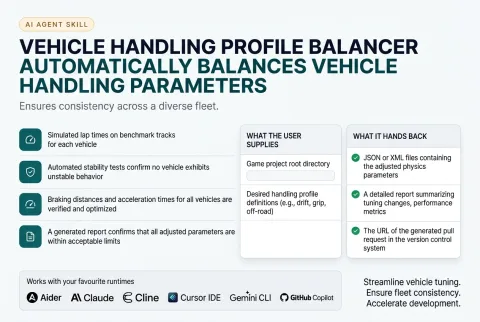
Featured image The one image that represents the skill in the gallery and in a social share. -
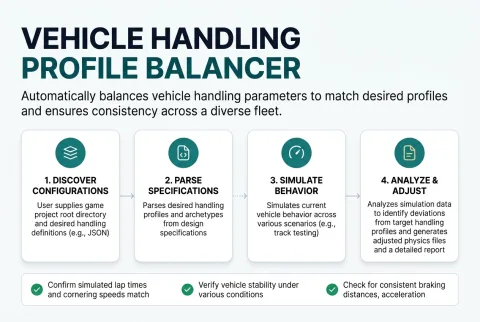
How it works Shows the path from what the user supplies to what they get back. -
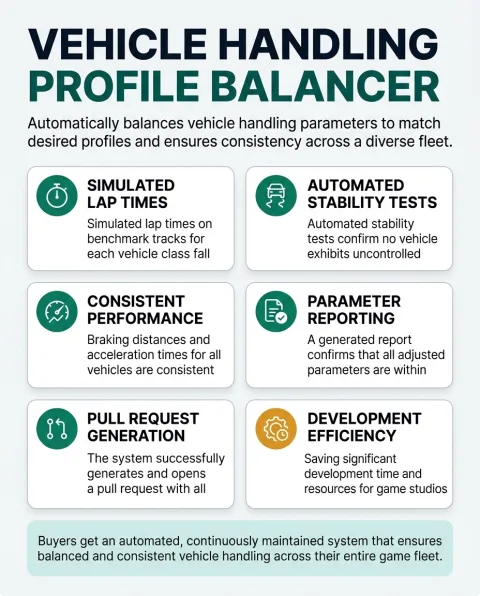
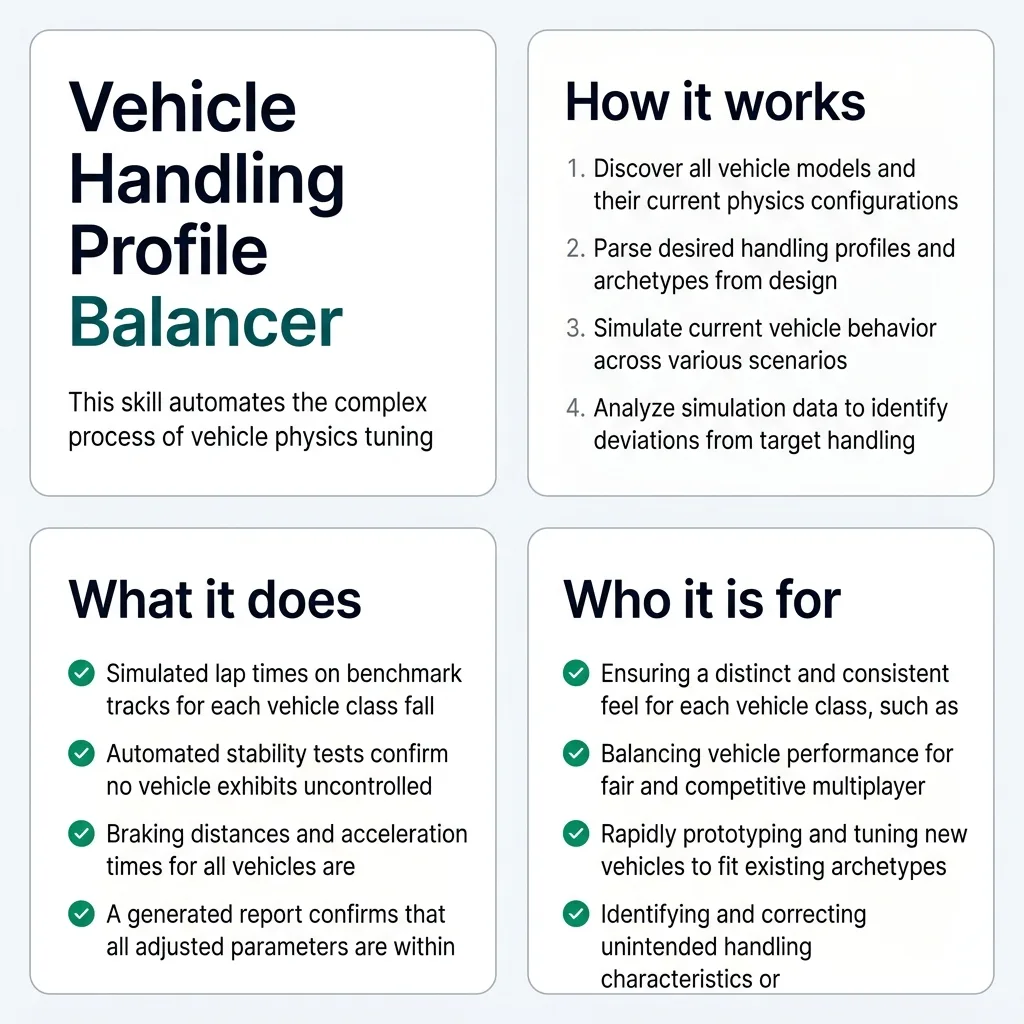
What it does The capability grid, for a reader scanning rather than reading. -
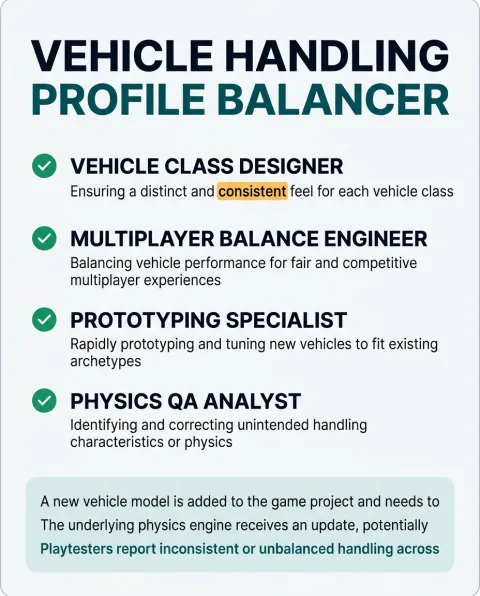
Who it is for Lets a reader recognise themselves, which is what decides whether they keep reading. -
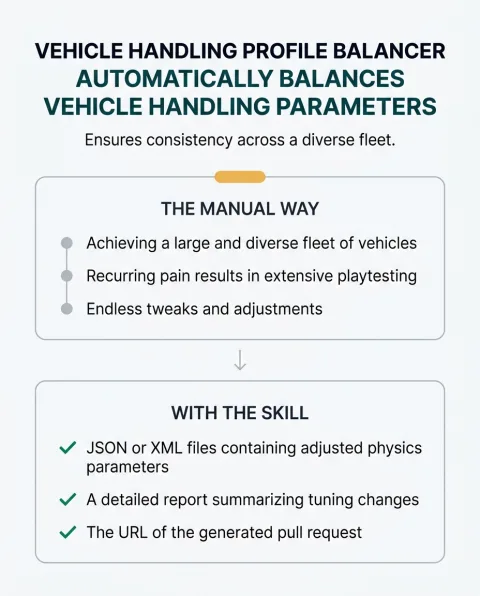
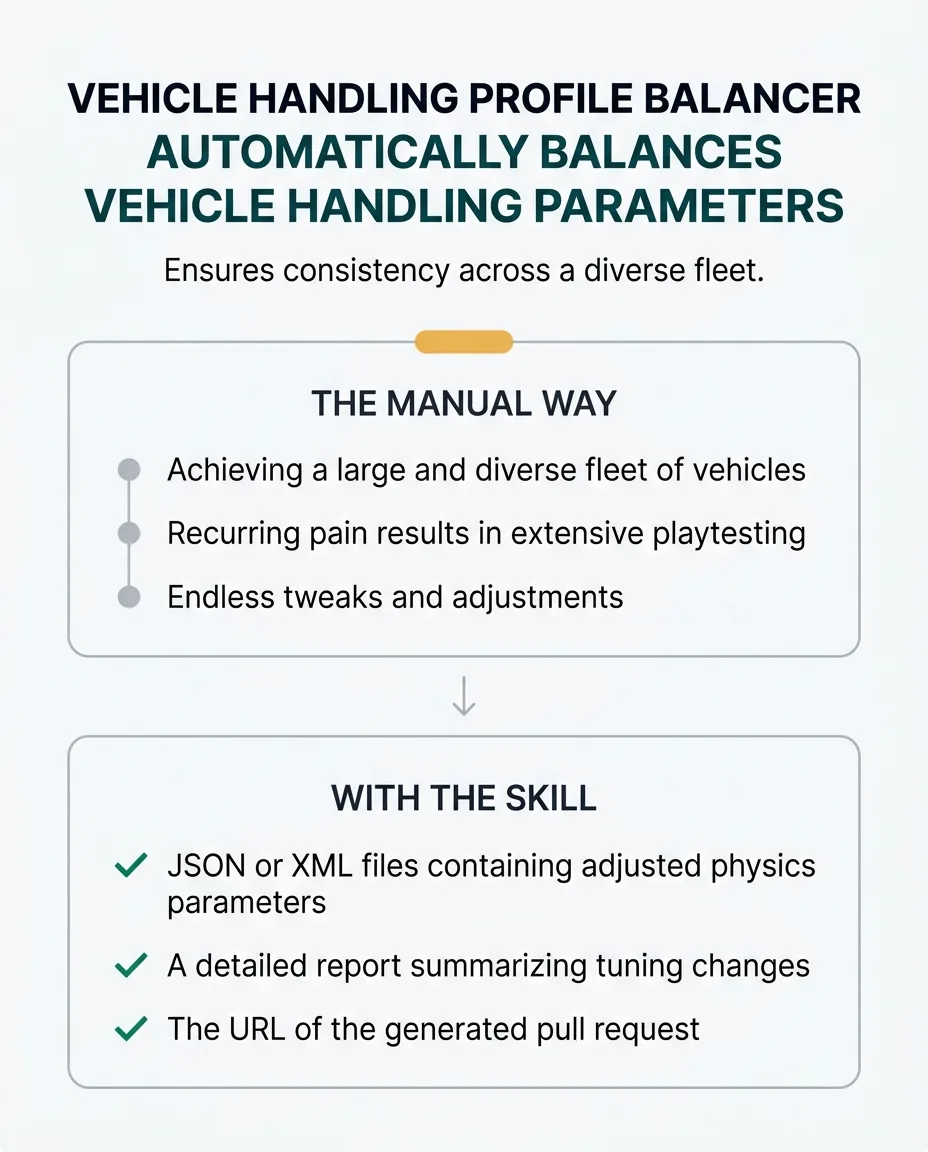
The change it makes Contrasts the manual way with the skill, without claiming a measured result. -
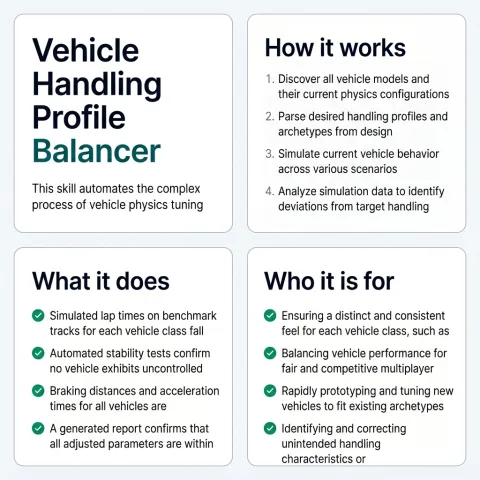
Summary sheet One square image that carries the whole story, for a social share or a card.
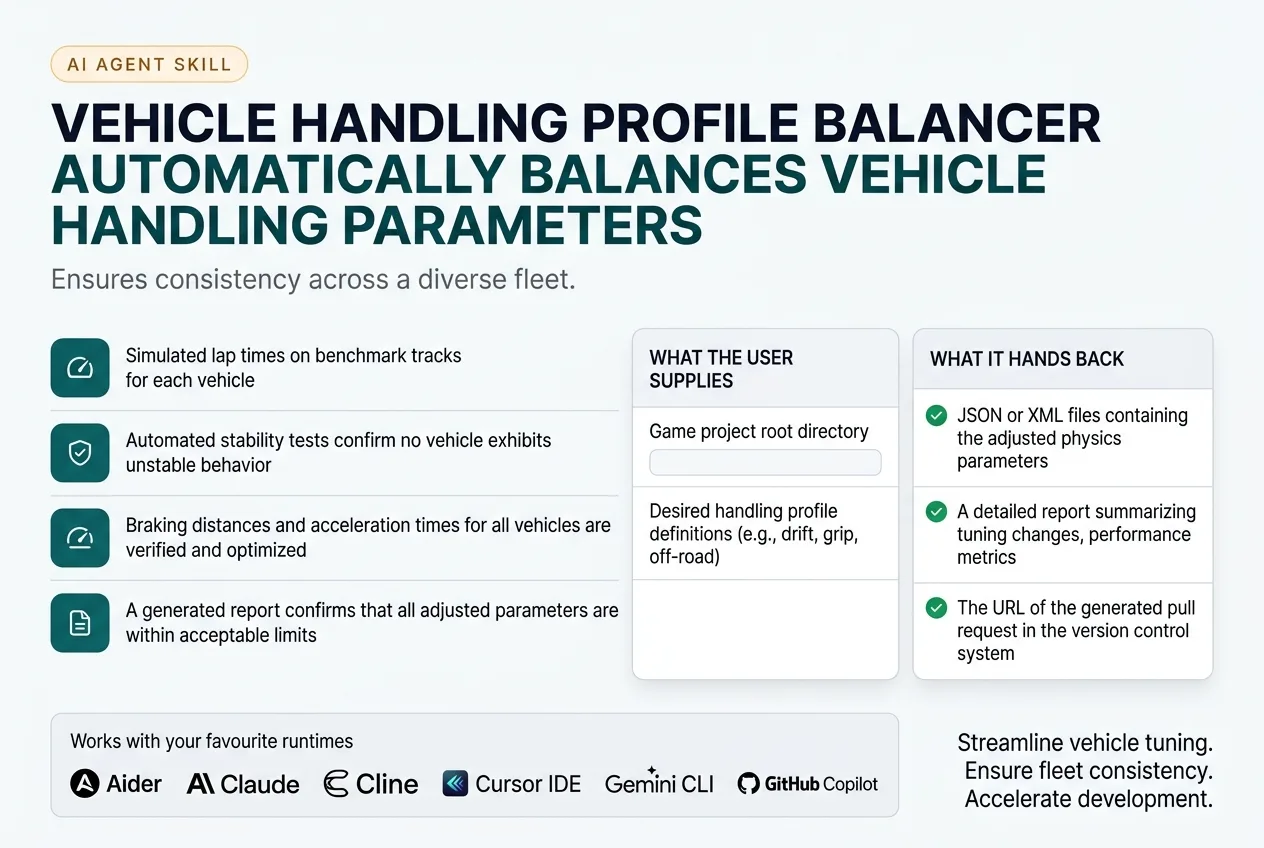
This skill discovers existing vehicle models, physics configurations, and desired handling profiles within a game project. It analyzes current vehicle parameters, simulates their behavior across various scenarios, and identifies discrepancies from the target profiles. The skill produces adjusted physics parameters, such as suspension stiffness, tire grip, engine torque curves, and center of mass, to align with the desired handling characteristics. It verifies the results through automated simulations, comparative analysis against established benchmarks, and real-world physics models. It keeps handling profiles current by re-evaluating and re-balancing vehicles upon physics engine updates or new vehicle additions.
What It Does
This skill discovers existing vehicle models, physics configurations, and desired handling profiles within a game project. It analyzes current vehicle parameters, simulates their behavior across various scenarios, and identifies discrepancies from the target profiles. The skill produces adjusted physics parameters, such as suspension stiffness, tire grip, engine torque curves, and center of mass, to align with the desired handling characteristics. It verifies the results through automated simulations, comparative analysis against established benchmarks, and real-world physics models. It keeps handling profiles current by re-evaluating and re-balancing vehicles upon physics engine updates or new vehicle additions.
The Problem It Removes
In games featuring a large and diverse fleet of vehicles, achieving a balanced and consistent handling feel for each vehicle type is a massive undertaking. Manual tuning is an iterative, subjective, and time-consuming process for physics programmers and designers, often leading to unbalanced gameplay, frustrating driving experiences, and a lack of distinctiveness between vehicles.
This recurring pain results in extensive playtesting, endless tweaks, and player dissatisfaction, impacting game reviews. This skill automates the complex process of vehicle physics tuning, ensuring a consistent and enjoyable driving experience across the entire fleet.
Who It Is For
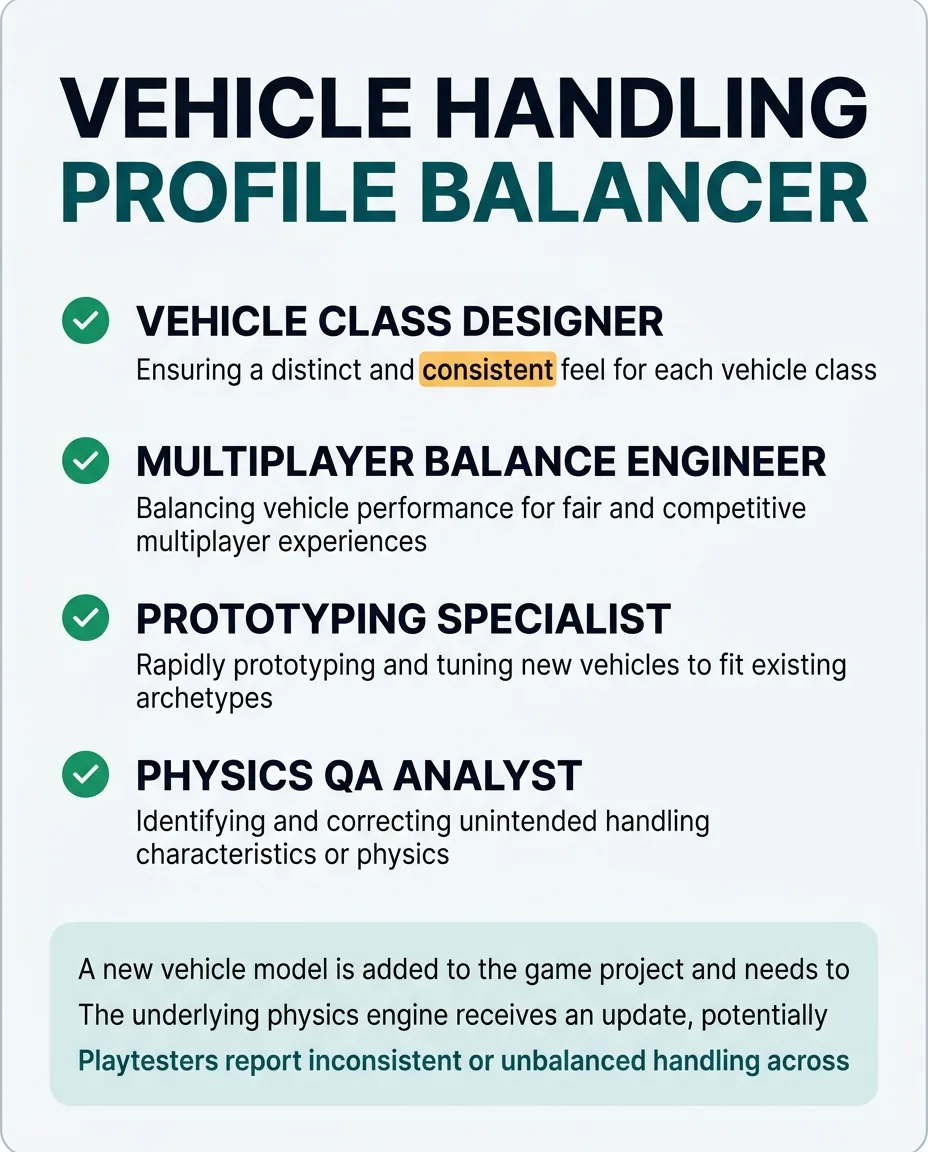
Vehicle designers, physics programmers, game engineers, and QA teams in studios developing games with diverse vehicle fleets.
Especially valuable when:
- Ensuring a distinct and consistent feel for each vehicle class, such as muscle cars, sports cars, and utility vehicles.
- Balancing vehicle performance for fair and competitive multiplayer experiences.
- Rapidly prototyping and tuning new vehicles to fit existing archetypes and design goals.
- Identifying and correcting unintended handling characteristics or physics exploits.
- Reducing the manual effort and time spent on subjective physics tuning and iteration.
- Adapting vehicle physics to changes in the underlying game engine or physics middleware.
- Maintaining consistency when multiple tuners or teams work on different vehicles simultaneously.
Why This Price
This skill addresses a significant recurring pain point in game development: the manual, iterative, and subjective process of balancing vehicle handling across a large fleet. Physics programmers and designers spend countless hours tweaking parameters, leading to development bottlenecks and inconsistent gameplay.
The value compounds because it not only automates this complex task initially but also provides continuous maintenance. It automatically re-balances vehicles upon engine updates or new additions, preventing regressions and ensuring long-term consistency without ongoing manual intervention. This saves hundreds of hours of expert labor over the lifetime of a game project.
Buyers pay for the sophisticated multi-objective optimization algorithms, the integration with game engine physics and version control systems, and the automated simulation and verification framework. This goes far beyond simple text generation, delivering a robust, verifiable engineering solution that directly impacts game quality and player satisfaction.
One payment, yours permanently. Download it again at any time and get later versions free.
How It Differs From Similar Skills
While performance-profiling identifies performance bottlenecks, it does not specifically tune vehicle physics parameters to match desired handling profiles. agentic-test-generator creates tests, but not for simulating and adjusting complex real-time physics models for game vehicles.
This skill performs a specialized analysis of vehicle dynamics, applies physics-based adjustments, and validates against simulated driving metrics and predefined handling archetypes, which is a unique operational job requiring deep understanding of game physics.
When To Use
- A new vehicle model is added to the game project and needs to conform to an existing handling archetype.
- The underlying physics engine receives an update, potentially altering existing vehicle behaviors.
- Playtesters report inconsistent or unbalanced handling across different vehicle types.
- A game designer requests a significant change to a specific handling profile, like making 'heavy trucks' feel even heavier.
- Preparing for a major game update or release, requiring a final pass on vehicle handling consistency.
Inputs
gameProjectRootDirectory: The root directory of the game project.
handlingProfileDefinitions: Definitions of desired handling profiles (e.g., 'sporty', 'heavy') in JSON or YAML format, including target metrics.
Outputs
tuned_vehicle_parameters: JSON or XML files containing the adjusted physics parameters for each vehicle.
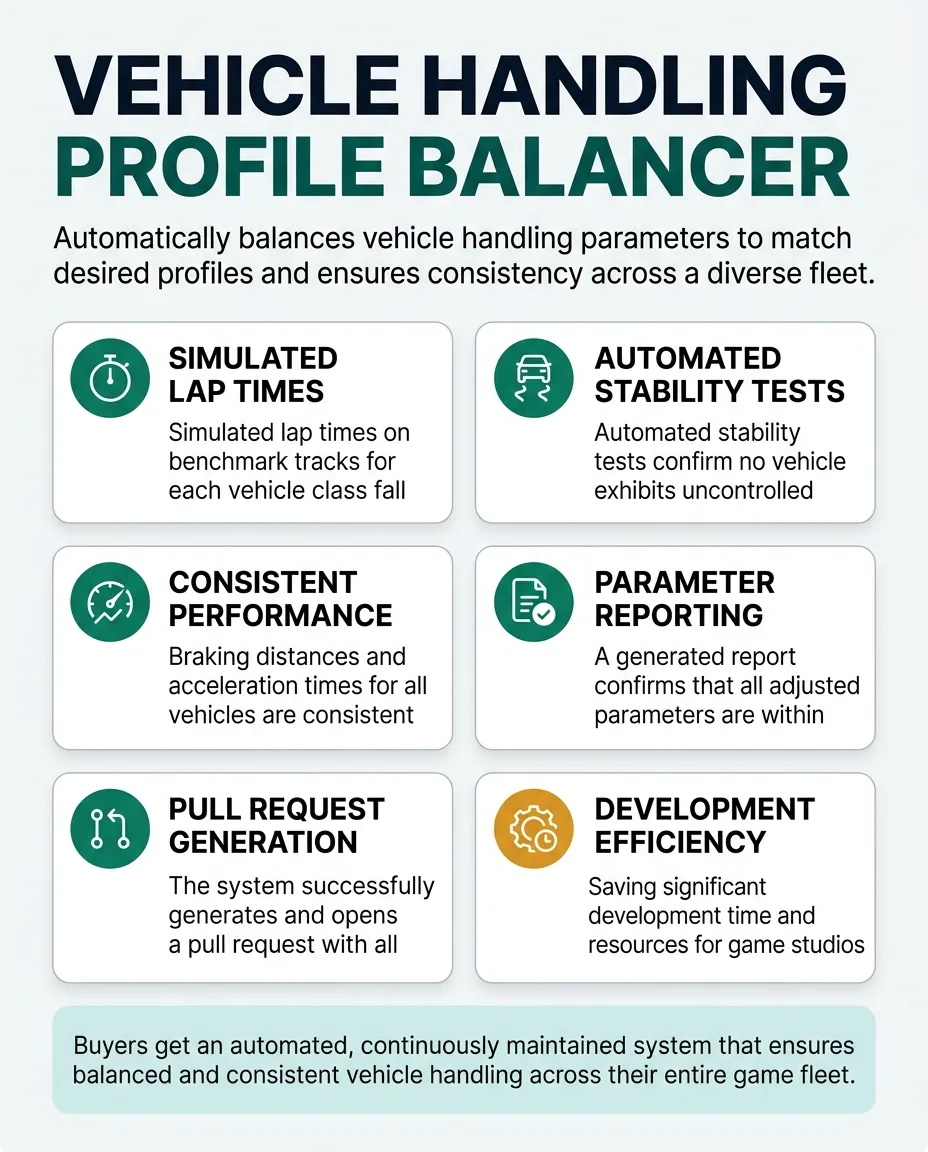
tuning_report: A detailed report summarizing tuning changes, performance metrics, and compliance with desired handling profiles.
pull_request_url: The URL of the generated pull request in the version control system.
How It Works From Start To Finish
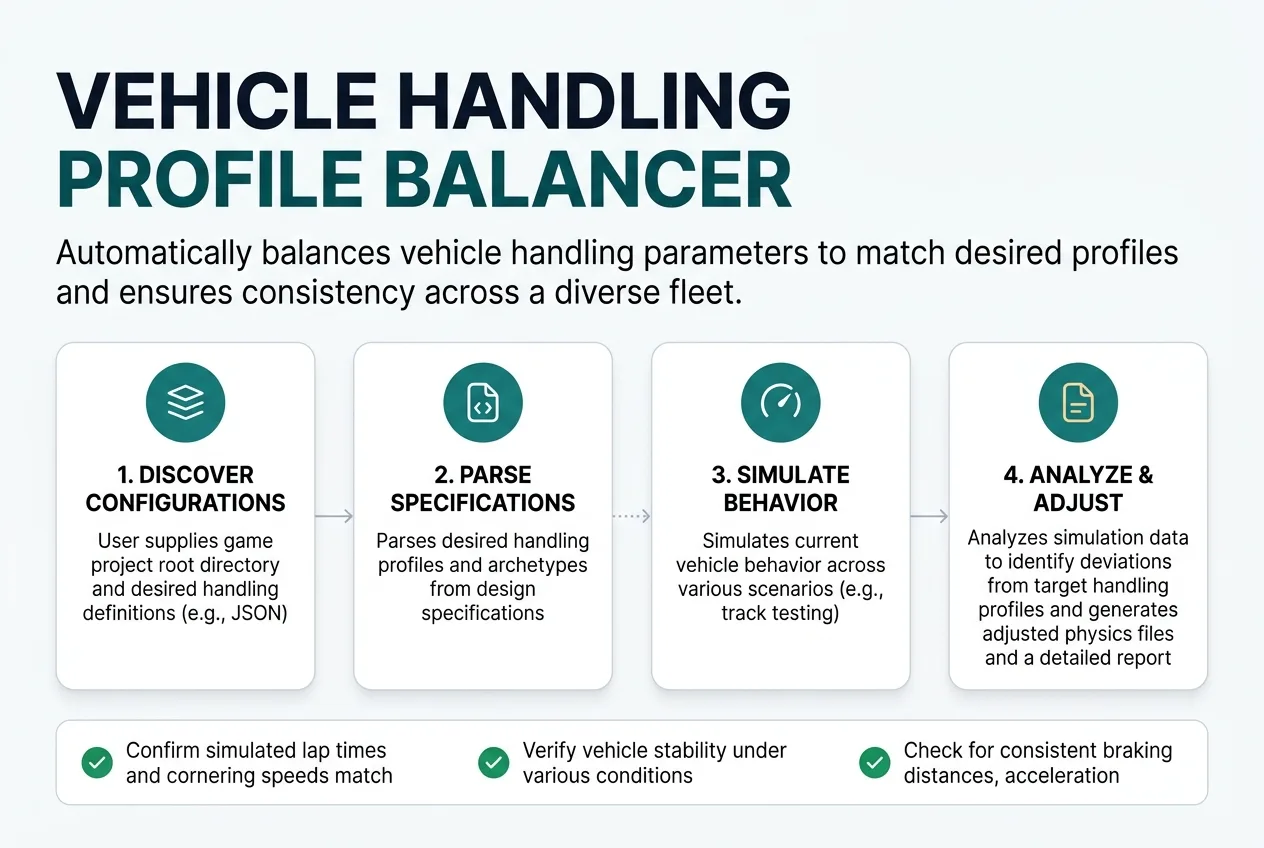
- Discover all vehicle models and their current physics configurations in the project
- Parse desired handling profiles and archetypes from design specifications
- Simulate current vehicle behavior across various scenarios (e.g., cornering, acceleration, braking)
- Analyze simulation data to identify deviations from target handling profiles
- Calculate optimal adjustments to suspension, tires, engine, and other physics parameters
- Apply calculated adjustments to vehicle configuration files
- Run automated driving tests and compare against established benchmarks and target metrics
- Generate a detailed report of tuning changes, performance metrics, and compliance with profiles
- Integrate balanced parameters into the game project's vehicle data
- Open a reviewed pull request with all vehicle physics changes
- Monitor vehicle configurations for updates in version control
- Re-balance vehicles automatically as needed due to engine changes or new additions
What you supply
- Game project root directory
- Desired handling profile definitions (e.g., JSON, YAML describing 'sporty,' 'heavy,' etc.)
What it finds out on its own
- Game engine's physics system (e.g., Havok, PhysX, custom engine)
- Existing vehicle models (meshes, collision data) and their associated physics parameter files
- Track layouts or test environments for simulation purposes
- Existing vehicle archetypes and their current handling characteristics
Step By Step
-
Discover Project Context
Scan the game project root directory to identify the game engine, physics system, and all vehicle model assets and their associated physics configuration files.
Done when: All vehicle models, their physics configurations, and the active physics engine are identified and cataloged.
If it cannot finish: Report inability to locate project root or parse essential configuration files, and halt.
-
Parse Desired Handling Profiles
Read and parse the provided desired handling profile definitions (e.g., JSON, YAML) to extract target metrics for each archetype (e.g., 'sporty car', 'heavy truck').
Done when: All handling profiles and their associated target metrics are successfully loaded and validated against a schema.
If it cannot finish: Report parsing errors in the profile definitions, indicating the problematic file and line, and halt.
-
Analyze Current Vehicle Physics
For each discovered vehicle model, extract its current physics parameters (suspension, tires, engine, center of mass) and analyze its physical properties (mass, wheelbase, center of mass).
Done when: All current vehicle physics parameters and physical properties are extracted and stored for analysis.
If it cannot finish: Report any missing or corrupted physics configuration files for specific vehicles, skipping them and logging the issue.
-
Simulate Current Vehicle Behavior
Run automated driving simulations for each vehicle on diverse track layouts and scenarios (cornering, acceleration, braking) using the identified physics engine.
Done when: Simulation data, including lap times, cornering speeds, acceleration curves, and stability metrics, is collected for all vehicles across all test scenarios.
If it cannot finish: Report simulation environment setup failures or physics engine errors, indicating the affected vehicle or scenario, and halt.
-
Calculate Optimal Parameter Adjustments
Compare simulated current vehicle behavior against target handling profiles, applying a multi-objective optimization algorithm to calculate adjustments to suspension stiffness, tire grip, engine torque curves, and center of mass, ensuring physically plausible adjustments specific to the vehicle model and respecting stability constraints.
Done when: A set of proposed physics parameter adjustments is generated for each vehicle, aiming to minimize deviation from target profiles while maintaining stability and realism.
If it cannot finish: Report if an optimal solution cannot be found within physically plausible bounds for a vehicle, marking the profile as unachievable for that model.
-
Apply and Verify Adjustments
Apply the calculated adjustments to a temporary copy of the vehicle configuration files, then re-run automated driving tests and compare against established benchmarks and target metrics, including checks for extreme values or sudden changes in behavior.
Done when: All adjusted parameters are applied to temporary configurations, and verification simulations are completed, yielding new performance metrics.
If it cannot finish: If verification simulations show unstable or unrealistic behavior, revert the temporary changes for that vehicle and report the failure with simulation data.
-
Generate Report and Pull Request
Generate a detailed report summarizing tuning changes, performance metrics, and compliance with profiles, and any unachievable aspects. Create a new branch and open a pull request in the version control system with the proposed changes to vehicle physics files.
Done when: A comprehensive report is generated, and a pull request containing the validated physics parameter changes is opened in the project's version control system.
If it cannot finish: Report failure to generate the report or open the pull request, providing details of the error.
How It Checks Its Own Work
Checks before it delivers
- Confirm simulated lap times and cornering speeds match target profiles for specific tracks.
- Verify vehicle stability under various conditions, such as high speed, rough terrain, and sudden braking.
- Check for consistent braking distances, acceleration curves, and top speeds across vehicle classes.
- Ensure no unintended physics glitches, exploits, or unrealistic behaviors are introduced.
- Validate that vehicle handling feels distinct and appropriate for its intended archetype, as defined.
If something goes wrong
- If a tuning attempt results in unstable or unrealistic vehicle behavior (e.g., flipping, uncontrollable spinning), revert to previous parameters and report the failure with simulation data.
- If a desired handling profile is physically impossible to achieve with the given vehicle model or engine, report the unachievable aspects without forcing unrealistic parameters.
- If a vehicle model or its physics configuration is incomplete or corrupted, skip it and log the issue, continuing with other valid vehicles.
Mistakes It Prevents
| The mistake | What it costs | How the skill prevents it |
|---|---|---|
| Over-tuning a single parameter to meet one profile aspect, inadvertently breaking another critical handling characteristic. | A vehicle might achieve target acceleration but become unstable during cornering, leading to an unrealistic or frustrating driving experience. | Implement multi-objective optimization that considers all target metrics simultaneously, with hard constraints on stability and realism, and verify against a comprehensive suite of driving scenarios. |
| Applying a generic tuning approach without accounting for unique vehicle model characteristics, such as mass distribution or wheelbase. | A small, lightweight car might end up with the suspension characteristics of a heavy truck, resulting in a floaty or unresponsive feel that contradicts its archetype. | Analyze the vehicle's physical properties (mass, wheelbase, center of mass) and use these as inputs to scale or constrain tuning parameters, ensuring physically plausible adjustments specific to the model. |
| Relying solely on numerical metrics without simulating actual driving behavior in diverse environments. | A vehicle might meet all statistical targets (e.g., top speed, braking distance) but feel 'off' or unnatural during actual gameplay, leading to player dissatisfaction. | Conduct automated driving simulations on diverse track layouts, including cornering, braking, and acceleration tests, and compare simulated behavior against established benchmarks and qualitative design goals. |
| Introducing unintended physics exploits or glitches through parameter changes, such as unrealistic grip or excessive bounce. | Players might discover ways to gain unfair advantages, breaking game balance and leading to a negative competitive experience. | Include specific checks for extreme values, sudden changes in velocity or orientation, and collision responses during automated simulations, flagging any behavior outside physically plausible bounds. |
| Overwriting existing, manually tuned parameters without proper version control or review, losing valuable human-tuned work. | Valuable human-tuned work is lost, requiring significant re-work and potentially introducing regressions that were previously resolved. | Integrate with the project's version control system, generate a detailed diff of proposed changes, and require a pull request review process before applying any modifications to the main branch. |
| Failing to re-evaluate handling profiles after significant game engine or physics middleware updates. | Vehicles that were previously balanced become unbalanced or behave unexpectedly due to underlying physics changes, leading to a degraded player experience. | Implement a monitoring system that detects changes in the physics engine version or related middleware, automatically triggering a re-evaluation and re-balancing process for all affected vehicles. |
Edge Cases It Handles
- Over-tuning a single parameter to meet one profile aspect, inadvertently breaking another critical handling characteristic.
- Implement multi-objective optimization that considers all target metrics simultaneously, with hard constraints on stability and realism, and verify against a comprehensive suite of driving scenarios.
- Applying a generic tuning approach without accounting for unique vehicle model characteristics, such as mass distribution or wheelbase.
- Analyze the vehicle's physical properties (mass, wheelbase, center of mass) and use these as inputs to scale or constrain tuning parameters, ensuring physically plausible adjustments specific to the model.
- Relying solely on numerical metrics without simulating actual driving behavior in diverse environments.
- Conduct automated driving simulations on diverse track layouts, including cornering, braking, and acceleration tests, and compare simulated behavior against established benchmarks and qualitative design goals.
- Introducing unintended physics exploits or glitches through parameter changes, such as unrealistic grip or excessive bounce.
- Include specific checks for extreme values, sudden changes in velocity or orientation, and collision responses during automated simulations, flagging any behavior outside physically plausible bounds.
- Overwriting existing, manually tuned parameters without proper version control or review.
- Integrate with the project's version control system, generate a detailed diff of proposed changes, and require a pull request review process before applying any modifications to the main branch.
- Failing to re-evaluate handling profiles after significant game engine or physics middleware updates.
- Implement a monitoring system that detects changes in the physics engine version or related middleware, automatically triggering a re-evaluation and re-balancing process for all affected vehicles.
- A desired handling profile is physically impossible to achieve with the given vehicle model or engine.
- Report the unachievable aspects without forcing unrealistic parameters, explicitly marking them as unresolved.
- A vehicle model or its physics configuration is incomplete or corrupted.
- Skip the problematic vehicle, log the issue, and continue processing other valid vehicles.
A Worked Example
A game studio is developing a new racing title with 50+ vehicles. They have defined 'sporty_car' and 'heavy_truck' handling profiles, but many vehicles don't feel consistent. The 'RacerX' car feels too sluggish, and the 'HaulerXL' truck is too nimble.
Input
gameProjectRootDirectory: "/Users/dev/GameProject", handlingProfileDefinitions: "{\"sporty_car\": {\"max_speed\": 280, \"0_to_60_time\": 3.0, \"cornering_g\": 1.3, \"suspension_stiffness\": 15000}, \"heavy_truck\": {\"max_speed\": 130, \"0_to_60_time\": 9.0, \"cornering_g\": 0.6, \"suspension_stiffness\": 50000}}"Expected output
A pull request is opened with adjusted physics parameters for 'RacerX' (e.g., increased engine torque, stiffer suspension) and 'HaulerXL' (e.g., reduced tire grip, softer suspension). A detailed report confirms 'RacerX' now achieves 0-60 in 3.1s (target 3.0s) and 'HaulerXL' has a cornering_g of 0.65 (target 0.6), with all stability checks passed. The report also highlights that the 'VintageRacer' model cannot achieve the 'sporty_car' cornering_g due to its high center of mass, marking it as unachievable.Why this output: The skill identified discrepancies in 'RacerX' and 'HaulerXL' by simulating their current behavior against the defined profiles. It then calculated and applied optimal physics adjustments to bring them closer to their targets while maintaining physical plausibility and stability. The 'VintageRacer' limitation was correctly identified and reported without forcing unrealistic parameters, adhering to the 'never invent facts' principle.
Keeping It Current And Knowing Its Limits
Keeping it current
The skill integrates with the project's version control system, automatically re-running analysis and re-balancing whenever vehicle physics parameters or models are updated. It creates pull requests for approved changes and alerts the team to any newly introduced imbalances or regressions.
What it will not do
- It will not design new vehicle models, textures, or create new visual assets.
- It cannot verify subjective 'fun factor' or emotional connection to a vehicle's handling.
- It requires access to game engine physics configurations, vehicle model data, and simulation environments.
- It never invents unverified details, always reporting any unresolvable issues as such.
Limitations
Installation
Copy to ~/.claude/skills/Configure in API settingsAdd to Copilot workspace settingsAdd to .vscode/skills/Add to Cline skills directoryConfigure in .aider.conf.ymlAdd to Windsurf skillsAdd to ~/.gemini/skills/Register as MCP toolBefore You Run It
Security notes
- This skill modifies game project files related to vehicle physics. While it integrates with version control and generates pull requests for review, always review proposed changes carefully before merging to prevent unintended gameplay alterations or exploits.
- The skill executes shell commands for simulations and version control operations. Ensure your environment is secure and that the skill is run with appropriate permissions.
- Outbound network access is required for interacting with remote version control repositories (e.g., GitHub, GitLab) to create pull requests. Be aware of the data being transmitted.
- The skill relies on the integrity of your game engine and physics system. Any vulnerabilities in these underlying systems could potentially be exploited or exacerbated by automated parameter changes.
Questions People Ask
How does this skill ensure physical realism?
The skill uses multi-objective optimization with hard constraints on stability and realism, analyzing vehicle physical properties like mass and wheelbase. It verifies adjustments through automated driving simulations across diverse scenarios, flagging any behavior outside physically plausible bounds.
Can this skill work with any game engine?
It is designed to work with recognized game engines that have an accessible and configurable physics system. It discovers the specific physics system in use and adapts its interactions, but requires vehicle configurations to be in a parseable format.
What if a desired handling profile is impossible to achieve?
The skill will report any unachievable aspects without forcing unrealistic parameters. It explicitly marks these as unresolved in the generated report, providing clear feedback on limitations rather than inventing unverified details.
How does it prevent overwriting manual tuning efforts?
The skill integrates with your project's version control system. It generates a detailed diff of proposed changes and requires a pull request review process, ensuring that manual tuning efforts are not lost without explicit approval.
Is this a one-time fix or continuous maintenance?
This skill is designed for continuous maintenance. It monitors vehicle configurations and physics engine versions in your version control system, automatically re-running analysis and re-balancing whenever updates occur, and creating new pull requests as needed.
What people say, and where to get help
No ratings yet. If you have used this skill, yours would be the first.
Sign in to leave a rating
An account keeps your review with your name on it, and lets you edit it later. Sign in or create one free.
No reviews yet
This skill has not been rated. If you have run it, a short note about what you used it for helps the next person more than any description can.
Related Skills You May Like
Discover more AI agent skills in the same category to enhance your workflow automation.
Expert in building 3D experiences for the web - Three.js, React Three Fiber, Spline, WebGL, and interactive 3D scenes. Covers product configurators, 3D portfolios, immersive websites, and bringing depth to web experie...
Leverages AI-assisted debugging and multi-agent orchestration to systematically diagnose, resolve, and prevent production issues, reducing Mean Time To Recovery (MTTR).
Automate Mixpanel tasks via Rube MCP (Composio): events, segmentation, funnels, cohorts, user profiles, JQL queries. Always search tools first for current schemas.
Interact with Azure Data Lake Storage Gen2 using Python for hierarchical file systems, big data analytics, and file/directory operations.
A collection of Jupyter notebooks and Python examples for building with the Claude API.
Have a Skill to Share?
Join the community and help AI agents learn new capabilities. Submit your skill and reach thousands of developers.